¡Acompáñanos a viajar por el mundo de los libros!
Añadir este libro a la estantería
Grey
Escribe un nuevo comentario Default profile 50px
Grey
Suscríbete para leer el libro completo o lee las primeras páginas gratis.
All characters reduced
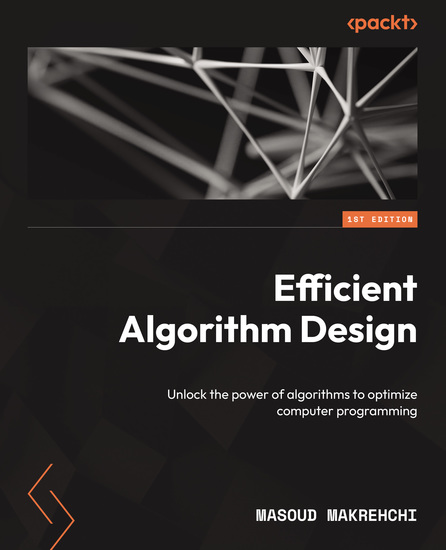
Efficient Algorithm Design - Unlock the power of algorithms to optimize computer programming - cover

Efficient Algorithm Design - Unlock the power of algorithms to optimize computer programming

Masoud Makrehchi

Editorial: Packt Publishing

  • 0
  • 0
  • 0

Sinopsis

Efficient Algorithm Design redefines algorithms, tracing the evolution of computer science as a discipline bridging natural science and mathematics. Author Masoud Makrehchi, PhD, with his extensive experience in delivering publications and presentations, explores the duality of computers as mortal hardware and immortal algorithms. The book guides you through essential aspects of algorithm design and analysis, including proving correctness and the importance of repetition and loops. This groundwork sets the stage for exploring algorithm complexity, with practical exercises in design and analysis using sorting and search as examples. Each chapter delves into critical topics such as recursion and dynamic programming, reinforced with practical examples and exercises that link theory with real-world applications. What sets this book apart is its focus on the practical application of algorithm design and analysis, equipping you to solve real programming challenges effectively.By the end of this book, you’ll have a deep understanding of algorithmic foundations and gain proficiency in designing efficient algorithms, empowering you to develop more robust and optimized software solutions.
Disponible desde: 31/10/2024.
Longitud de impresión: 360 páginas.
Otros libros que te pueden interesar

  • AI and the Art of War - Artificial Intelligence's Role in National Defense and Security - cover

    AI and the Art of War -...

    Paul Rodrigues

    • 0
    • 0
    • 0
    In AI and the Art of War, the Chief Intelligence Officer of Microsoft's National Security Group, Paul Rodrigues, explains the contemporary realities of artificial intelligence in the context of national security, defense, and warfare in stunning detail. Dr. Rodrigues draws on his extensive experience supporting the AI efforts of US federal customers and the defense industrial base to explain what modern AI is, how it works, the problems it solves, and the risks it creates. 
     
    AI and the Art of War offers original discussions of language AI―including Large Language Models―computer vision, geospatial AI, and agentic AI and AI reasoning capabilities. It examines how these technologies interact with national security initiatives and policies, like DARPA, IARPA, JAIC, and a variety of federal laws and executive orders. 
     
    You'll also find:Informed walkthroughs of emerging AI threats, including propaganda, powerful nonstate actors, and financial system insecurityExplorations of AI pipeline security vulnerabilities, including prompt injection attacks and prompt leakingObstacles to the responsible use of artificial intelligence, like bias, and the inherent drawbacks to "black box" algorithms
    Ver libro
  • Does Coffee Cause Cancer? - And 8 More Myths about the Food We Eat - cover

    Does Coffee Cause Cancer? - And...

    Dr. Christopher Labos

    • 0
    • 0
    • 0
    In this fascinating, refreshingly clarifying book about food, food myths, and how sloppy science perpetuates misconceptions about food, a medical doctor on his way to a conference gets drawn into conversations that answer the following questions:
    		
    		Does vitamin C prevent the common cold? And if it works, why does it only work in Canadian soldiers, ultramarathon runners, and skiers?
    		Was red meat really declared a carcinogen by the WHO? Does that mean I should become a vegetarian? And who decides what gets labeled as red meat and white meat?
    		Is salt really not that bad for you and did a group of researchers really want to experiment on prisoners to prove the point?
    		Does coffee cause cancer or heart attacks? Why did a California court say coffee needed a warning label?
    		Is red wine really good for your heart, and what makes the French Paradox such a paradox?
    		Why did the New England Journal of Medicine link eating chocolate with winning a Nobel Prize?
    		Why were eggs once bad for you but now good for you again? Does that mean I don’t need to worry about cholesterol?
    		Should I be taking vitamin D?
    Ver libro
  • From Big Bang to Black Holes - The Influence of Dark Space - cover

    From Big Bang to Black Holes -...

    Dirk Fallon

    • 0
    • 0
    • 0
    The origins of the universe are a subject of profound scientific interest and philosophical debate. The most widely accepted explanation for the birth of the cosmos is the Big Bang Theory. According to this theory, the universe began as an incredibly hot, dense point around 13.8 billion years ago. This singularity contained all of the matter and energy that would eventually form stars, galaxies, planets, and everything else that makes up the cosmos. 
    The event itself wasn’t an explosion in the traditional sense but a rapid expansion of space itself. Immediately following the Big Bang, the universe began to expand exponentially, a process known as cosmic inflation. During this phase, the universe grew from smaller than the size of an atom to a vast, nearly infinite expanse in an instant. The rapid expansion allowed matter and energy to cool, leading to the formation of elementary particles such as quarks, electrons, and neutrinos. As the universe continued to expand and cool, quarks combined to form protons and neutrons, which eventually led to the creation of simple atomic nuclei like hydrogen and helium. 
    After hundreds of thousands of years, the universe cooled enough for electrons to combine with protons and form neutral hydrogen atoms. This allowed light to travel freely, marking the beginning of what is known as the "cosmic dark ages." During this time, the universe was nearly invisible to the human eye, as light was scattered by free electrons. Eventually, gravity began to take hold, pulling matter together to form the first stars and galaxies.
    Ver libro
  • The NO GUESSWORK Diet - Discover Your Carb Number for Swift Healthy and Sustainable Weight Loss - cover

    The NO GUESSWORK Diet - Discover...

    MD Rameck Hunt

    • 0
    • 0
    • 0
    Dr. Hunt presents his first medical book, The NO GUESSWORK Diet, based on his unique program that has helped thousands of his patients lose weight and keep it off. Dr. Hunt's weight management center in Princeton, New Jersey is the only one of its kind in the area. Now, in this book, he shares all the guidance and information that is available in his clinic.With so many gimmicks out there about how to lose weight, many people are confused about what to do. This book takes the guesswork out of weight management, explaining the science simply and laying out the research that shows that this plan is the most effective approach for losing weight and not regaining it. How does the plan work? By taking into account the bodily processes that lead to obesity and explaining what it takes to reverse those processes. Dr. Hunt has devised a unique system that teaches the reader to find their individualized carb number (#WhatsYourCarbNumber) that will allow them to predictably lose 1lb to 2lbs per week. His easy-to-follow, low-carb program leaves readers feeling full and satisfied, and includes an extensive follow-up plan for maintaining your weight. Through it all, Dr. Hunt takes the radical position that a person with obesity is not at fault and that losing weight and maintaining that loss is about more than just will power. In doing so, he takes away the blame and allows readers to focus on the science to help them get to a healthier, sustainable weight for longevity. In his three previous books Dr. Hunt worked to motivate readers and help them to see a different life for themselves. NGW is no different. It is written to inspire readers to desire a healthier lifestyle and begin doing the work to get there, for your health but more importantly for healthspan and longevity.
    Ver libro
  • Vondor3 the changelings quest - cover

    Vondor3 the changelings quest

    Grry Higgs

    • 0
    • 0
    • 0
    This audiobook is narrated by an AI Voice.  
    In a universe where Changeling Warriors have nearly vanished, only one remains in each sector ,reborn with full memories of past battles and trained by the ancient masters, they are guardians of peace and order. 
    In the Vondor3 sector, the great Burzoin Reigns, though undefeated in war, he is haunted by a love that transcends space and time, Kisha, an Earth-born girl who  visited his world through the Earthlings power of Astral Projection, which is an unknown power in this sector,and become revered ambassador among the Alien races of Laparzia. 
    When Kisha had lived out here natural life and passed away, Berzoin was left shattered, now driven by love frustration anger and pain of loss, he must find a way to cross the vast distances of the cosmos and perhaps even the boundaries of life death and time itself, to reach Earth,  and his Kisha once more.
    Ver libro
  • Africulture - How the Principles Practices Plants and People of African Descent Have Shaped American Agriculture - cover

    Africulture - How the Principles...

    Michael Carter Jr.

    • 0
    • 0
    • 0
    "Africulture is a gift and inspiration."—Michael W. Twitty, author of the James Beard Foundation Award-winning The Cooking Gene 
     
    A bold, timely history illuminating the essential contributions to U.S. agriculture arising from the expertise and innovations of Black men and women. 
     
    In Africulture, fifth-generation family farmer Michael Carter, Jr. has blended an eclectic brew of history, culture, African-centered perspectives, and African American farm realities. Throughout, he includes inspiring stories of innovators as well as sobering facts tracking the severe decline in the number of Black farmers in the United States over the last century. Descriptions of tropical crops that Carter grows, from jute to Nigerian spinach, enliven the text, as do anecdotes from his compelling family history and profiles of contemporary Black farmers and activists. Drawing on the lifecycle of a plant as a metaphor for both individual growth and the larger story of African American farming, Carter evokes the relationship between soil health (metaphorically, society and community) and plant health (i.e., the ability of Black farmers and families to thrive). 
     
    Africulture also includes Carter’s heartfelt reflections on the cycles of progress and backsliding—what he calls “blacklash”—that are an inescapable part of the history of Black people in the United States, in agriculture and beyond. In the present moment, when the civil rights gains and progress toward economic parity for Black Americans of the past fifty years may be slipping away, Carter offers the possibility of a better future through several foundational principles of Africulture. 
     
    Destined to surprise, challenge, and enrich, Africulture lays bare the undeniable revelation that without African expertise and innovation, American agriculture—and America itself—would not exist. 
     
    “The ancestors are undoubtedly shaking their tambourines in celebration of Africulture...[it] provides a blueprint for the blossoming of an agriculture rooted in cultural memory, ecological care, and mutual thriving.”—Leah Penniman, cofounder, Soul Fire Farm; author of Farming While Black
    Ver libro