Begleiten Sie uns auf eine literarische Weltreise!
Buch zum Bücherregal hinzufügen
Grey
Einen neuen Kommentar schreiben Default profile 50px
Grey
Jetzt das ganze Buch im Abo oder die ersten Seiten gratis lesen!
All characters reduced
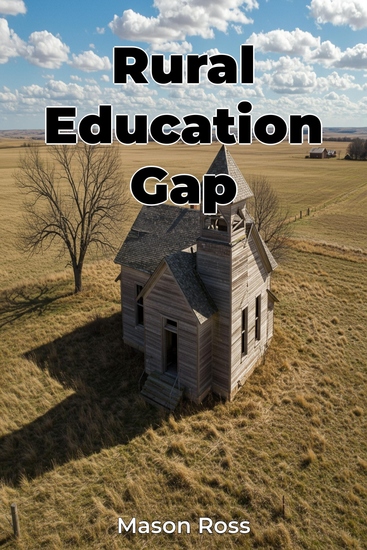
Rural Education Gap - cover

Rural Education Gap

Mason Ross

Übersetzer A AI

Verlag: Publifye

  • 0
  • 0
  • 0

Beschreibung

"Rural Education Gap" examines the significant differences in educational opportunities between rural and urban schools in the United States. This academic work explores how disparities in areas like school funding and teacher quality contribute to a persistent achievement gap. The book emphasizes that equitable access to quality education is crucial for both individual success and the economic well-being of rural communities, as the cumulative effect of educational disadvantages can perpetuate cycles of poverty and limit upward mobility.

 
The book uniquely integrates quantitative data from government sources with qualitative insights from regional studies and interviews, providing a balanced perspective on the complexities of rural education. It progresses from defining the scope of the rural education gap to examining key components like financial resources and teacher quality, followed by regional case studies and actionable strategies for closing the gap.

 
Readers will gain an understanding of how factors such as resource allocation and public policy impact educational equity in rural areas. This comprehensive analysis is valuable for educators, policymakers, and anyone interested in social justice, offering insights into addressing the challenges facing rural schools. By connecting sociological perspectives with economic analyses, the "Rural Education Gap" offers a nuanced understanding of the multifaceted issues affecting education disparities and proposes strategies for improving rural education.
Verfügbar seit: 21.02.2025.
Drucklänge: 77 Seiten.

Weitere Bücher, die Sie mögen werden

  • Path to Zero - 12 Climate Conversations That Changed the World - cover

    Path to Zero - 12 Climate...

    Tucker Perkins

    • 0
    • 0
    • 0
    Tucker Perkins’s Path to Zero shows how we can reverse climate change and create a cleaner environment for future generations by putting aside our biases and working together for change. 
    Climate catastrophe-inspired narratives like “Electrify Everything!” have a grip on people’s minds. The simplicity of the solution to the most complex endeavor ever faced by humans—the journey to a net zero future—is seductive, but it is fundamentally flawed. 
    In Path to Zero: 12 Climate Conversations That Changed the World, author Tucker Perkins takes listeners on a series of future-casting journeys from the year 2050 back to the present day to show us how a better way—a wide path to net zero carbon emissions—was, and can be, achieved in an accelerated time frame. 
    In this work, Perkins uncovers an array of practical, often obvious, measures the world can take to achieve a better, cleaner future inclusive of energy and power. Unlike other authors and voices of this age, Perkins shows us that change is possible, innovation is happening, and dogmatic devotion to singular solutions is one of the biggest impediments to progress.
    Zum Buch
  • We're Speaking - The Life Lessons of Kamala Harris: How to Use Your Voice Be Assertive and Own Your Story - cover

    We're Speaking - The Life...

    Hitha Palepu

    • 0
    • 0
    • 0
    Inspirational lessons about life, work, and overcoming adversity—drawn from Kamala Harris's norm-shattering ascent to Vice President of the United States.​Kamala Harris is one of our country's most awe-inspiring political figures, dawning on a new age as the first—but not last—Black and Asian-American female Vice President. Having spent her entire career smashing glass ceilings and influencing the next generation of young women, Harris has completely redefined what it means to be a woman in politics. In We’re Speaking, Palepu connects illuminating stories from Harris’ unique biography with tactical advice about learning to own the power of your multitudes, acting on your ambition, finding your North Star to guide your decisions, and developing your unique voice and style. We're Speaking will leave you feeling empowered to follow in Harris's footsteps — shattering glass ceilings of your own as you live the life of your dreams.
    Zum Buch
  • Portuguese Empire and Asia The: The History and Legacy of Portugal’s Exploration and Colonization in Asia - cover

    Portuguese Empire and Asia The:...

    Editors Charles River

    • 0
    • 0
    • 0
    By the mid-15th century, the Byzantine Empire had collapsed and the various Crusades that had taken place in the region had largely disrupted the overland routes of the Silk Road and trade. Compounding the difficulties of trade was the rise of the Ottoman Empire in place of the Byzantines and the outbreak of the Black Death in Europe.  
    It was roughly around this time that a period of European exploration began, and major factors that contributed to this period of exploration were introduced by the Chinese, albeit indirectly. The magnetic compass had already been developed and used by the Chinese sailors since the 12th century, although it had first been created in the 3rd century BCE as a divination device. The Portuguese started exploring the west coast of Africa and the Atlantic under orders from Prince Henry the Navigator. At this point, Europeans had not yet been capable of navigating completely around Africa since the ships being built were not yet fully capable of being able to sail very far from the coast and navigation in open waters was difficult, but the Portuguese continued pushing down the western African coast looking for ways to bypass the Ottomans and Muslims of Africa who had been making overland trade routes difficult.  
    	In 1488, Bartholomew Diaz rounded the southern tip of Africa, named the Cape of Good Hope by King John of Portugal, and entered the Indian Ocean from the Atlantic. 	The Portuguese had found access to the trade regions that they had been searching for, but sailing from Portugal to India and beyond would require too many resources to travel with at once. To remedy this problem, Portugal began establishing a number of forts and trading posts along the route. The Portuguese were able to establish a fort on the west coast of India, Fort Manuel, in 1500, and in 1505 a fort was erected off the coast of Tanzania. 
    Zum Buch
  • The Great Refusal - A New Vision of Resistance - cover

    The Great Refusal - A New Vision...

    Casey Gerald

    • 0
    • 0
    • 0
    In the spirit of American cultural prophecy — from Ta-Nehisi Coates to Rebecca Solnit — acclaimed writer Casey Gerald offers a groundbreaking work of joyous dissent and stunning vision, a survival guide to a society in crisis. “Somehow Casey Gerald has pulled off the most urgently political, most deeply personal, and most engagingly spiritual statement of our time by just looking outside his window and inside himself. Extraordinary.” –Marlon James on The Will Be No Miracles Here Most afternoons for the past three years, Casey Gerald took a walk. He would pass the compound that Elon Musk was building in his neighborhood; the burned-down Freedman's church; the little house where he and his lover Jack had seen a shooting star. He knew the world was crumbling, but he didn't fret. He had been promised: When it breaks, you'll be ready. "There is a great unfolding going on," Gerald writes, "and all the clues for what's to come are planted in the people." In this quietly redemptive and lyrical book, Gerald shares his map for finding those clues, finding each other, and finding our way out of this dark and wearied time. On the other side of No, Gerald insists, there is a Yes—an embrace of what we really want, what we might finally claim once we refuse. Calling forth a kaleidoscopic cast, from Odysseus to D'Angelo, Sun Tzu to Simone Biles, Black literati and desert mystics, Gerald implores us to take our power back and to remake the world together, on our terms. Written with Didion's cold eye and Baldwin's unflinching urgency, and with the dark humor of a man who’s seen too much but still wants to see what’s next, The Great Refusal is a lifeline from the other side of ruin.
    Zum Buch
  • The Goop Directory - cover

    The Goop Directory

    Frank Gelett Burgess

    • 0
    • 0
    • 0
    In this DIRECTORY you'll see just what you never ought to be; and so, it should direct your way to Good Behavior, every day. The children of whose faults I tell are known by other names, as well, so see that you aren't in this group of Naughty Ones. Don't be a Goop!(The author's introduction)
    Zum Buch
  • The Siege of Tyre - Alexander the Great and the Gateway to Empire - cover

    The Siege of Tyre - Alexander...

    David A. Guenther

    • 0
    • 0
    • 0
    The island city of Tyre along the coast of Lebanon was for centuries an impregnable fortress and key to unlocking Phoenician and Persian power in the Near East. Its fall was first prophesied in the Book of Ezekiel; but it would not be Nebuchadnezzar, king of Babylon, who would take the city as the Bible foretold, but a Macedonian warrior king, Alexander. Alexander's siege of 332 BC was one of the most remarkable events in the classical world. 


    The Siege of Tyre is the first book-length treatment of this critical and fascinating campaign, featuring catapults, triremes, religious invocations, close combat, and marvels of engineering, including a massive man-made causeway from the mainland to the island. The siege is thoroughly analyzed from the standpoint of what is plausible given the nature of the technology of the time and what we now know of the geology and physical fortifications of ancient Tyre. Critical to the siege were evolving technologies, including innovations in catapult design, military engineering, and naval architecture. David A. Guenther also takes into account recent scientific discoveries about the geology of the ancient seabed around Tyre and its effect on the siege. Finally, the book points out possible gender-biased views on topics such as sacred temple prostitution and the fate of women in besieged cities of the ancient world.
    Zum Buch