Junte-se a nós em uma viagem ao mundo dos livros!
Adicionar este livro à prateleira
Grey
Deixe um novo comentário Default profile 50px
Grey
Assine para ler o livro completo ou leia as primeiras páginas de graça!
All characters reduced
Private Education Debate - cover
LER

Private Education Debate

Mason Ross

Tradutor A AI

Editora: Publifye

  • 0
  • 0
  • 0

Sinopse

Private Education Debate offers a comprehensive exploration of private education's global impact, moving beyond simple assumptions to examine its complexities. The book investigates the varying academic outcomes between private and public schools, the socioeconomic factors influencing access to private education, and the market forces driving its growth. One intriguing insight is how the impact of private education significantly varies depending on national contexts and socioeconomic backgrounds.

 
The book is structured into three parts, beginning with the fundamental concepts and diverse types of private schools. It then delves into academic performance data, drawing from OECD market studies and other reports to analyze the relationship between private schooling and student achievement. Finally, it investigates socioeconomic implications, highlighting who accesses private education and the financial burdens it creates.

 
This approach ensures a balanced understanding, making it valuable for academics, policymakers, educators, and parents seeking to navigate the complex landscape of educational markets and school choice.
Disponível desde: 21/02/2025.
Comprimento de impressão: 72 páginas.

Outros livros que poderiam interessá-lo

  • Three Ways to Love - The Neuroscience of Attraction - cover

    Three Ways to Love - The...

    Gregory Bicaj

    • 0
    • 0
    • 0
    What if the chaos in your relationships is not a personal failing, but a pattern wired into you long before you could name it? In Three Ways to Love: The Neuroscience of Attraction, neuroscientist and clinical psychologist Gregory Bicaj draws on twenty years of laboratory research and clinical practice to reveal the hidden architecture beneath every relationship you have ever had — the invisible blueprint formed in early childhood that quietly shapes who you are drawn to, how you fight, how close you let someone get, and how quickly you pull away. Grounded in the latest findings from attachment science, predictive coding, neuroplasticity, and social neuroscience, this book offers an entirely new way of understanding love — not as mystery, fate, or weakness, but as a deeply biological, learnable, and changeable system. Bicaj introduces readers to the three dominant attachment styles — anxious, avoidant, and disorganized — along with the secure foundation that each can grow toward. He explains why the most electrifying chemistry sometimes signals danger rather than compatibility, how the anxious-avoidant loop keeps millions of people locked in cycles of craving and withdrawal, and why genuine love often feels less exciting than destructive love — at first. But this is not a book about being trapped by your past. It is a book about the neuroscience of change. Across sixteen chapters, Bicaj translates complex research into vivid, practical insight: how to read attachment signals in a first conversation or a dating profile, how to tell the difference between growth pain and repetitive pain, how to fight in ways that heal instead of erode, and how to build the kind of relationship that functions as both safe haven and secure base — a place that genuinely feels like home. Six detailed case studies bring the science to life, showing real turning points in real couples — the moment an avoidant partner admits panic instead of fleeing, the moment an anxious partner realizes distance is not abandonment, the moment a disorganized person first separates past terror from present safety. The central claim of the book is both scientifically rigorous and quietly radical: your attachment blueprint was written in pencil, not ink. The patterns that have governed your love life were learned through experience, and they can be revised through new experience. Earned security — the capacity for stable, warm, and honest connection — is not reserved for people who had perfect childhoods. It is available to anyone willing to understand what they are actually carrying into love, and to do something about it. For readers of Jonathan Haidt and Gabor Maté, Three Ways to Love is the book that finally explains not just how love works in the brain, but how to make it work better in your life.
    Ver livro

  • Special Operations Executive and the Office of Strategic Services The: The History of the British and American Intelligence Agencies during World War II - cover

    Special Operations Executive and...

    Editors Charles River

    • 0
    • 0
    • 0
    When people think about the Second World War, they seldom think in terms of silence and small acts. This was a war in which the industry of entire nations was rearranged to feed fighting, and it was fought on a scale in which battles could include hundreds of thousands of combatants. Whole cities and populations were destroyed, with millions of casualties occurring at places like Leningrad. 
    But World War II was also a conflict in which modern covert operations first hit their stride. From the jungles of Burma to the streets of Paris, spies, saboteurs, and commandos carried out missions built on secrecy and cunning. Precise, self-contained operations could be as important to the outcome of the war as acts of massive destruction, whether it involved targeted assassinations, sabotaging key logistics, or counterintelligence to break up the enemy’s own rings. At the time, most of these operations were hidden from the public since that was the only way they could be successfully carried out, but in the years since, stories about various missions have emerged. They paint a picture of incredible courage and ingenuity, whether in war zones, enemy territory, or far from the front lines. 
    Though it might be hard to believe, the Americans did not have a covert operations organization when they joined the war, and like the British, it took them some time to realize it could be a powerful tool. In time, all the hard work led to the growth of the OSS into an organization with over 13,000 staff and 40 offices scattered across the world. Its purposes were initially similar to that of Britain’s Special Operations Executive, including espionage, sabotage, and intelligence assessments, but with time and experience, it expanded to include economic, psychological, and guerrilla warfare, as well as counter-intelligence work. And of course, it would all chart a path for the early days of America’s most famous intelligence agency, the CIA. 
    Ver livro
  • Mandarin Made Easy - Beginner - Volume 2 of 3 - cover

    Mandarin Made Easy - Beginner -...

    Lingo Wave

    • 0
    • 0
    • 0
    We broke our new series on learning Chinese [Mandarin] down into different learning stages. Start with the "Lower Beginner" books followed by the "Beginner" and "Upper Beginner" books. Next, progress to the "Intermediate" series, then test and reinforce your knowledge with the "Conversations" series. 
    This audiobook is divided into units.While it provides different learning patterns and accommodates various needs, this audiobook focuses on helping you improve your ability to understand, speak, and memorise Chinese [Mandarin]. 
    In Unit 1 you will hear Chinese [Mandarin] decoded with each syllable spoken very slowly and clearly with repetition. Immediately before each sentence is spoken, you will hear the translation, so you will always understand what is being said. 
    Unit 2 focuses solely on increasing your listening ability, which will improve your abilities to engage in dialogue with a native Chinese [Mandarin] speaker. This chapter requires you to listen very carefully to nuances in the language. 
    By Unit 3 you will already notice progress in your abilities to speak and understand Chinese [Mandarin]. The spoken translation is followed by two repetitions in Chinese [Mandarin] at a completely natural speed. While you are learning to process naturally spoken Chinese [Mandarin], Units 3 and 4 will help you memorise new vocabulary and full sentences. 
    In Unit 5 you can test yourself on how much you have learned. If you are having difficulties, we suggest you revisit the listening, speaking, or memorisation section of Units 1, 2 3 or 4, according to what you need more help with. 
    Topics covered in this book: 
    1. Asking about family 
    2. Asking about relationship status 
    3. Expressing frequency 
    4. Talking about spare time activities and hobbies 
    5. Using quantifiers/determiners 
    6. Talking about preference 
    7. Talking about abilities 
    8. Talking about location of places 
    ...
    Ver livro
  • What the Hell - How Wittgenstein Made Philosophy Even More Confusing While Claiming to Solve Everything - cover

    What the Hell - How Wittgenstein...

    Sophia Blackwell

    • 0
    • 0
    • 0
    Finally, a philosophy book that won't make you contemplate throwing yourself into the abyss! " WHAT THE HELL" tears into Ludwig Wittgenstein—history's most insufferable genius—with savage wit and zero academic pretension. 
    Journey through the mind-bending contradictions of a trust-fund philosopher who claimed to solve all philosophical problems (twice!), while making everyone around him miserable. Discover how a man who couldn't maintain a single healthy relationship somehow revolutionized our understanding of language, meaning, and communication. 
    From his early days writing numbered lists so pretentious they make Instagram influencers look humble, to his later career interrupting people to tell them they're using words wrong, this book exposes Wittgenstein in all his paradoxical glory. You'll laugh, you'll cry, you'll question whether language has any meaning at all—just like Ludwig wanted! 
    Whether you're a philosophy student desperately seeking comic relief, or simply enjoy watching neurotic geniuses get thoroughly roasted, this irreverent guide proves that even the most profound philosophical insights can come from someone you'd absolutely hate to be seated next to at dinner. Warning: Reading this book in public may cause uncontrollable snorting in libraries and concerned looks from serious academics.
    Ver livro
  • Kelvin - cover

    Kelvin

    JP Sayle, Lisa Olivera

    • 0
    • 0
    • 0
    Fated mates find themselves drawn into a web of lies and deceit. Can they find the answers and protect those closest to them when danger lurks in the most unlikely of places?  
    Seeking answers to his sister’s disappearance two years before, FBI Special Agent Magnus Fallows will use all of the resources at his disposal. That includes Thalassa Security. Getting off on the wrong foot with the Thalassa family, Magnus struggles to figure out if there is anything the elusive Kelvin Thalassa is keeping from him.  
    For Kelvin Thalassa being in the field isn’t his area of expertise, yet he’ll do anything to find the answers and protect his growing family. Trust is becoming difficult, so Kelvin goes to a man who has had no issue pushing for answers ─ Agent Fallows. The last thing he expects is to find out that Magnus is his fated mate. 
    The search for Big Foot leads right back to an old nemesis: Andromeda. The battle is on to stop the heinous acts that have been happening right under the noses of the shifter council.  
    Kelvin #5 is a paranormal gay romance with a protective leopard who will stop at nothing to uncover the truth and a Kraken who learns strength comes in many forms. This is the fifth and final book in the Tangled Tentacles Series. HEA is guaranteed, and the Epilogue will hint at what is to come in the future for these two authors.
    Ver livro
  • Crusading against Christians: The History and Legacy of the Catholic Church’s Crusades against Other Christians during the Middle Ages - cover

    Crusading against Christians:...

    Editors Charles River

    • 0
    • 0
    • 0
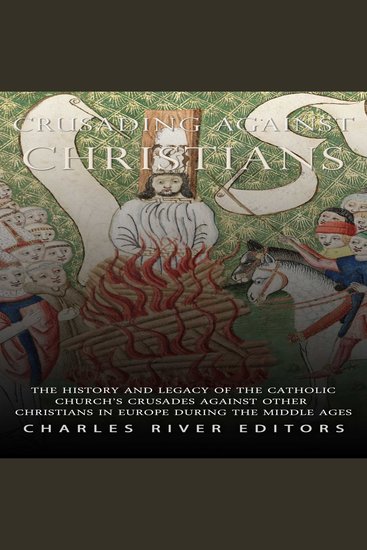
    After the fall of the Western Roman Empire in the 5th century, when Western Europe was governed by a Germanic warrior-caste, the theory of a just and virtuous war took root. The Roman Church enhanced its authority by sanctifying oaths taken for just military purposes, and Bishop Anselm of Lucca (d. 1086) was the first to suggest that military action for the cause of religion could remit sin. At the Council of Clermont in July 1095, Pope Urban II canonized religious war by urging Western Europe's nobility to take up arms in defense of the Byzantine Empire against the Muslims, thus launching the Crusades. Religious military orders such as the Knights of Saint John, the Templars, and the Hospitallers arose, ostensibly founded to protect the weak and the sick but also to extend the boundaries of Christianity and the power of the Church. In Europe, the knight, originally a mounted warrior, became a consecrated soldier of Christ, dedicated to the defense of the Church by solemn vows made before an altar. 
    Naturally, the question remained concerning the use of arms against other Christians. Eastern Christians did not acknowledge the Pope's supremacy, and many held that it was lawful for him to declare a crusade to bring schismatics back to the obedience of Rome. German knights fighting the Orthodox Russians at the Battle on the Ice in 1242 believed this, as did the Hungarian prosecutors of the 1235 invasion of Bosnia, which was thinly disguised as a crusade. The Church even extended the object of crusade to believers in communion with Rome, who refused to obey lawful authority. After peasants revolted against the Prince-Archbishop of Bremen in 1204 over tithes and land rights, Pope Gregory IX was persuaded to declare them heretics and proclaim a crusade against them.
    Ver livro