¡Acompáñanos a viajar por el mundo de los libros!
Añadir este libro a la estantería
Grey
Escribe un nuevo comentario Default profile 50px
Grey
Suscríbete para leer el libro completo o lee las primeras páginas gratis.
All characters reduced
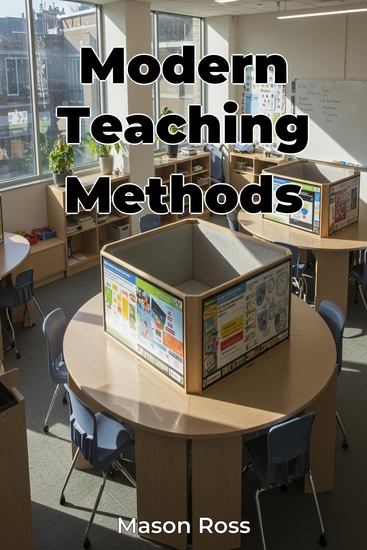
Modern Teaching Methods - cover

Modern Teaching Methods

Mason Ross

Traductor A AI

Editorial: Publifye

  • 0
  • 0
  • 0

Sinopsis

Modern Teaching Methods explores the shift from traditional, teacher-centered approaches to innovative, student-centered methodologies in education. It emphasizes the necessity of modern teaching methods to prepare students for the complexities of the 21st century. The book highlights how active learning, technology integration, and personalized learning strategies can enhance student engagement and improve learning outcomes. 

 
Notably, the book argues that embracing these innovative techniques is crucial for creating more equitable and effective learning environments. The book challenges the status quo by offering practical solutions for educational reform amid rapid change. It begins by defining key concepts and establishing a theoretical framework, then progressively explores active learning strategies, technology integration, and personalized learning approaches. It also offers guidance for practical application of these methods in various classrooms. 

 
The book presents its information in an accessible yet academic tone, combining rigorous research with clear language to present complex ideas in a comprehensible manner, making it a valuable resource for educators and policymakers.
Disponible desde: 11/03/2025.
Longitud de impresión: 99 páginas.

Otros libros que te pueden interesar

  • Stonewall Brigade and Hood’s Brigade The: The History of the Most Famous Units in Robert E Lee’s Army of Northern Virginia during the Civil War - cover

    Stonewall Brigade and Hood’s...

    Editors Charles River

    • 0
    • 0
    • 0
    The Stonewall Brigade went on to fight in every major battle in the Eastern theater of the American Civil War, to the extent that of the 6,000 men who fought with the brigade over the course of four years, less than 200 remained by the time General Robert E. Lee surrendered at Appomattox Courthouse on April 9, 1865. They were organized, trained, and mentored by one of the most revered military leaders in American history, and they made a decisive impact on battles like First Manassas, the 1862 Valley Campaign, and Chancellorsville. The brigade was virtually a spent force by the end of the Battle of Spotsylvania Courthouse in May 1864, which took place nearly a year after Stonewall Jackson himself had been mortally wounded at Chancellorsville. 
    Organized in Richmond, Virginia on October 22, 1861, Hood’s Texas Brigade was one of the most formidable fighting forces of the Confederate States during the American Civil War. At times undisciplined, the men who comprised this brigade were a group of fearless and determined volunteers-turned-soldiers. Over the course of the Civil War, the Texas Brigade engaged over 4,000 men and was comprised of the only Texans to fight with General Robert E. Lee’s Army of Northern Virginia in the Eastern Theater. With the exception of Chancellorsville, these men fought in every major battle in the East, and they also participated in significant battles in the Western Theater. Of the more than 4,000 men who fought with the brigade over the course of the war, approximately 600 remained to surrender at Appomattox. The brigade suffered a horrific casualty rate of sixty-one percent and were lauded for their courage by men such as generals Thomas “Stonewall” Jackson, James Longstreet, and Lee.
    Ver libro
  • Back in the USSR - Heroic Adventures in Transnistria - cover

    Back in the USSR - Heroic...

    Rory Maclean

    • 0
    • 0
    • 0
    Transnistria is a nowhereland hugging a narrow valley near the Black Sea. No bigger than Cornwall or Rhode Island, the unrecognised country is a Soviet museum long occupied by Russian ‘peace-keepers’. Its oligarchs in Adidas track suits hunt wild boar with AK-47s. Its young people train for revolution at the Che Guevara High School of Political Leadership. Its secret factories have supplied arms to African insurgents and electrical generators for Iran’s nuclear power programme. Yet its isolation and sliver-size belie the real threat it poses to the West, above all since Russia's invasion of Ukraine. 	‘We know our people and how to treat them, ' bragged a local-boy-made-good oligarch. ‘And I tell you that the only way to get them to act or to change their ways is to point a gun at their heads, and threaten to shoot.’	‘And if they still don’t change?’ I asked, shocked by his arrogant candour.	‘Then one pulls the trigger.’	Re-issued with a new Introduction, Back in the USSR is a snapshot in time - presented in a social realist style - and a chilling reminder of the fate that awaits the conquered.
    Ver libro
  • Speed Reading - How To Read Smarter Learn Faster and Remember More - cover

    Speed Reading - How To Read...

    Steve Collins

    • 0
    • 0
    • 0
    Do you ever wish you could read faster without forgetting what you just read? 
    In today’s information-overloaded world, mastering the art of speed reading isn’t just a skill—it’s a superpower. 
    Speed Reading: How to Read Faster, Understand Better, and Retain More Information is your complete guide to unlocking your mind’s full reading potential. Whether you’re a student, professional, or lifelong learner, this book teaches you how to absorb information quickly, boost comprehension, and remember what truly matters. 
    Inside, you’ll discover:The fascinating history and science of speed readingProven techniques to double or even triple your reading speedHow to improve focus and comprehension while reading fastThe most common bad reading habits—and how to fix themEasy exercises to train your eyes and brain for faster learningPractical tips to retain key ideas long after you finish reading 
    If you want to read smarter, learn faster, and retain more knowledge, this book will show you exactly how.
    Ver libro
  • How to Save the World for Just a Trillion Dollars - The Ten Biggest Problems We Can Actually Fix - cover

    How to Save the World for Just a...

    Rowan Hooper

    • 0
    • 0
    • 0
    What would you do with a trillion dollars? The ultimate thought experiment opens our eyes to ten world-changing ideas within our graspIf we can come up with a trillion dollars to bail out banks, imagine what else we could do. Science journalist Rowan Hooper decided to find out, speaking with experts of all kinds about ten incredibly ambitious projects that— if realized—would secure profound, enduring benefits: trying to end global poverty, reverse climate change, extend our lifespans, refreeze the Arctic, save all endangered species, and more. Then, he dives into strategies and costs to see: How far would $1 trillion really go? You’ll have to read on to learn which project he concludes would do the most good . . . but the biggest surprise is how many astonishing advances are actually within our grasp—if we dare to reach for them.
    Ver libro
  • Demystifying the Spanish Subjunctive - Feel the fear and Subjunctive anyway - cover

    Demystifying the Spanish...

    Gordon Smtih Durán, Cynthia...

    • 0
    • 0
    • 0
    We, Gordon and Cynthia of LightSpeed Spanish, are totally excited to bring you the book that really does demystify the Present and Past Spanish Subjunctive. 
    Most students of the Spanish language shy away from this subject and it's no wonder! So many books on the market make it look complex and difficult to understand. 
    Yet here, at LightSpeed Spanish, we have developed the perfect system to walk you through the entire range of the Spanish Subjunctive, step by step. 
    This comprehensive book uses simple, easy to understand explanations that won't leave you mind boggled, while it guides you through the creation of over 600 Subjunctive sentences. 
    By the time you've finished this learning journey we anticipate that you will be more confident, more at ease and far more able to use the Spanish Subjunctive in every facet of your communication. It really is a must buy for any serious student of the Spanish language! 
    Un saludo, 
    Gordon y Cynthia:)
    Ver libro
  • Battle of Kadesh The: The History of the Most Important Battle Between the Egyptians and Hittites - cover

    Battle of Kadesh The: The...

    Editors Charles River

    • 0
    • 0
    • 0
    Many battles fought in antiquity remain famous thousands of years later, such as Marathon, Thermopylae, and Cannae, mainly due to the belligerents involved and the ways in which the battles changed the course of history. However, even as people are fascinated by the Egyptians, one of the most important battles in antiquity has also been one of the most overlooked: the Battle of Kadesh, fought by Ramesses II against the Hittites.  
    	For one thing, it is the earliest known pitched battle to be documented, and the number of troops deployed by both the Egyptians and Hittites may have made it the largest battle ever fought up until that point in time. The organization of the forces, especially the Egyptians, is another intriguing aspect of this battle, because the Egyptians organized their units into divisions, which may be the first such case in history or simply the first time the organization was recorded. 
    	Arguably the most famous aspect of the battle is that it was passed down in ways that barely aligned with reality. Surrounded and swiftly outnumbered, most of the Egyptian soldiers were killed in the battle, and Ramesses II was forced to retreat in order to survive. What is known of the rest of the battle is that the pharaoh rallied his forces, fought on through the battlefield in order to evade capture and death, and managed to get away with only with a fraction of his troops, while the majority of his army lay slain on the field of battle that he left behind him. 
    	Nonetheless, the battle essentially ended in a stalemate, after which there was a period of extended peace and eventually an alliance between the Egyptians and Hittites. The ensuing peace also helped to solidify the Late Bronze Age Near Eastern geopolitical system modern scholars often refer to as the “Great Powers Club,” during which the most powerful empires of the Near East tended to use diplomacy instead of warfare to settle their differences.
    Ver libro