Join us on a literary world trip!
Add this book to bookshelf
Grey
Write a new comment Default profile 50px
Grey
Subscribe to read the full book or read the first pages for free!
All characters reduced
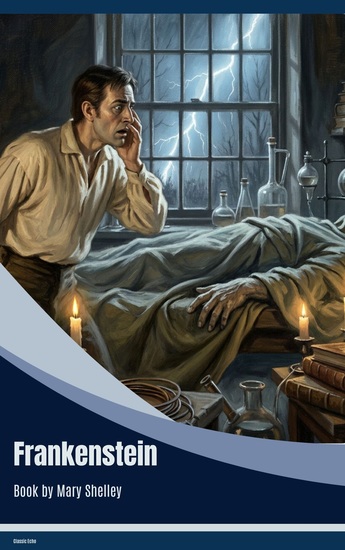
Frankenstein - cover

Frankenstein

Mary Shelley

Publisher: Classic Echo

  • 0
  • 0
  • 0

Summary

What happens when the desire to conquer nature goes beyond the limits of human responsibility?

In Frankenstein, Mary Shelley presents one of the most enduring and influential novels in world literature. The story follows Victor Frankenstein, a brilliant young scientist whose obsessive pursuit of knowledge leads him to create a living being from assembled human remains.

But Victor's triumph quickly becomes a nightmare. Horrified by his creation, he abandons it—setting in motion a tragic chain of events that forces both creator and creation to confront questions of responsibility, isolation, identity, rejection, revenge, and the consequences of unchecked ambition.

The creature is far more complex than a simple monster. Intelligent, sensitive, and desperate for companionship, he struggles to understand his place in a world that fears and rejects him. His experiences raise one of the novel's central questions: is someone born monstrous, or can society make them so?

Blending Gothic horror, science fiction, philosophical fiction, and Romantic literature, Shelley explores the boundaries between science and ethics, humanity and monstrosity, knowledge and responsibility.

First published in 1818, Frankenstein; or, The Modern Prometheus has influenced generations of writers, filmmakers, scientists, and thinkers. Its themes remain remarkably relevant in an age of rapid technological and scientific advancement.

For readers who enjoy classic horror, Gothic literature, science fiction, philosophical fiction, dark Romanticism, and stories about scientific discovery, Frankenstein remains an essential literary experience.

Enter the laboratory, witness Victor Frankenstein's extraordinary experiment, and confront the creature who changed literature forever. Download Frankenstein today and experience Mary Shelley's timeless masterpiece of horror, science, ambition, and humanity.
Available since: 08/17/2026.
Print length: 113 pages.

Other books that might interest you

  • Horse in the Moon - From their pens to your ears genius in every story - cover

    Horse in the Moon - From their...

    Luigi Pirandello

    • 0
    • 0
    • 0
    Luigi Pirandello was born on 28th June 1867 into an upper-class family in Agrigento, in Sicily. 
    In 1880, the family moved to Palermo and there he completed high school and thence to the University of Palermo, at that time the centre of what became the Fasci Siciliani movement.  Although not an active member he had close friendships with many of its leading ideologists.  Pirandello then completed his university studies in Rome and Bonn, receiving his Doctorate in March, 1891. 
    His time in Rome had provided him with the opportunity to visit its many theatres. "Oh the dramatic theatre! I will conquer it. I cannot enter into one without experiencing a strange sensation, an excitement of the blood through all my veins..." 
    1894 brought marriage, at his father's suggestion, to a shy, withdrawn girl: Mara Antonietta Portulano.  The marriage encouraged his studies and writings and, the following year, the first part of the ‘Dialoghi tra Il Gran Me e Il Piccolo Me’ was published. 
    In 1903 the flooding of the sulphur mines in which his father had invested the family capital and Antonietta's dowry, brought financial catastrophe.  She, on hearing the news, was mentally broken.  Pirandello would now work a full day and then watch over his troubled wife at night. Somehow he found time to write ‘The Late Mattia Pascal’.  It was an immediate and resounding success.  
    In 1909, Pirandello began his collaboration with the prestigious Corriere della Sera.  Whilst his fame as a writer was increasing his private life was poisoned by the suspicion and jealousy of Antonietta who now turned physically violent.  His plays were now being regularly performed but, within a decade, Antonietta had to be placed into an asylum from which she never left. 
    In 1921, in Rome his play, ‘Six Characters in Search of an Author’ debuted.  It was a failure.  However, when presented in Milan it was a great success, as it also was in London and New York. 
    In 1925, Pirandello, with Mussolini’s help, assumed the artistic direction and ownership of the Teatro d'Arte di Roma.  He now described himself both as ‘a Fascist because I am Italian’ and ‘I'm apolitical, I'm only a man in the world...’  However his later conflicts with fascist leaders meant he fell under close surveillance by the OVRA, the secret police. 
    In 1934 he won the Nobel Prize but asked that the medal be melted down for Italy’s occupation of Abyssinia Campaign to which he had given his support.  
    Pirandello's canon stretches across novels, short stories, poetry, essays and some 40 plays.  His tragic farces are often cited as forerunners of the Theatre of the Absurd. 
    Luigi Pirandello died on the 10th December 1936 at his home at Via Bosio, Rome, Italy.  He was 69.
    Show book
  • The Complete Short Stories of Guy De Maupassant - cover

    The Complete Short Stories of...

    Guy de Maupassant

    • 0
    • 0
    • 0
    Discover the brilliance of one of the world's greatest short story writers in this comprehensive collection of timeless literary masterpieces.
    
    Explore "The Complete Short Stories of Guy de Maupassant," an extraordinary anthology bringing together the celebrated short fiction of one of France's most influential authors. Renowned for his elegant prose, psychological insight, vivid realism, and unforgettable storytelling, Guy de Maupassant transformed the short story into a literary art form that continues to captivate readers around the world.
    
    This comprehensive collection offers readers the opportunity to experience Maupassant's remarkable range of storytelling. Through compelling characters and richly observed narratives, his stories explore universal themes of love, ambition, friendship, family, human nature, social class, morality, war, loneliness, fate, and the unexpected twists of everyday life. Blending realism, irony, emotional depth, and subtle humor, these timeless works remain as engaging and relevant today as when they were first published.
    
    Widely regarded as one of the greatest masters of the short story, Guy de Maupassant influenced generations of writers with his concise style, memorable characters, and masterful endings. His literary legacy continues to inspire readers, scholars, and authors across the globe.
    
    Perfect for readers who enjoy classic literature, French literature, literary fiction, psychological fiction, realist fiction, nineteenth-century classics, short stories, and timeless literary masterpieces, "The Complete Short Stories of Guy de Maupassant" is an essential addition to every digital library.
    
    Experience the artistry of one of literature's finest storytellers. Add "The Complete Short Stories of Guy de Maupassant" to your Kindle library today and enjoy a timeless collection of unforgettable stories and literary masterpieces.
    Show book
  • Kilo - Being the Love Story of Eliph' Hewlitt Book Agent - cover

    Kilo - Being the Love Story of...

    Ellis Parker Butler

    • 0
    • 0
    • 0
    Eliph' Hewlitt sells Jarby's Encyclopaedia of Knowledge and Household Recipes door to door through the small towns of Iowa, and decides to marry a woman he has not met, using the encyclopaedia as his method. Butler wrote Pigs Is Pigs, a six-page joke that sold in the millions; this 1907 novel is Iowa itself — the depot, the store, the newspaper — and the book agent is a masterpiece.
    Show book
  • Two Tales From Lord Dunsany - The Sword of Welleran Carcassone - cover

    Two Tales From Lord Dunsany -...

    Lord Dunsany

    • 0
    • 0
    • 0
    Edward John Moreton Drax Plunkett, 18th Baron of Dunsany, (July 24, 1878 - October 25, 1957), commonly known as Lord Dunsany, was an Anglo-Irish writer and dramatist who published more than 90 books during his lifetime, as well as hundreds of short stories, plays, and essays. He gained a name in the 1910s as a great writer in the English-speaking world. The following recording includes the short stories "The Sword of Welleran" and "Carcassone."
    Show book
  • The Coup de Grace - From their pens to your ears genius in every story - cover

    The Coup de Grace - From their...

    Ambrose Bierce

    • 0
    • 0
    • 0
    Ambrose Gwinnett Bierce was born on 24th June 1842 at Horse Cave Creek in Meigs County, Ohio. His parents were poor but they introduced him to literature at an early age, instilling in him a deep appreciation of books, the written word and the elegance of language.  
    Growing up in Koscuisko County, Indiana poverty and religion were defining features of his childhood, and he would later describe his parents as “unwashed savages” and fanatically religious, showing him little affection but always quick to punish. He came to resent religion, and his introduction to literature appears to be their only positive effect. 
    At age 15 Bierce left home to become a printer’s devil, mixing ink and fetching type at The Northern Indian, a small Ohio paper. Falsely accused of theft he returned to his farm and spent time sending out work in the hopes of being published. 
    His Uncle Lucius advised he be sent to the Kentucky Military Institute. A year later he was commissioned as an Officer.  As the Civil War started Bierce enlisted in the 9th Indiana Infantry Regiment.  
    In April 1862 Bierce fought at the Battle of Shiloh, an experience which, though terrifying, became the source of several short stories. Two years later he sustained a serious head wound and was off duty for several months. He was discharged in early 1865.  
    A later expedition to inspect military outposts across the Great Plains took him all the way to San Francisco. He remained there to become involved with publishing and editing and to marry, Mary Ellen on Christmas Day 1871.  They had a child, Day, the following year.  
    In 1872 the family moved to England for 3 years where he wrote for Fun magazine. His son, Leigh, was born, and first book, ‘The Fiend’s Delight’, was published.  
    They returned to San Francisco and to work for a number of papers where he gained admiration for his crime reporting. In 1887 he began a column at the William Randolph Hearst’s San Francisco Examiner.  
    Bierce’s marriage fell apart when he discovered compromising letters to his wife from a secret admirer. The following year, 1889 his son Day committed suicide, depressed by romantic rejection. 
    In 1891 Bierce wrote and published the collection of 26 short stories which included ‘An Occurrence at Owl Creek Bridge’.  Success and further works including poetry followed.  
    Bierce with Hearst’s resources helped uncover a financial plot by a railroad to turn 130 million dollars of loans into a handout. Confronted by the railroad and asked to name his price Bierce answered “my price is $130 million dollars. If, when you are ready to pay, I happen to be out of town, you may hand it over to my friend, the Treasurer of the United States”.  
    He now began his first foray as a fabulist, publishing ‘Fantastic Fables’ in 1899.  But tragedy again struck two years later when his second son Leigh died of pneumonia relating to his alcoholism.  
    He continued to write short stories and poetry and also published ‘The Devil’s Dictionary’.  
    At the age of 71, in 1913 Bierce departed from Washington, D.C., for a tour of the battlefields where he had fought during the civil war. At the city of Chihuahua he wrote his last known communication, a letter to a friend. It’s closing words were “as to me, I leave here tomorrow for an unknown destination,” Ambrose Bierce then vanished without trace.
    Show book
  • The Man of the Crowd - cover

    The Man of the Crowd

    SAMPI Books, Edgar Allan Poe

    • 0
    • 0
    • 0
    In "The Man of the Crowd" by Edgar Allan Poe, the narrator becomes obsessed with following a mysterious old man through the bustling streets of London, intrigued by his enigmatic presence. This pursuit reveals the complexity of human nature and the impenetrability of urban anonymity.
    Show book