¡Acompáñanos a viajar por el mundo de los libros!
Añadir este libro a la estantería
Grey
Escribe un nuevo comentario Default profile 50px
Grey
Suscríbete para leer el libro completo o lee las primeras páginas gratis.
All characters reduced
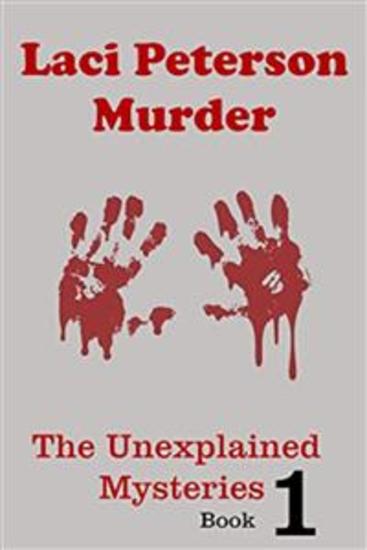
Laci Peterson Murder - Secrets Lies & Sadness - cover

Laci Peterson Murder - Secrets Lies & Sadness

Mary Patricia

Editorial: Rachel Hudson

  • 0
  • 0
  • 0

Sinopsis

Find out every minute details to this mysterious case which is guaranteed to keep you up at night...

She went missing on Christmas Eve 2002 – and when her husband started acting suspicious, the entire country started paying attention.
Throughout early 2003, her disappearance dominated the TV news right alongside the hunt for Saddam Hussein. The tragic story established a cast of characters who covered tabloid magazines for years, including Laci’s handsome husband Scott Peterson, Scott’s mistress, and a gaggle of celebrity lawyers.

A missing pregnant woman is newsworthy enough, but it was the police search of the Peterson home after Christmas that tipped off the media to the seriousness of the investigation into Scott Peterson.

From the moment of her disappearance, the Rocha family – Laci’s mother, stepfather and brother – repeatedly spoke to the media in the teary-eyed manner viewers have come to expect from loved ones in crisis. The family publicly supported her husband and defended his innocence.

The tangled drama proved that even with other, more serious problems in the world, Americans had a bottomless appetite for true crime.
Disponible desde: 29/05/2023.

Otros libros que te pueden interesar

  • Party Lines - Dance Music and the Making of Modern Britain - cover

    Party Lines - Dance Music and...

    Ed Gillett

    • 0
    • 0
    • 0
    A Guardian Guide Cultural Book of the Year 2023An Irish Times Music Book of the Year 2023'A deep, engrossing history' The Observer'A fascinating deep dive' Jeremy DellerFrom the illicit reggae blues dances and acid-rock free festivals of the 1970s, through the ecstasy-fuelled Second Summer of Love in 1988, to the increasingly corporate dance music culture of the post-Covid era, Party Lines is a groundbreaking new history of UK dance music, exploring its pivotal role in the social, political and economic shifts on which modern Britain has been built.Taking in the Victorian moralism of the Thatcher years, the far-reaching restrictions of the Criminal Justice Act in 1994, and the resurgence of illegal raves during the Covid-19 pandemic, Party Lines charts an ongoing conflict, fought in basement clubs, abandoned warehouses and sunlit fields, between the revolutionary potential of communal sound and the reactionary impulses of the British establishment. Brought to life with stunning clarity and depth, this is social and cultural history at its most immersive, vital and shocking.____'Excellent' The Sunday Times'Reminds us why the dance floor matters . . . fascinating' Telegraph
    Ver libro
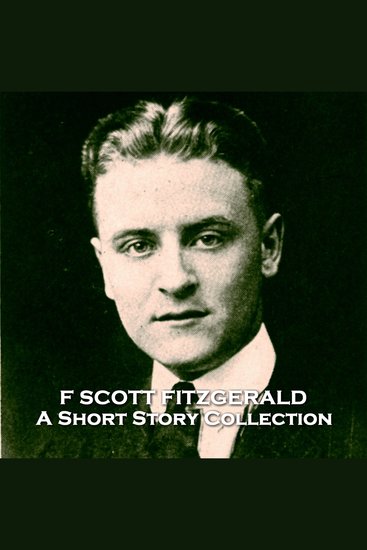
  • F Scott Fitzgerald - A Short Story Collection - A wonderful collection from the legendary American author of The Great Gatsby - cover

    F Scott Fitzgerald - A Short...

    F. Scott Fitzgerald

    • 0
    • 0
    • 0
    Francis Scott Key Fitzgerald was born on September 24th 1896 in Saint Paul, Minnesota, to an upper-middle-class family. His early years in Buffalo, New York showed him to be a boy of high intelligence and drive with a thirst for literature.  
     
    In 1908, his father was fired from Procter & Gamble, and the family returned to Minnesota. Here Fitzgerald attended St. Paul Academy, in St. Paul, until 1911. At 13 he was published in the school newspaper, it was, of all things, a detective story. In 1911, aged 15, he was sent to the prestigious Newman School, in Hackensack, New Jersey. And, after graduating in 1913, he decided to continue at Princeton University. Here he firmly dedicated himself to writing. Unfortunately his writing pursuits came at the expense of his coursework. In 1917 he dropped out to join the U.S. Army.  
     
    However this service to his country came with the very real fear that he might perish in the trenches of Western Europe with his literary dreams not yet begun. So he spent the weeks before reporting for duty at work on a novel entitled The Romantic Egotist.  Fitzgerald was assigned to Camp Sheridan, in Alabama. It was there that Fitzgerald met the love of his life; Zelda Sayre, the "golden girl," of Montgomery youth society.  
     
    The war ended before Fitzgerald could be deployed, and he moved to New York City hoping to start a career in advertising that would be lucrative enough to convince Zelda to marry him. Unable to convince her that his means were enough to support her she broke off the engagement. Fitzgerald returned to his parents in St. Paul, to revise The Romantic Egoist, now recast as This Side of Paradise. His revised novel was accepted by Scribner's and published in 1920 becoming an instant success.  
     
    It launched Fitzgerald's career as a writer and provided a steady income suitable for Zelda's ambitions. The engagement resumed and they married at St. Patrick's Cathedral in New York. Frances Scott "Scottie" Fitzgerald, their only child, was born on October 26, 1921. 
     
    Inspired by the parties he had attended visiting Long Island's north shore Fitzgerald began planning the greatest of his novels, The Great Gatsby, in 1923, wanting to produce "something new—something extraordinary and beautiful and simple and intricately patterned."  Published in April 1925, The Great Gatsby received mixed reviews and sold poorly; only 20,000 in its first year.  Today, it is considered a literary classic and one of a small circle vying for the title "Great American Novel".  
     
    Fitzgerald continued to supplement his income by writing short stories for magazines and to sell his stories and novels to Hollywood. He called this "whoring".  
     
    In February 1932, Zelda was hospitalized with schizophrenia. Fitzgerald rented a house nearby and worked on his latest book, Tender Is the Night, and finally published it in 1934.  
     
    Fitzgerald's heavy and excessive drinking had now developed into alcoholism and with recurring financial difficulties, the emotional toll of Zelda's mental illness, this meant several difficult years.  
     
    In 1937, Fitzgerald moved to Hollywood. His income improved and he began to work in the film industry. He found movies beneath his talents, but was once again in perilous financial straits, and so spent the second half of the 1930s in Hollywood, working on a triangle of short stories, scripts for MGM, and his final novel, The Love of the Last Tycoon.   
     
    In 1939, MGM ended the contract, and Fitzgerald became a writer for hire. Still an alcoholic, he now became estranged from Zelda and developed a relationship with Sheilah Graham, the Hollywood gossip columnist. They quickly became lovers.  
     
    In this last period of his life his alcoholism had left him physically wrecked. After suffering a heart attack, in Schwab's Drug Store, he was ordered to avoi
    Ver libro

  • The Bridge to the Kingdom - cover

    The Bridge to the Kingdom

    Andrew Whitelaw

    • 0
    • 0
    • 0
    Andrew´s post-war childhood in Scotland. His parents met during the second world war, his father being lucky to survive as his warship was the only one of its class to survive the Arctic convoys to Russia.  Andrew´s primary school (in the Kingdom of Fife) maintained discipline with ”six of the best” from a heavy leather belt but the children proudly learned Scotland´s history and culture. His grammar school journey took him over the Forth Rail Bridge to Edinburgh every day. Initial enthusiasm for model planes, starting fires and blowing up derelict buildings with fireworks was replaced by kissing girls and playing electric guitar in two bands and bagpipes in a third. An English teacher ignited a love of poetry and prose that led on to acting, drama and writing. 
    Ver libro
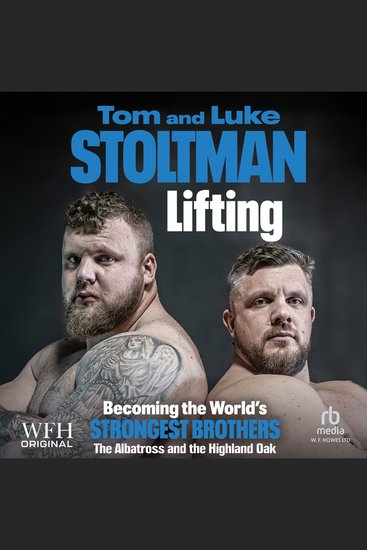
  • Lifting: Becoming the World's Strongest Brothers - Becoming The World's Strongest Brothers - cover

    Lifting: Becoming the World's...

    Luke Stoltman, Tom Stoltman

    • 0
    • 0
    • 0
    An Original Audiobook Production from W. F. Howes, read by the Stoltman Brothers with exclusive audio content 
     
    When Loch Morlich freezes over, we cut a hole in the ice and jump in… 
     
    Tom “The Albatross” and Luke “the Highland Oak” Stoltman are the world’s strongest brothers. Between them, they’ve won everything there is to win in the mighty world of Strongman. Tom can deadlift a 430kg bar to hip height, equivalent to about seven washing machines. Luke isn't far behind. Yet for the Stoltmans, being strong is about more than pure muscle. It's about overcoming adversity. And it's about honouring their biggest fan: their mother, who died in 2016 leaving the family devastated. 
     
    But they’ve also transcended the sport, not least through launching the hugely successful online Stoltman Strength Academy. Through it all, they’ve stayed true to their roots in the Highlands of Scotland, giving back to their community, their family, and each other. 
     
    But it wasn’t always like this. Back in 2010, Luke worked full time on oil rigs in the North Sea, and Tom was a teenager that the rest of the world had written off due to his autism. 
     
    How did two lads from Invergordon conquer the world? Simple. They started lifting. 
     
    In their astonishing autobiography, Tom and Luke Stoltman are going to show you how to lift. How to lift the lid on life with autism. How to lift yourself out of the darkness of bereavement. How to lift the trophy at the World's Strongest Man. 
    LIFTING is the story of two athletes pushing themselves, and each other, to the limits. 
     
    Packed with bonus audio content, you can hear Luke and Tom in conversation as they discuss training plans, life goals, favourite music tracks for the gym and most importantly – spicy food.
    Ver libro
  • Elizabeth Bishop - A Very Short Introduction - cover

    Elizabeth Bishop - A Very Short...

    Jonathan F.S. Post

    • 0
    • 0
    • 0
    Elizabeth Bishop has been described as the "best-loved" poet in English of the second half of the twentieth century. This Very Short Introduction explores the ninety or so published poems that are at the core of her remarkable canon of verse. Drawing on biographical and critical material, Jonathan Post also makes frequent use of Bishop's letters and commentary by fellow poets, including Marianne Moore, Robert Lowell, and James Merrill to illuminate her writing and contemporary landscape. 


    Throughout, Post places Bishop's lyric poetry alongside her other poetic genres, short stories, and translations within the context of her life and aesthetic values, showing how these shaped her work. Ranging across her poems, the book covers a wide range of core themes, including Bishop's powerful use of description, the environment, balance, and ideas of love and loss, as well as looking at Bishop's interest in the visual arts.
    Ver libro
  • Living Medicine - Don Thomas Marrow Transplantation and the Cell Therapy Revolution - cover

    Living Medicine - Don Thomas...

    Dr. Fred Appelbaum

    • 0
    • 0
    • 0
    A sweeping biography of the visionary behind bone marrow transplantation and the story of the diseases cured by Don Thomas's discovery. In the last half of the twentieth century, Thomas himself discovered a cure for every marrow-based disease—like leukemia, lymphoma, and sickle-cell anemia—forever changing treatment for some of the deadliest illnesses. His feats were extraordinary, earning him a Nobel Prize, and the cascade of treatments he inspired have reshaped and will continue to reshape the practice of clinical medicine. Yet no one has ever written Thomas’s courageous story. Dr. Frederick R. Appelbaum, a member of Thomas’s research team, does so for the first time in Living Medicine: Don Thomas, Marrow Transplantation, and the Cell Therapy Revolution. Bone marrow transplantation has now saved over a million lives, but when Thomas first had the idea, he was met with disbelief by the scientific community. Appelbaum, informed by decades in the field and personal connection with Thomas, tells us the secrets to Thomas’s success: his unique characteristics, how he created an effective team of researchers, and how he overcame the technical obstacles of marrow transplantation. Appelbaum tells a bigger story, too, of the scientific and societal implications of this achievement, which are critical for scientific and lay readers alike so that we all might be better informed of how far our medical progress has come and will go.
    Ver libro