Join us on a literary world trip!
Add this book to bookshelf
Grey
Write a new comment Default profile 50px
Grey
Subscribe to read the full book or read the first pages for free!
All characters reduced
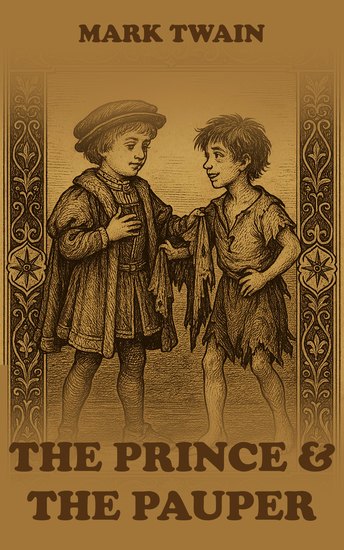
The Prince and the Pauper - cover

The Prince and the Pauper

Mark Twain

Publisher: CLXBX

  • 0
  • 0
  • 0

Summary

"The Prince and the Pauper" by Mark Twain is a timeless historical novel that explores identity, justice, and social inequality through a compelling tale of mistaken identities. Set in 16th-century England, the story follows two boys who are identical in appearance but worlds apart in circumstance—Prince Edward, heir to the English throne, and Tom Canty, a poor boy raised in the streets of London.

When the two boys meet by chance and exchange clothes as a game, they accidentally switch lives. Tom finds himself thrust into the rigid and dangerous world of royal court politics, while Edward is cast into poverty, forced to survive among the very people he is destined to rule. Through their parallel journeys, Twain exposes the stark contrasts between privilege and hardship, revealing how social systems shape behavior and opportunity.

As Edward experiences cruelty, injustice, and suffering firsthand, he gains compassion and wisdom that transform him into a more humane ruler. Meanwhile, Tom struggles to navigate royal expectations, relying on intelligence and restraint to survive among powerful adults who doubt his sanity.

Written with warmth, humor, and moral insight, The Prince and the Pauper blends adventure with thoughtful social commentary. Twain's vivid portrayal of Tudor England, combined with his enduring concern for fairness and human dignity, makes the novel both entertaining and deeply meaningful.

Beloved by readers of all ages, The Prince and the Pauper remains one of Mark Twain's most accessible and socially conscious works. It is an essential classic for anyone interested in historical fiction, coming-of-age stories, and timeless tales of empathy and justice.
Available since: 02/06/2026.
Print length: 234 pages.

Other books that might interest you

  • The Longest Journey - cover

    The Longest Journey

    E. M. Forster

    • 0
    • 0
    • 0
    Bookish, sensitive, and given to wild enthusiasms, Rickie Elliot is virtually made for a life at Cambridge, where he can subsist on a regimen of biscuits and philosophical debate. But the love-smitten Rickie leaves his natural habitat to marry the devastatingly practical Agnes Pembroke, who brings with her, as a sort of dowry, a teaching position at the abominable Sawston School. 
    Out of this misalliance comes Forster's most stylistically daring novel. As it follows Rickie from the comforts of Cambridge to the petty intrigues of Sawston to the lush, haunted environs of rural Wiltshire, The Longest Journey gives us a comic yet immensely moving vision of a country split between pragmatism and imagination, sober conformity and redemptive eccentricity, upright Christianity and delirious paganism. 
    This, the author's own favorite of his works, is an introspective novel of manners at once comic and tragic.
    Show book
  • Emma - cover

    Emma

    Jane Austen

    • 0
    • 0
    • 0
    Emma, is a novel about youthful hubris and romantic misunderstandings. It is set in the fictional country village of Highbury and the surrounding estates of Hartfield, Randalls and Donwell Abbey, and involves the relationships among people from a small number of families. The novel was first published in December 1815, with its title page listing a publication date of 1816. As in her other novels, Austen explores the concerns and difficulties of genteel women living in Georgian–Regency England. Emma is a comedy of manners, and depicts issues of marriage, sex, age, and social status.Before she began the novel, Austen wrote, "I am going to take a heroine whom no one but myself will much like."  In the first sentence, she introduces the title character as "Emma Woodhouse, handsome, clever, and rich, with a comfortable home and a happy disposition... had lived nearly twenty-one years in the world with very little to distress or vex her." Emma is spoiled, headstrong, and self-satisfied; she greatly overestimates her own matchmaking abilities; she is blind to the dangers of meddling in other people's lives; and her imagination and perceptions often lead her astray.Emma, written after Austen's move to Chawton, was her last novel to be published during her lifetime, while Persuasion, the last complete novel Austen wrote, was published posthumously.The novel has been adapted for a number of films, television programmes and stage plays.Jane Austen was an English novelist known primarily for her six major novels, which interpret, critique, and comment upon the British landed gentry at the end of the 18th century. Austen's plots often explore the dependence of women on marriage in the pursuit of favorable social standing and economic security. Her works critique the novels of sensibility of the second half of the 18th century and are part of the transition to 19th-century literary realism.
    Show book
  • The Adventures of Sherlock Holmes - Step into 221B Baker Street for a gripping historical Mystery Join the world's greatest consulting detective as he unravels baffling crimes and daring plots in Victorian London's darkest shadows - cover

    The Adventures of Sherlock...

    Arthur Conan Doyle

    • 0
    • 0
    • 0
    The game is afoot. Dive into the foggy, gas-lit alleys of Victorian London, where no crime is too complex for the ultimate master of deduction. 
    From scandalous royal secrets to bizarre underground leagues, the city's official police force is utterly baffled. Enter Sherlock Holmes, the world's only consulting detective, alongside his loyal friend and chronicler, Dr. John H. Watson. Together, they navigate the treacherous underworld and high-society drawing rooms of England. Armed with razor-sharp intellect, unparalleled observational skills, and a penchant for the bizarre, Holmes tackles the seemingly impossible. But with adversaries ranging from cunning blackmailers to ruthless bank robbers, one misstep could prove fatal for the iconic duo. The stakes are high, the danger is real, and the clues are hidden in plain sight. 
    Why you will love this classic mystery: If you crave intricately plotted whodunits, brilliant amateur sleuths, atmospheric gaslamp thrillers, and twisty deductive logic, this timeless collection will hold you spellbound. Fans of historical crime fiction, police procedurals, and cerebral mysteries will find themselves mesmerized as Holmes pieces together the puzzles that nobody else can. 
    Arthur Conan Doyle (1859–1930) was a Scottish writer and physician whose unparalleled creation of Sherlock Holmes forever revolutionized the detective genre. His works remain some of the most widely read and influential literary masterpieces in the history of crime fiction.
    Show book
  • The Unparrelled invasion - From their pens to your ears genius in every story - cover

    The Unparrelled invasion - From...

    Jack London

    • 0
    • 0
    • 0
    John Griffith Chaney was born on January 12th, 1876 in San Francisco.   
    His father, William Chaney, was living with Flora Wellman when she became pregnant.  Chaney insisted she have an abortion.  Flora's response was to turn a gun on herself.  Although her wounds were not severe the trauma made her temporarily deranged. 
    In late 1876 his mother married John London and the young child was brought to live with them as they moved around the Bay area, eventually settling in Oakland where now, calling himself Jack, he completed grade school. 
    Jack worked hard at several jobs, sometimes 12-18 hours a day, but his dream was university.  He studied hard and borrowed the money to enrol in the summer of 1896 at the University of California in Berkeley. 
    In 1897, at 21, Jack searched out newspaper accounts of his mother's suicide attempt and for the name of his biological father. He wrote to Chaney, then living in Chicago, who claimed he could not be Jack’s father because he was impotent and casually asserted that London's mother had relations with other men.  Jack, devastated by the response, quit Berkeley and went to the Klondike. Other accounts suggest that his dire finances presented Jack with the excuse he needed to leave. 
    In the Klondike Jack began to gather material for his writing but also accumulated many health problems, including scurvy, which together with hip and leg problems he would carry for the rest of his life. 
    During the late 1890's Jack was regularly publishing short stories and by the turn of the century full blown novels. 
    By 1904 Jack had married, fathered two children and was now in the process of divorcing.  A stint as a reporter on the Russo-Japanese war of 1904 was equal amounts trouble and experience. But that experience was always put to good use in a continuing and remarkable output of work. 
    In 1905 he married Charmian Kittredge who at last was a soul and companion who brought him some semblance of peace despite his advancing alcoholism and his incurable wanderlust. 
    Twelve years later Jack had amassed both wealth and a literary reputation through such classics as ‘The Call of the Wild’, ‘White Fang’ and many others. He had a reputation as a social activist and was a tireless friend of the workers.   
    Jack London died suffering from dysentery, late-stage alcoholism and uremia, aged only 40, on November 22nd 1916 at his property in Glen Elen in California.
    Show book
  • The Remarkable Rocket - cover

    The Remarkable Rocket

    Oscar Wilde

    • 0
    • 0
    • 0
    At a royal wedding celebration, a group of fireworks discuss life, philosophy and politics. One supercilious rocket considers himself to be particularly "remarkable". A witty fable on the subject of vanity, The Remarkable Rocket was first published in The Happy Prince and Other Tales in 1888.
    Show book
  • The Monk and the Hangman's Daughter - Classic Tales Edition - cover

    The Monk and the Hangman's...

    Ambrose Bierce

    • 0
    • 0
    • 0
    A knot of monks happens upon a gallows in the middle of a dark forest. Hanging from the gallows is a fresh corpse, and underneath the dangling wretch a young woman performs a haunting dance. When Ambrosius falls in love with this outcast woman, his efforts to suppress his natural feelings result in a gradual descent toward calamity and tragedy.  Bierce’s subtle transformation of the monk Ambrosius from innocent monk to violent zealot is masterfully done, ranking this among Bierce’s finest achievements.
    Show book