¡Acompáñanos a viajar por el mundo de los libros!
Añadir este libro a la estantería
Grey
Escribe un nuevo comentario Default profile 50px
Grey
Suscríbete para leer el libro completo o lee las primeras páginas gratis.
All characters reduced
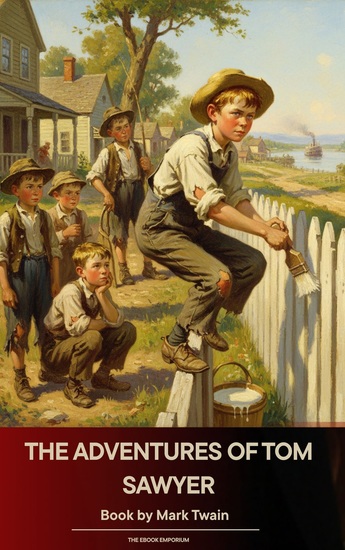
The Adventures of Tom Sawyer - cover

The Adventures of Tom Sawyer

Mark Twain

Editorial: The Ebook Emporium

  • 0
  • 0
  • 0

Sinopsis

"To make a man or a boy covet a thing, it is only necessary to make the thing difficult to attain."

a clever, imaginative, and hopelessly rebellious boy with a talent for avoiding work and a hunger for glory. Whether he's tricking his friends into painting a fence for him, hunting for buried treasure with the social outcast Huckleberry Finn, or trying to win the heart of the lovely Becky Thatcher, Tom's life is a whirlwind of "splendid" schemes. But the games of childhood turn deadly serious when Tom and Huck witness a midnight crime in a graveyard. Forced to grow up faster than he intended, Tom must navigate the dangers of the villainous Injun Joe and the terrifying depths of McDougal's Cave. Twain's masterpiece is a warm, witty, and sometimes dark exploration of the joys and terrors of growing up.

The famous whitewashing scene is more than just a funny story; it is a brilliant observation of human psychology. Tom's ability to turn a chore into a privilege is the hallmark of his character—a youthful entrepreneur of fun who understands that value is often a matter of perspective.

Twain expertly weaves the local myths of the 1840s into the narrative. From "curing" warts with dead cats to the belief in haunted houses, the novel captures a specific moment in American history where the boundary between the real world and the supernatural was thin and thrilling.

While its sequel, Huckleberry Finn, is more cynical and political, The Adventures of Tom Sawyer is a love letter to the imagination. It reminds us of a time when a forest could be a pirate's cove and a rainy afternoon could be the setting for a grand tragedy. It remains essential for readers of all ages who want to reconnect with the spirit of adventure.

Rediscover the magic of the river. Purchase "The Adventures of Tom Sawyer" today.
Disponible desde: 20/01/2026.
Longitud de impresión: 248 páginas.

Otros libros que te pueden interesar

  • A Saga of the Seas - From their pens to your ears genius in every story - cover

    A Saga of the Seas - From their...

    Kenneth Grahame

    • 0
    • 0
    • 0
    Kenneth Grahame was born on 8th March 1859 in Edinburgh. 
    At age 5 his mother succumbed to puerperal fever.  His father, who had a drinking problem, now sent his 4 children to live with their grandmother at her large house in Cookham, Berkshire. Here the children lived in large open grounds next to the river.  These early experiences would in later years, be retold in his writing through a myriad of characters. 
    Grahame loved being a pupil at St Edward's School, Oxford and wanted to enroll at the university there but his guardian demurred on account of the cost. 
    Instead, a banking career was chosen for him, starting in 1879 at the Bank of England, where he rose steadily to the rank of its Secretary until retiring, with a pension, in 1908 due to ill health. 
    Alongside his commercial career Grahame had written and published various stories and essays in several periodicals. Some were anthologized as ‘Pagan Papers’ in 1893, and two years later ‘The Golden Age’ and later still ‘Dream Days’ and its masterpiece ‘The Reluctant Dragon’ became part of many home libraries.  His ability to view life through the lens of a young and curious child was superb, enabling the reader to easily identify with the character.   
    Grahame married Elspeth Thomson in 1899 and they had one child; Alastair, born semi-blind and plagued by health problems.  In a heart-rending tragedy he would later take his own life whilst attending Oxford University in 1920.   
    In 1908 Grahame reworked many of the bedtime stories he had fashioned for his son into the enduring favourite; ‘The Wind in the Willows’, describing the heart-warming adventures of Mr Toad and his friends.   
    Kenneth Grahame died in Pangbourne, Berkshire, on 6th July 1932.
    Ver libro
  • Captain Rogers - From their pens to your ears genius in every story - cover

    Captain Rogers - From their pens...

    W Jacobs

    • 0
    • 0
    • 0
    William Wymark Jacobs was born on 8th September 1863 in Wapping, East London.  
    He was educated at a private school and then Birkbeck Literary and Scientific Institution, now part of the University of London. 
    In 1879, Jacobs began work as a clerk in the civil service, in the Post Office Savings Bank.  In 1885 his first short story was published but it was not until almost the turn of the century that he would abandon his post office career to that as a full-time writer. By then he was a very popular author, his collections selling extremely well and with an excellent income. 
    His best-known work is the macabre ‘The Monkey's Paw’ and he is also highly regarded for his ghost stories although much of his remaining short story output is streaked with humour.  His characters are immediately identifiable and we all know that life will take chunks out of them in no time at all.  
    Jacobs married the noted suffragette Agnes Eleanor Williams in 1900 at West Ham, Essex. They went on to have two daughters and three sons as they settled down to life.  
    By the outbreak of the First World War his literary output had declined and he now mainly spent his time rewriting his earlier stories for the stage.  In all he wrote 18 plays. 
    W W Jacobs died on 1st September 1943 at Hornsey Lane, Islington in London. He was 79.
    Ver libro
  • Nana - cover

    Nana

    Émile Zola

    • 0
    • 0
    • 0
    "Nana" by Émile Zola is a novel that explores the decadence and moral decay of Parisian society in the 19th century. It follows the life of Nana, a beautiful and ambitious young woman, as she navigates the social and economic challenges of her time. The novel provides a vivid portrayal of the excesses and corruption of the Second Empire, using Nana as a symbol of the destructive influence of unchecked desire and hedonism.
    Ver libro
  • The Eater of Souls - cover

    The Eater of Souls

    Henry Kuttner

    • 0
    • 0
    • 0
    "The Eater of Souls" by Henry Kuttner tells the story of Sindara, the ruler of Bel Yarnak, who confronts a monstrous entity known as the Eater of Souls. This entity's call has been drawing his people to their deaths in the Gray Gulf of Yarnak. Sindara, rejecting the advice of his necromancers and hydromancers, turns to his god, Vorvadoss, for help. After a harrowing battle, Sindara undergoes a horrific transformation, merging with the Eater of Souls to break the cycle of despair. The story ends with his tragic descent into darkness, forever separated from the beauty of his homeland.
    Ver libro
  • Les Misérables: Volume 4: The Idyll in the Rue Plumet and the Epic in the Rue St Denis - Book 2: Éponine (Unabridged) - cover

    Les Misérables: Volume 4: The...

    Victor Hugo

    • 0
    • 0
    • 0
    Victor-Marie Hugo (26 February 1802 - 22 May 1885) was a French poet, novelist, essayist, playwright, and dramatist of the Romantic movement. During a literary career that spanned more than sixty years, he wrote abundantly in an exceptional variety of genres: lyrics, satires, epics, philosophical poems, epigrams, novels, history, critical essays, political speeches, funeral orations, diaries, and letters public and private, as well as dramas in verse and prose.
    BOOK 2: ÉPONINE: Marius had witnessed the unexpected termination of the ambush upon whose track he had set Javert; but Javert had no sooner quitted the building, bearing off his prisoners in three hackney-coaches, than Marius also glided out of the house. It was only nine o'clock in the evening.
    Ver libro
  • At the Villa Rose - cover

    At the Villa Rose

    Edward Woodley Mason

    • 0
    • 0
    • 0
    ""At the Villa Rose" is a captivating detective novel written by the British author A. E. W. Mason in 1910. It marks the debut of his character, Inspector Hanaud. The story unfolds against the backdrop of Aix-les-Bains, a picturesque French town.    Here's a glimpse into the intriguing plot:    The Crime: A wealthy widow named Mme Dauvray is found murdered at the Villa Rose. Her valuable jewels have vanished, and her maid, Hélène Vauquier, lies unconscious, chloroformed, and bound.  The Suspects: Suspicion falls on Mme Dauvray's young English companion, Celia Harland, who has mysteriously disappeared. Celia is in love with a fellow Englishman, Harry Wethermill, who pleads with Inspector Hanaud to prove her innocence.  Spiritualism and Deception: Mme Dauvray was fascinated by spiritualism, and Celia's role included staging séances for her. But beneath the veneer of mediumship lies trickery.  The Cunning Criminal: Enter Adèle Tacé, a seasoned criminal who arrives in Aix with the intent to steal Mme Dauvray's jewels. She goads the widow into holding a séance, where Celia is expected to perform while bound hand and foot.  The Unexpected Twist: Celia becomes a prisoner during the séance, and her life takes a dark turn. The true identity of the murderer remains shrouded in mystery.  Abduction and Pursuit: Celia is abducted and taken to Geneva, kept alive only to reveal the hidden location of the stolen jewels.  The Unraveling: As the investigation unfolds, Inspector Hanaud navigates deception, love, and betrayal to unmask the killer.  "At the Villa Rose" weaves together elements of suspense, illusion, and human frailty, making it a compelling read. The novel's success led to adaptations as a stage play and several films."
    Ver libro