Join us on a literary world trip!
Add this book to bookshelf
Grey
Write a new comment Default profile 50px
Grey
Subscribe to read the full book or read the first pages for free!
All characters reduced
Pudd'nhead Wilson - cover

Pudd'nhead Wilson

Mark Twain

Publisher: CLXBX

  • 0
  • 0
  • 0

Summary

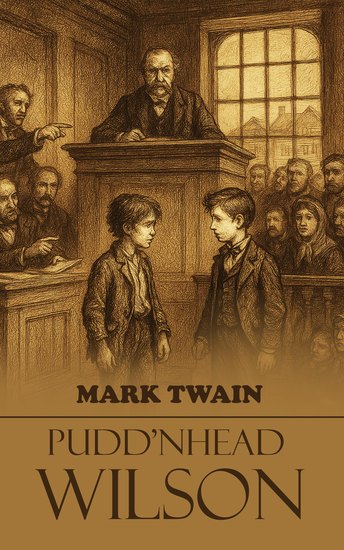
"Pudd'nhead Wilson" by Mark Twain is a bold, darkly comic novel that blends satire, mystery, and social critique into one of the author's most provocative works. Set in a small Missouri town along the Mississippi River, the story explores identity, race, and morality in pre–Civil War America through a gripping and unconventional narrative.

The novel centers on David "Pudd'nhead" Wilson, a sharp-minded lawyer whose reputation is ruined early in life after a misunderstood remark leads the townspeople to dismiss him as a fool. Living on the margins of society, Wilson spends his time collecting fingerprints—an unusual hobby that later proves crucial to unraveling a shocking crime.

Running parallel to Wilson's story is the powerful and unsettling tale of two boys—one born enslaved and the other born free—who are secretly switched at birth by a desperate mother. As they grow up, the consequences of this deception expose the absurdity and cruelty of racial classifications and social hierarchies. Twain uses this dramatic premise to challenge the idea that race determines character, intelligence, or worth.

Part courtroom drama, part social satire, Pudd'nhead Wilson examines how prejudice, hypocrisy, and rigid social norms distort justice and human relationships. Twain's use of fingerprint evidence—one of the earliest appearances of forensic science in fiction—adds a surprising modern element to the story.

Serious, unsettling, and often ironic, Pudd'nhead Wilson stands apart from Twain's more lighthearted novels, revealing his willingness to confront the moral failures of American society. It is an essential read for lovers of classic literature, social commentary, and thought-provoking fiction that remains strikingly relevant today.
Available since: 02/06/2026.
Print length: 176 pages.

Other books that might interest you

  • Emma - cover

    Emma

    Jane Austen

    • 0
    • 0
    • 0
    "I am going to take a heroine whom no one but myself will much like." — Jane Austen
    
    Emma Woodhouse is perfectly content with her life in the quiet village of Highbury. Wealthy, independent, and perhaps a bit too sure of her own judgment, she occupies her time by orchestrating the romantic lives of those around her. However, her well-intentioned meddling—particularly with her protégé, Harriet Smith—leads to a comedy of errors that threatens the happiness of her friends and herself. As Emma navigates a maze of social blunders and misplaced affections, she must confront the wisdom of her longtime friend and mentor, Mr. Knightley, and finally recognize the true desires of her own heart.
    
    The Art of the "Comedy of Manners": Austen's sharp wit shines as she satirizes the social pretensions and gossip of 19th-century provincial life. Through Emma's eyes, we see a world where a misunderstood glance or a misinterpreted letter can change a person's fate. It is a brilliant study of human nature that remains as relevant today as it was in the Regency era.
    
    A Heroine's Growth: Unlike many romantic leads of her time, Emma doesn't need to marry for money or status. Her journey is internal—it is a transformation from a spoiled, self-important young woman into a mature adult who understands the weight of her influence on others. The tension between her and the stoic, honorable George Knightley provides one of the most satisfying "slow-burn" romances in fiction.
    
    Rediscover the wit and warmth of Austen's most playful work. Purchase "Emma" today.
    Show book
  • The Wind in the Rose-Bush - And Other Supernatural Stories - cover

    The Wind in the Rose-Bush - And...

    Mary Wilkins

    • 0
    • 0
    • 0
    Ford Village has no railroad station, being on the other side of the river from Porter’s Falls, and accessible only by the ford which gives it its name, and a ferry line.The ferry-boat was waiting when Rebecca Flint got off the train with her bag and lunch basket. When she and her small trunk were safely embarked she sat stiff and straight and calm in the ferry-boat as it shot swiftly and smoothly across stream. There was a horse attached to a light country wagon on board, and he pawed the deck uneasily. His owner stood near, with a wary eye upon him, although he was chewing, with as dully reflective an expression as a cow. Beside Rebecca sat a woman of about her own age, who kept looking at her with furtive curiosity; her husband, short and stout and saturnine, stood near her. Rebecca paid no attention to either of them. She was tall and spare and pale, the type of a spinster, yet with rudimentary lines and expressions of matronhood. She all unconsciously held her shawl, rolled up in a canvas bag, on her left hip, as if it had been a child. She wore a settled frown of dissent at life, but it was the frown of a mother who regarded life as a forward child, rather than as an overwhelming fate. Listen and enjoy.
    Show book
  • A Simple Heart - cover

    A Simple Heart

    Gustave Flaubert

    • 0
    • 0
    • 0
    She lived in the shadow of others—quietly, dutifully, without question. Her world was small: a kitchen hearth, the rhythm of chores, a parrot who would outlive most dreams. But in that stillness, something vast took root. A devotion so complete, it blurred the line between the sacred and the simple.
    This story doesn't shout. It listens. It watches. It waits.
    And by the time it's done, you'll understand how the softest hearts carry the heaviest truths.
    Show book
  • Sketches by Seymour - Cockney Sportsmen Drawn from Life - cover

    Sketches by Seymour - Cockney...

    Robert Seymour

    • 0
    • 0
    • 0
    Cockney sporting sketches - the amateur angler, the militia man, the fellow on a horse he cannot manage - drawn by the artist who proposed the idea that became The Pickwick Papers. Seymour shot himself after the second number, and Dickens took the project over. Its 80 original illustrations have been carefully restored and coloured for this edition.
    Show book
  • War and Peace - cover

    War and Peace

    Lev Nikolayevich Tolstoy

    • 0
    • 0
    • 0
    One of the greatest novels ever written, blending personal stories with sweeping historical events.
    
    Set during the Napoleonic Wars, the novel follows the lives of families whose hopes, struggles, romances, and ambitions unfold against the backdrop of war and political upheaval.
    
    Rich in emotional depth and historical detail, the story explores themes of fate, love, power, sacrifice, and the meaning of life.
    
    Written by Leo Tolstoy.
    
    Step into a monumental story of humanity and history—download your copy today.
    Show book
  • From the Earth to the Moon - cover

    From the Earth to the Moon

    Jules Verne

    • 0
    • 0
    • 0
    Before humanity reached the Moon, Jules Verne imagined what it might take to get there.
    
    In From the Earth to the Moon, Jules Verne presents one of the pioneering works of science fiction and one of literature's most imaginative visions of lunar exploration. When the ambitious members of the Baltimore Gun Club decide to launch a projectile toward the Moon, their extraordinary plan sets an unforgettable adventure into motion.
    
    Led by the determined Impey Barbicane, the group begins tackling the enormous scientific and engineering challenges involved in their lunar project. Their plans attract worldwide attention and bring together remarkable personalities, ambitious inventors, and unexpected complications.
    
    Blending science fiction, adventure, humor, engineering, and scientific speculation, Verne transforms a seemingly impossible idea into an entertaining and surprisingly detailed vision of space travel. His fascination with technology and scientific progress gives the story its distinctive sense of wonder.
    
    The novel explores enduring themes of human curiosity, technological innovation, exploration, ambition, scientific discovery, and the desire to push beyond known boundaries. Verne's imaginative approach makes the Moon feel both distant and tantalizingly within reach.
    
    First published in the nineteenth century, From the Earth to the Moon became one of Jules Verne's most influential works and helped establish the imaginative tradition of space adventure that continues to inspire readers and creators today.
    
    Join the daring expedition that attempts to reach the Moon from Earth. Download From the Earth to the Moon today and experience Jules Verne's visionary classic of science, adventure, innovation, and exploration.
    Show book