Join us on a literary world trip!
Add this book to bookshelf
Grey
Write a new comment Default profile 50px
Grey
Subscribe to read the full book or read the first pages for free!
All characters reduced
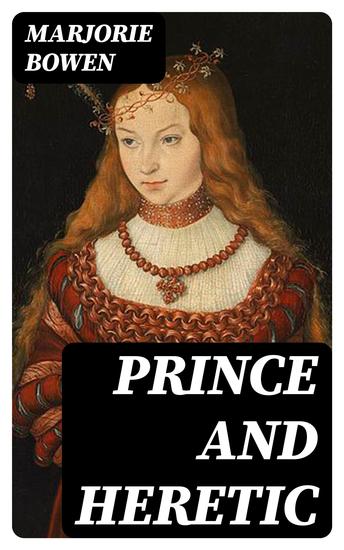
Prince and Heretic - cover

Prince and Heretic

Marjorie Bowen

Publisher: DigiCat

  • 0
  • 0
  • 0

Summary

In Marjorie Bowen's captivating historical novel, "Prince and Heretic," readers are transported to the tumultuous religious and political landscape of 16th-century Europe. With her signature fluid prose and rich characterizations, Bowen intricately weaves the story of Prince Edward of England and the complexities of his faith amid the rise of Protestantism and Catholic opposition. The novel serves not only as a historical fiction piece but also as a poignant exploration of the human heart's contention with duty, belief, and desire, deftly propelling the narrative through the intricate interplay of personal and public stakes that defined the era. Marjorie Bowen, known for her prolific contributions to historical fiction, often drew inspiration from the turbulent epochs of history, reflecting her fascination with the moral dilemmas faced by individuals against grand narratives of power. Born in 1885, Bowen lived through significant societal changes and was deeply influenced by her scholarly family background, which cultivated her interest in historical themes and characters who dared to challenge the status quo. This rich context informs her nuanced portrayal of Edward, illuminating the struggles between faith and governance. "Prince and Heretic" is a must-read for those who appreciate a compelling narrative fused with historical depth and emotional resonance. Bowen's exploration of faith, identity, and the conflicts that arise from them offers profound insights for contemporary readers, making the book a remarkable meditation on the timeless struggles between tradition and change.
Available since: 09/15/2022.
Print length: 283 pages.

Other books that might interest you

  • The Last Of The Mohicans - cover

    The Last Of The Mohicans

    James Fenimore Cooper

    • 0
    • 0
    • 0
    Set during the French and Indian War, "The Last of The Mohicans" is one of James Fenimore Cooper's most enduring works, part of his Leatherstocking Tales series. The novel follows Natty Bumppo, known as Hawkeye, and his Mohican companions Chingachgook and Uncas as they navigate the dangers of a war-torn wilderness. Their journey intertwines with the fates of two British sisters, Alice and Cora Munro, leading to thrilling adventures, battles, and acts of heroism. Through rich and vivid descriptions of the American frontier, Cooper explores complex themes of cultural conflict, love, loyalty, and identity.
    Show book
  • 'Til the Well Runs Dry - A Novel - cover

    'Til the Well Runs Dry - A Novel

    Lauren Francis-Sharma

    • 0
    • 0
    • 0
     “As universally touching as it is original” this saga of love and family secrets sweeps from the 1940s to the 1960s in Trinidad and the United States (The New York Times).In a seaside village in the north of Trinidad, young Marcia Garcia, a gifted and smart-mouthed sixteen-year-old seamstress, lives alone, raising two small boys and guarding a family secret. When she meets Farouk Karam, an ambitious young policeman, so taken with Marcia that he elicits help from a tea-brewing obeah woman to guarantee her ardor, the rewards and risks in Marcia's life amplify forever. 'Til the Well Runs Dry sees Marcia and Farouk from their sassy and passionate courtship through personal and historical events that threaten Marcia's secret, entangle the couple and their children in a tumultuous scandal, and put the future in doubt for all of them. With this deeply human novel, Lauren Francis-Sharma gives us an unforgettable story about a woman's love for a man, a mother's love for her children, and a people's love for an island rich with calypso and Carnival, cricket and salty air, sweet fruits and spicy stews-a story of grit, imperfection, steadfast love and of Trinidad that has never been told before.“Lauren Francis-Sharma's talent shines.” ―USA Today“You'll hear the calypso music in this vivid debut.” ―People  “[A] spellbinding, intimately detailed, psychologically lush, and suspenseful tale.” ―Booklist, starred review“A saga ripe with heartbreak and joy . . . rich and satisfying.” ―Kirkus Reviews“Lauren Francis-Sharma takes us to the island of Trinidad, the ‘Land of the hummingbird,' in a story that feels like a song, with a chorus of voices across generations.” ―Henry Louis Gates, Jr., Alphonse Fletcher University Professor, Harvard University
    Show book
  • The Witchfinder’s Assistant - cover

    The Witchfinder’s Assistant

    Ruth Goldstraw

    • 0
    • 0
    • 0
    ⭐⭐⭐⭐⭐'Beautifully written and a thoroughly absorbing read. I found it impossible to put down' Deborah Carr, USA Today Bestseller 
    THE TOWN OF WEM, SHROPSHIRE 1643 
    Civil war is ripping England apart. 
    Families are divided, emotions run high. 
    Whether on the bleakness of the moors or in snug, wood-panelled rooms, danger lurks. 
    A body is found, its mouth pierced with thorns. 
    The Justice of the Peace, a godly man, is certain that witchcraft is involved. 
    Only his assistant, former cavalryman John Carne, looks for reason where others see demons and witches. 
    But John has secrets of his own – secrets that concern his cold and distant wife. And it’s not long before the darkness that has engulfed Wem grows darker still…Readers are loving The Witchfinder's Assistant: 
    ⭐⭐⭐⭐⭐'Fascinating… a thoroughly enjoyable and entertaining read' 
    ⭐⭐⭐⭐⭐'The final denouement was a surprise, and was told in a thrilling and interesting manner. Wickedness can sometimes be hidden behind a fair face. I enjoyed it very much' 
    ⭐⭐⭐⭐⭐'A well researched and intriguing look at England in 1643…Goldstraw's an excellent storyteller- this one pulled me in and kept me reading' 
    ⭐⭐⭐⭐'Engaging and absorbing…an historical novel for our own times' 
    ⭐⭐⭐⭐'The historical setting is richly detailed, and Goldstraw does an excellent job of capturing the tension and paranoia of the time' 
    The supernatural and occult stories of the 19th-century era in Wem become a labyrinth for John Carne to navigate. As he delves deeper, he finds that the paranormal is more intertwined with his life than he could have ever imagined. 
    For fans of Elena Collins (The Wicked Lady), William Boyd (The Predicament), Sarah Woodbury (This Small Corner of Time), David Field (Beyond The Setting Sun), and Giles Kristian (Arthur). 
    HarperCollins 2024
    Show book
  • White Horizon - cover

    White Horizon

    T.K. Blackwood

    • 0
    • 0
    • 0
    The year is 1992. 


    The Soviet Blitzkrieg in Germany has been beaten to a bloody halt along the Rhine River. The Reds rush masses of teenage conscripts and rusty reservists to the front, while NATO scrambles to mount a killing blow against their reeling nemesis. 


    The flames of war spread north to Scandinavia, embroiling Sweden and threatening Norway. In this grinding war of attrition, both sides endure, and the death toll mounts. Is a breakthrough at hand or has the carnage only begun?
    Show book
  • Jerusalem Delivered - cover

    Jerusalem Delivered

    Torquato Tasso

    • 0
    • 0
    • 0
    The First Crusade provides the backdrop for a rich tapestry of political machinations, military conflicts, martial rivalries, and love stories, some of which are complicated by differences in religion. The supernatural plays a major role in the action. Partly on this account, and partly because of the multilayered, intertwined plots, the poem met with considerable contemporary criticism, so Tasso revised it radically and published the revision under a new name, La Gerusalemme Conquistata, or "Jerusalem Conquered," which has remained virtually unread, a warning to authors who pay attention to the critics.The original poem influenced Edmund Spenser, whose unfinished epic, The Faerie Queene, is still more complicated in plot than Tasso's poem and, being an allegory, affords the supernatural an even greater share in the action. In Milton's Paradise Lost, the council in hell (first half of Book II) owes much to Tasso's similar scene in Book IV. (Someone with sufficient background in Old English might profitably compare the tirade of Satan in Book IV to the remarkably similar speech of Satan in the Anglo-Saxon Genesis.) Moreover, Milton's decision to write in English rather than in Latin, then the language of international discourse, was due in part to his visit to Tasso's patron, Giovanni Battista Manso, who advised him as he had advised Torquato Tasso before him, to dignify his native language by employing his talents in bold defiance of custom and precedent. Had Petrarch had the benefit of Manso's advice, his great epic, The Africa, might now eclipse his off-hour doodlings, the sonnets about Laura.The text is the Gutenberg Project's version, corrected in certain places by consulting editions, also in the public domain, published in 1749, 1844, 1845, and 1901; A Dictionary of the Italian and English Languages, by Joseph Baretti (Venice, 1795); The Oxford English Dictionary; and an edition of La Gerusaleme liberata itself (Paris: Victor Masson, 1836).(Summary by Thomas A. Copeland)
    Show book
  • My Land of Freedom - A poem of war and freedom - cover

    My Land of Freedom - A poem of...

    Ifeanyi Njoku

    • 0
    • 0
    • 0
    This poem is a powerful reflection on war, displacement, and the struggle for freedom. It tells the tragic story of a people who fought for liberation but were met with violence, loss, and eventual surrender. Likely referencing the Igbo experience during the Nigerian Civil War, it captures the pain of oppression and the resilience of those who endured it. 
    The poem begins with a contradiction: "In my land of freedom, I walked with fear." This highlights the irony of living in a place meant to be free but being consumed by anxiety. The people demand justice, yet their cries are silenced by violence. The line "Killing our brothers, and leaving us undone" conveys both physical loss and emotional devastation. 
    The imagery of "scorching soil" and "separated from families" paints a picture of suffering and displacement. War does not just take lives—it tears families apart and leaves hearts unable to thrive. The mention of "refugee camps" emphasizes how many were forced from their homes, left to question their identity: "Are we unlucky, to be Igbo?" This speaks to a deep sense of abandonment and injustice. 
    The poem also highlights betrayal, as leaders fail to protect their people. "Everyone was a soldier, in this war we couldn't win." This line captures the grim reality of a war where survival itself was a battle. Despite their bravery, they were up against overwhelming forces. 
    The final lines are heartbreaking: "We had to surrender, and say goodbye to our pride." This is not just a loss of battle but a loss of dignity. Yet, even in surrender, their story lives on. This poem is a tribute to resilience, a reminder of suffering, and a call to remember those who fought, even when the world turned away.
    Show book