Unisciti a noi in un viaggio nel mondo dei libri!
Aggiungi questo libro allo scaffale
Grey
Scrivi un nuovo commento Default profile 50px
Grey
Iscriviti per leggere l'intero libro o leggi le prime pagine gratuitamente!
All characters reduced
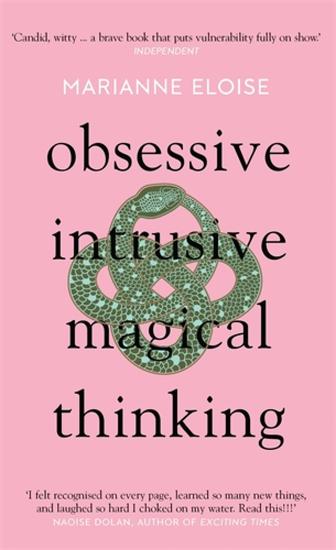
Obsessive Intrusive Magical Thinking - cover

Obsessive Intrusive Magical Thinking

Marianne Eloise

Casa editrice: Icon Books

  • 0
  • 1
  • 0

Sinossi

'I FELT RECOGNISED ON EVERY PAGE, LEARNT SO MANY NEW THINGS, AND LAUGHED SO HARD I CHOKED ON MY WATER. READ THIS!!!' NAOISE DOLAN, AUTHOR OF EXCITING TIMES

'CANDID, WITTY ... A BRAVE BOOK THAT PUTS VULNERABILITY FULLY ON SHOW'  INDEPENDENT


Obsessive was, still is, my natural state, and I never wondered why. I didn't mind, didn't know that other people could feel at peace. I always felt like a raw nerve, but then, I thought that everyone did.

Writer and journalist Marianne Eloise was born obsessive. What that means changes day to day, depending on what her brain latches onto: fixations with certain topics, intrusive violent thoughts, looping phrases. Some obsessions have lasted a lifetime, while others will be intense but only last a week or two.
Obsessive, Intrusive, Magical Thinking is a culmination of a life spend obsessing, offering a glimpse into Marianne's brain, but also an insight into the lives of others like her. From death to Medusa, to Disneyland to fire, to LA to her dog, the essays explore the intersection of neurodivergence, fixation and disorder, telling the story of one life underpinned and ultimately made whole by obsession.
Disponibile da: 07/04/2022.
Lunghezza di stampa: 288 pagine.

Altri libri che potrebbero interessarti

  • Epicurus - Pleasure Atoms and the Good Life - cover

    Epicurus - Pleasure Atoms and...

    Hector Davidson

    • 0
    • 0
    • 0
    Epicurus, a Greek philosopher born in 341 BCE on the island of Samos, founded the school of philosophy known as Epicureanism, which emphasized the pursuit of happiness through the cultivation of pleasure and the avoidance of pain. His teachings were revolutionary for their focus on the individual’s inner peace and well-being, rather than devotion to the gods or the pursuit of wealth and power. Epicurus advocated for a life of simple pleasures, good friendships, and intellectual contemplation, arguing that these were the true sources of happiness. 
      
    His philosophy was grounded in atomism, the belief that everything in the universe is made up of small, indivisible particles, or atoms, moving through the void. For Epicurus, the natural world was not governed by divine intervention, but by laws that could be understood through reason and observation. He believed that by understanding the workings of nature, individuals could free themselves from irrational fears, especially the fear of death and the gods. 
      
    Epicurus placed great importance on pleasure, defining it not as indulgence in material excess, but as the absence of pain (ataraxia) and the pursuit of a serene and balanced life. He argued that physical and mental pleasures, when experienced in moderation, contributed to a life of tranquility. Furthermore, he saw pain not as an inherent part of life, but as something to be minimized or avoided through thoughtful living and wise choices.
    Mostra libro
  • Germany and the World Wars: The History and Legacy of the Germans’ Participation in History’s Biggest Conflicts - cover

    Germany and the World Wars: The...

    Charles River Editors

    • 0
    • 0
    • 0
    Not surprisingly, German unity in 1871 caused geopolitical ripples that reverberated for decades. Other larger European powers, such as Britain, France, and Russia, came to feel threatened by the rise of Germany. These tensions were still prevalent at the outbreak of World War I in 1914, and it became even more important in World War II. In part this was because Germany also became an economic powerhouse, fundamentally altering the global economy. Alongside the rapid expansion of the United States, trade went through a transformation that still has ramifications today. 
    Germany's defeat in World War I brought about the Weimar Republic, but Weimar has since become a byword for a failed, tragic, political experiment. The official period of its existence, 1919-1933, marked the interwar years in Germany and their related uncertainty, chaos, and the state’s ultimate collapse. Historians have found the roots of Nazism embedded in the Weimar years and that in the final analysis, Weimar politicians voluntarily handed over power to the man who wrought destruction on an epic scale, Adolf Hitler. This set the German nation irrevocably on the path towards World War II. That war would plunge much of the planet into an existential battle that ultimately cost an estimated 60 million lives.
    Mostra libro
  • A Measure Short of War - A Brief History of Great Power Subversion - cover

    A Measure Short of War - A Brief...

    William C. Wohlforth, Jill Kastner

    • 0
    • 0
    • 0
    In 2016, the United States was stunned by evidence of Russian meddling in the US presidential elections. But it shouldn't have been. Subversion—domestic interference to undermine or manipulate a rival—is as old as statecraft itself. The basic idea would have been familiar to Sun Tzu, Thucydides, Elizabeth I, or Bismarck. 


    It came as a surprise in 2016 because the sole superpower had fallen asleep at the wheel. But what's really new? Have we entered a new age of vulnerability? To answer these questions, and to protect ourselves against future subversion, we need a clear-eyed understanding of what it is and how it works. 


    In A Measure Short of War, Jill Kastner and William C. Wohlforth provide just that, taking the listener on a compelling ride through the history of subversion, exploring two thousand years of mischief and manipulation to illustrate subversion's allure, its operational possibilities, and the means for fighting back against it. With vivid examples from the ancient world, the great-power rivalries of the nineteenth century, epic Cold War struggles, and more, A Measure Short of War shows how prior technological revolutions opened up new avenues for subversion, and how some democracies have been fatally weakened by foreign subverters while others have artfully defended themselves—and their democratic principles.
    Mostra libro
  • Wired To Change - How Neuroplasticity Shapes Your Brain Habits And Life - cover

    Wired To Change - How...

    Brian Gibson

    • 0
    • 0
    • 0
    This audiobook is narrated by an AI Voice.   
    Unlock the astonishing power of your brain to rewire itself, transforming the way you think, act, and live. 
    Wired to Change is a groundbreaking guide that demystifies neuroplasticity, the brain's remarkable ability to adapt and evolve at any stage of life. Drawing on cutting-edge neuroscience, psychology, and practical strategies, this book empowers you to take charge of your mental pathways and rewrite the patterns that shape your daily behavior. 
    Whether you're looking to break free from limiting habits, cultivate resilience, or unlock peak performance, this book offers a science-backed roadmap to rewiring your brain for lasting change. You'll discover: 
    •	How thought patterns physically reshape your brain's neural architecture 
    •	The science of habit loops and how to reprogram them 
    •	Why mindset matters more than motivation 
    •	Tools to reduce anxiety, boost focus, and enhance emotional balance 
    •	Proven techniques to create meaningful, lasting personal growth 
    Wired to Change bridges the gap between science and self-transformation, offering insight and action. This book will leave you equipped and inspired to become the conscious architect of your mind. 
    You are not stuck. You are wired to change.
    Mostra libro
  • Policy Making - A Comprehensive Guide to Finding the Right Policies - cover

    Policy Making - A Comprehensive...

    Kevin Thorley

    • 0
    • 0
    • 0
    Policy making is a crucial aspect of governance that directly influences the well-being of citizens and the development of a nation. It is designed to promote the general welfare of the population, addressing issues such as health, education, and public safety to ensure that the needs of citizens are met. Economic policies play a significant role in managing the economy by promoting growth, reducing unemployment, and controlling inflation, which leads to a more stable and prosperous society. 
      
    Moreover, policy making is essential for reducing social inequalities by providing support to disadvantaged groups through measures related to housing, social security, and anti-discrimination. Environmental policies are also vital for the sustainable management of natural resources and the protection of ecosystems, addressing issues such as climate change, pollution, and conservation. In terms of national security, policies related to defense, immigration, and foreign relations are critical for maintaining security and protecting the country from external threats. 
      
    Policy making also encourages innovation and progress by funding research and development, supporting new technologies, and creating a favorable environment for entrepreneurship. It provides a framework for regulation and oversight, ensuring that industries operate fairly and safely, covering areas such as financial regulations, consumer protection laws, and labor standards. Additionally, the policy-making process allows for public participation and democratic governance, giving citizens a voice in how they are governed and ensuring their interests are represented.
    Mostra libro
  • Perplexing Passings - Five Demises That Continue to Baffle Experts - cover

    Perplexing Passings - Five...

    John Harpoon

    • 0
    • 0
    • 0
    Unsolved mysteries hold a unique and enduring fascination, inviting us into a world where questions linger and definitive answers seem perpetually out of reach. These enigmas, spanning unexplained deaths, puzzling disappearances, and baffling phenomena, captivate our imagination by defying the order and logic we strive to impose on life. Each unresolved case becomes more than a story; it transforms into a puzzle that teases the intellect and stirs the emotions. 
    At the heart of this allure is humanity’s deep-seated need to seek clarity and understanding. We are instinctively drawn to the unknown, compelled to uncover the truths hidden within layers of ambiguity. An unsolved mystery challenges this instinct, presenting clues that tantalize without fully revealing the whole picture. This tension between the known and the unknown fuels not only curiosity but also creativity, as people generate theories and speculations to fill the void left by unanswered questions. 
    The cultural impact of these mysteries cannot be ignored. Cases that remain unresolved take on lives of their own, evolving from isolated incidents into broader narratives that resonate across time. They inspire discussions, debates, and countless reinterpretations through books, documentaries, and online forums. These stories transcend their origins, becoming collective riddles that unite enthusiasts and experts alike in the pursuit of elusive truths.
    Mostra libro