Junte-se a nós em uma viagem ao mundo dos livros!
Adicionar este livro à prateleira
Grey
Deixe um novo comentário Default profile 50px
Grey
Assine para ler o livro completo ou leia as primeiras páginas de graça!
All characters reduced
Woman and the New Race - cover
LER

Woman and the New Race

Margaret Sanger

Editora: e-artnow

  • 0
  • 0
  • 0

Sinopse

"Woman and the New Race" by Margaret Sanger. Published by e-artnow. e-artnow publishes a wide range of titles that encompasses every genre. From well-known classics & literary fiction and non-fiction to forgotten−or yet undiscovered gems−of world literature, we issue the books that need to be read. Each e-artnow edition has been meticulously edited and formatted to boost readability for all e-readers and devices. Our goal is to produce eBooks that are user-friendly and accessible to everyone in a high-quality digital format.
Disponível desde: 25/11/2023.
Comprimento de impressão: 190 páginas.

Outros livros que poderiam interessá-lo

  • Nasty Politics - The Logic of Insults Threats and Incitement - cover

    Nasty Politics - The Logic of...

    Thomas Zeitzoff

    • 0
    • 0
    • 0
    A novel explanation for why politicians insult, accuse, and threaten their opponents, even though voters say they don't like it. 


    Why do politicians engage in nasty politics? Why do they use insult, accusations, intimidation, and in rare cases violence against their domestic political opponents? In Nasty Politics, Thomas Zeitzoff answers these questions by examining this global political trend in the US, Ukraine, and Israel and looking at how key leaders such as Trump, Zelensky, and Netanyahu use it. Drawing on surveys, case studies, in-depth interviews, databases of nasty politics, and large social media datasets, Zeitzoff shows that across all three countries, the public generally doesn't like nasty politics and it increases the threat of political violence. But it can also be a way to signal toughness to voters, which is especially important in threatening times. Featuring a powerful theory of why nastiness takes hold in democratic polities, Nasty Politics highlights how it influences the kinds of politicians who run for office and deepens our understanding for why so many politicians now rely on outsized 
    anger and withering insults for political gain.
    Ver livro
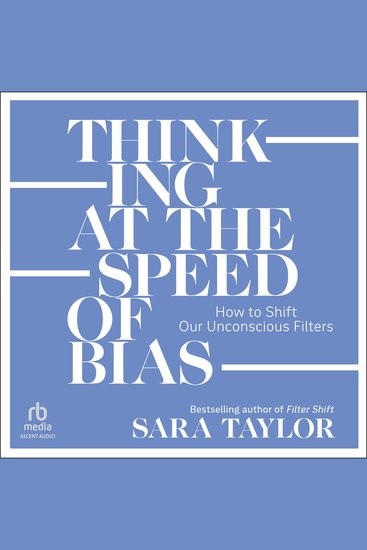
  • Thinking at the Speed of Bias - How to Shift Our Unconscious Filters - cover

    Thinking at the Speed of Bias -...

    Sara Taylor

    • 0
    • 0
    • 0
    Respected DEI expert Sara Taylor presents a down-to-earth guide on how to tackle unconscious biases and foster true equity in our rapidly changing world. Through relatable examples and practical strategies, listeners learn to deliberately slow down their thought processes and become aware of their filters in various situations. Taylor encourages listeners to question their own assumptions by asking, "Do I know that what I'm thinking is actually true?" and "Why might I be reacting this way?" 


    The book demonstrates the importance of a clear set of competencies, skills, and strategies for addressing unconscious bias. By developing a culturally competent mindset and using a shared, holistic language to discuss these issues, listeners gain the tools to understand, discuss, and implement change both at home and in the workplace. This approach avoids blame or shame, making it accessible and empowering for everyone. 


    The book's insights extend beyond individuals; it demonstrates how organizations can scale up cultural competence to transform their structures and systems. With a strong sense of hope, listeners are empowered to make a difference, creating a more just and equitable world for all.
    Ver livro
  • Second Treatise of Government - cover

    Second Treatise of Government

    John Locke

    • 0
    • 0
    • 0
    The Second Treatise of Government is a political treatise written by English philosopher John Locke in 1689. It is considered one of the most important works on political philosophy, as it presents Locke's ideas on the natural rights of individuals and the proper role and limits of government in a society based on the consent of the governed. 
    In the Second Treatise, Locke argues that all individuals have natural rights to life, liberty, and property, which cannot be taken away by any authority, including the government. These rights are inherent and universal, and are not granted by any social contract or agreement. 
    Locke also argues that governments are formed by the consent of the governed, and are therefore obligated to protect the natural rights of their citizens. He asserts that the purpose of government is to promote the common good, and that governments that fail to do so may be overthrown by the people. 
    Moreover, Locke suggests that there are limits to the power of government, and that individuals have the right to resist or even overthrow a government that becomes tyrannical or violates their natural rights. 
    The Second Treatise of Government has had a significant impact on political theory and the development of democratic governance. It influenced the United States Declaration of Independence and the Constitution, as well as many other constitutions around the world.
    Ver livro
  • Janis Joplin: A short biography - 5 Minutes: Short on time - long on info! - cover

    Janis Joplin: A short biography...

    5 Minutes, 5 Minute Biographies,...

    • 0
    • 0
    • 0
    Janis Joplin, blues singer with a legendary voice: Life and works in a short biography! Everything you need to know, brief and concise. Infotainment, education and entertainment at its best!
    Ver livro
  • Partylist for Profit: How the Rich Hijacked a System for the Poor - cover

    Partylist for Profit: How the...

    A.A. Castor

    • 0
    • 0
    • 0
    Once designed to amplify the voices of farmers, laborers, and the underrepresented, the Philippine party-list system has now become the ultimate low-risk, high-reward investment for the well-connected. In Partylist for Profit: How the Rich Hijacked a System for the Poor, A.A. Castor peels back the glossy surface of legislative charity to expose the machinery of legalized profiteering, dynastic expansion, and quiet political laundering. 
    With deadpan seriousness and a dose of dark humor, this book walks readers through the insider's playbook of how to build, fund, and quietly control a party-list with as little accountability—and as much profit—as possible. From choosing a vague advocacy ("OFWs" or "transport workers," anyone?) to securing alphabet-friendly names for ballot advantage, to recycling nominees across election cycles and repackaging greed as governance, this is not a how-to—this is a how-it's-done. 
    Perfect for political junkies, aspiring operators, or just disillusioned citizens looking to finally understand why nothing ever changes, Partylist for Profit isn't just a book—it's a public service announcement disguised as satire. 
    Learn how power is bought, maintained, and quietly passed down—not through revolution, but registration. After all, in today's politics, you don't need a platform. You just need a seat.
    Ver livro

  • How to Teach Buddhism to Children - cover

    How to Teach Buddhism to Children

    Dr. Helmuth Klar

    • 0
    • 0
    • 0
    This is an audiobook of Bodhi Leaves No. 9 by Dr. Helmuth Klar, 'How to Teach Buddhism to Children' found in the Pariyatti Edition of Collected Bodhi Leaves Vol. I, narrated by Christa Michel.
     
    Excerpt:
     
    "...How can Buddhist parents best teach their own children Buddhism? since they will seldom have the opportunity to teach it to other children, let alone the children of non-Buddhist parents. As I do not wish to theorize, I shall speak only from practical experience with my own children, and so of Western children in general. It is moreover particularly the Western child which is exposed to a Christian or materialistic environment, and hence is in need of a carefully considered Buddhist education. In a Buddhist country, steeped in its centuries-old Buddhist tradition, the position of a Buddhist child is (or should be) far easier. In such a favourable environment a good and effective Buddhist educational system may have developed. But even if it had it would be a great mistake for us, as Westerners, to copy it without due consideration.
    Ver livro