¡Acompáñanos a viajar por el mundo de los libros!
Añadir este libro a la estantería
Grey
Escribe un nuevo comentario Default profile 50px
Grey
Suscríbete para leer el libro completo o lee las primeras páginas gratis.
All characters reduced
Hamnet 2025 (The Untold Family Tragedy and the Making of a Master) - Experience the Pain and Inspiration Behind One of History’s Most Influential Playwrights Starring Jessie Buckley and Paul Mescal - cover

Hamnet 2025 (The Untold Family Tragedy and the Making of a Master) - Experience the Pain and Inspiration Behind One of History’s Most Influential Playwrights Starring Jessie Buckley and Paul Mescal

Margaret H. Rivera

Editorial: Margaret H. Rivera

  • 0
  • 0
  • 0

Sinopsis

Uncover the gripping, heart-wrenching story that reveals the deep, untold tragedy behind one of history’s greatest playwrights. “Hamnet 2025” is a cinematic masterpiece that takes you into the raw, emotional world of William Shakespeare, exploring the devastating loss that shaped the creation of his greatest work, Hamlet. This is not just a film about Shakespeare’s genius—it’s the untold story of a father’s grief, a mother’s suffering, and the birth of a masterpiece.Starring Jessie Buckley and Paul Mescal, this poignant film brings to life the Shakespeare family’s silent, tragic pain, as the death of their 11-year-old son, Hamnet, forces them into a journey of mourning, love, and emotional transformation. Watch as Shakespeare, tormented by the loss of his child, turns to his art—his greatest emotional outlet—to process his anguish. A work that would forever echo the sorrow he could not speak of, Hamlet was born in the shadow of a father’s grief.“Hamnet 2025” takes you beyond the public persona of Shakespeare. This is an intimate exploration of the man behind the myth—an artist, a father, and a husband, torn apart by the untimely death of his beloved son. Jessie Buckley’s portrayal of Agnes, Shakespeare’s wife, is a powerful testament to the quiet strength of a mother broken by the unimaginable. Paul Mescal masterfully embodies Shakespeare’s internal struggle, showing a man who creates not only to immortalize his grief but to survive it.This film will not just make you think; it will make you feel. “Hamnet 2025” is not just about Shakespeare's legacy—it's about the human cost of greatness, and how profound sorrow can lead to the creation of a masterpiece.Order your copy now to immerse yourself in this powerful tale of loss, love, and the haunting birth of one of history’s most iconic plays. Don’t miss the emotional rollercoaster that will leave you rethinking the meaning of art and suffering.
Disponible desde: 25/12/2025.
Longitud de impresión: 171 páginas.

Otros libros que te pueden interesar

  • 40 Favorite Hymns of the Christian Faith - A Closer Look at Their Spiritual and Poetic Meaning - cover

    40 Favorite Hymns of the...

    Leland Ryken

    • 0
    • 0
    • 0
    Every hymn begins its life as a poem—and we can give our favorite hymns fresh life by returning to their poetic roots. This anthology of several centuries' worth of great hymns invites us to experience these works as devotional poetry—to slow down and savor their well-turned phrases and evocative language. English professor Leland Ryken provides some historical background for each hymn, but his focus is on literary analysis. Combined with relevant Scripture texts, the result is a wonderfully devotional and poetic study of the Christian faith.
    Ver libro
  • Leonard Cohen - The Man Who Saw the Angels Fall - cover

    Leonard Cohen - The Man Who Saw...

    Christophe Lebold

    • 0
    • 0
    • 0
    Leonard Cohen has aimed high: to be all Jewish heroes at once. Like Jacob, he struggled with angels. Like David, he sang psalms and seduced women. But he never ceased doing what he did best: going from city to city and reviving our hearts. Leonard Cohen: The Man Who Saw the Angels Fall follows the singer’s cosmopolitan life from Montreal and New York to the Greek island of Hydra and examines his perpetual dialogues with himself, God, and avalanches.
    		 
    We see how six decades of radiant pessimism and a few thousand nights in hotel rooms transformed a young Jewish poet who longed to be a saint into an existentialist troubadour in love with women and a gravelly-voiced crooner who taught a thousand ways of dissolving into love.
    		 
    After more than two decades of research and travels, Christophe Lebold, who befriended the poet and spent time with him in Los Angeles, delivers a stimulating analysis of Cohen’s life and art. Gracefully blending biography and essay, he interrogates the mission Cohen set out for himself: to show us that darkness is just the flip side of light.
    Ver libro
  • Through a Crooked Lens - cover

    Through a Crooked Lens

    Monte Dwyer

    • 0
    • 0
    • 0
    “He views life with a Jack Nicholson like, quizzical overview, a Why is this thus? disdain.” Ted Egan 
    Entertaining account of Monte struggling to come to grips with Sunrise, technology and a newly-acquired 4WD bus determined to kill him. 
    Monte’s amusing transition from mainstream television to freelance multimedia something-or-other; stories edgier and more chaotic than the first book, a touch of restrained madness here.
    Ver libro
  • Satie in Words and Music - cover

    Satie in Words and Music

    Davinia Caddy

    • 0
    • 0
    • 0
    Famous today for his Trois Gymnopédies, ErikSatie was an eccentric and solitary figure whowas nevertheless viewed by some as a prophet ofFrench musical modernism, his strikingcreativity championed by Ravel and Debussy.From tragedy and trauma in his early years,through his time as a pianist and Parisianprovocateur at Le Chat Noir cabaret, and ashouse composer to the mystical Rose+Croix cultand beyond, Satie’s eventful life is told in thisfascinating revue of a composer whose uniquestatus is still influential today. The narrative isillustrated with musical excerpts from worksincluding Gymnopédie No. 3, Gnossienne No. 3,Sports et Divertissements, Trois Morceaux enforme de poire and Relâche, among others.
    Ver libro
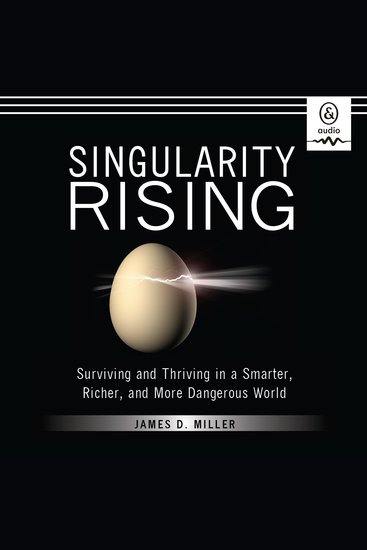
  • Singularity Rising - Surviving and Thriving in a Smarter Richer and More Dangerous World - cover

    Singularity Rising - Surviving...

    James D. Miller

    • 0
    • 0
    • 0
    In Ray Kurzweil's New York Times bestseller The Singularity is Near, the futurist and entrepreneur describes the Singularity, a likely future utterly different than anything we can imagine. The Singularity is triggered by the tremendous growth of human and computing intelligence that is an almost inevitable outcome of Moore's Law. Since the book's publication, the coming of the Singularity is now eagerly anticipated by many of the leading thinkers in Silicon Valley, from PayPal mastermind Peter Thiel to Google co-founder Larry Page. The formation of the Singularity University, and the huge popularity of the Singularity website kurzweilai.com, speak to the importance of this intellectual movement. 
    But what about the average person? How will the Singularity affect our daily lives—our jobs, our families, and our wealth? 
    Singularity Rising: Surviving and Thriving in a Smarter, Richer, and More Dangerous World focuses on the implications of a future society faced with an abundance of human and artificial intelligence. James D. Miller, an economics professor and popular speaker on the Singularity, reveals how natural selection has been increasing human intelligence over the past few thousand years and speculates on how intelligence enhancements will shape civilization over the next forty years. 
    Miller considers several possible scenarios in this coming singularity: A merger of man and machine making society fantastically wealthy and nearly immortal Competition with billions of cheap AIs drive human wages to almost nothing while making investors rich Businesses rethink investment decisions to take into account an expected future period of intense creative destruction Inequality drops worldwide as technologies mitigate the cognitive cost of living in impoverished environments Drugs designed to fight Alzheimer's disease and keep soldiers alert on battlefields have the fortunate side effect of increasing all of their users' IQs, which, in turn, adds a percentage points to worldwide economic growth  
    Singularity Rising offers predictions about the economic implications for a future of widely expanding intelligence and practical career and investment advice on flourishing on the way to the Singularity.
    Ver libro
  • Medieval Japan - Samurai and Shoguns - cover

    Medieval Japan - Samurai and...

    Harris Ropes

    • 0
    • 0
    • 0
    The rise of feudal Japan marked a significant turning point in the nation's political and social history. Beginning in the late 8th to early 9th centuries, the centralized power of the imperial court in Kyoto began to wane. As emperors became more ceremonial figures, real power shifted into the hands of powerful landowning families and military clans in the provinces. These regional lords, or daimyo, started to assert control over their own territories, gradually weakening the authority of the imperial government. 
    This period of decentralization gave birth to a new system where local warlords governed through a network of vassals and military retainers. In return for loyalty and service, these retainers were granted land or a share in the profits from agricultural production. This land-based reward system laid the foundation for the feudal structure that would define medieval Japan for centuries to come. Unlike in Europe, where feudalism was based on strict legal contracts, Japan’s version emphasized personal loyalty and honor, often backed by military strength. 
    The emergence of powerful clans such as the Minamoto and Taira further accelerated the move toward feudal governance. Their rivalry culminated in the Genpei War (1180–1185), a brutal conflict that ultimately led to the downfall of the Taira clan and the rise of the Minamoto. In 1192, Minamoto no Yoritomo was appointed Seii Taishogun, or Shogun, by the emperor, establishing the first shogunate in Kamakura. This event marked the formal beginning of military rule in Japan and the creation of a dual-government system, where the emperor remained as a symbolic figure while the shogun held actual power.
    Ver libro