Unisciti a noi in un viaggio nel mondo dei libri!
Aggiungi questo libro allo scaffale
Grey
Scrivi un nuovo commento Default profile 50px
Grey
Iscriviti per leggere l'intero libro o leggi le prime pagine gratuitamente!
All characters reduced
Treatises on Friendship and Old Age - cover

Treatises on Friendship and Old Age

Marcus Tullius Cicero

Traduttore Evelyn S. Shuckburgh

Casa editrice: e-artnow

  • 0
  • 0
  • 0

Sinossi

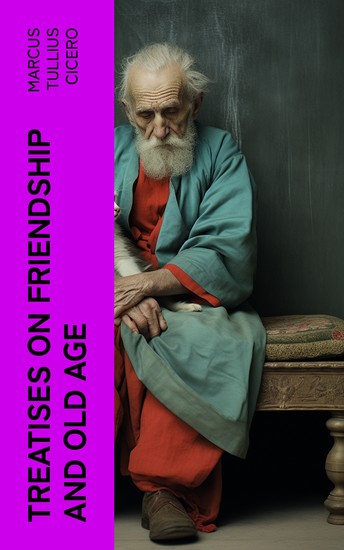
The following work is a collection of essays by Cicero, regarding friendship and old age. The Treatise on Friendship is written as a dialogue between prominent figures of the Middle Roman Republic and is set after the death of the younger Scipio Africanus (otherwise known as Scipio Aemilianus, Scipio Africanus Minor or Scipio the Younger). The interlocutors of the dialogue chosen by Cicero are Gaius Laelius, a close friend of the late statesman, and Laelius's two sons-in-law, Gaius Fannius, and Quintus Mucius Scaevola. As for The Treatise of Old Age, it was written by Cicero in his sixty-third year, and is addressed to his friend Atticus. Cicero represents the discourse as delivered by the elder Cato (in his eighty-fourth year) on occasion of young Scipio and Laelius expressing their admiration at the wonderful ease with which he still bore the load of life. Cicero acknowledges that the sentiments put into the mouth of Cato are really Cicero's own. His purpose is to show that old age is not only tolerable, but comfortable by internal resources of happiness.
Disponibile da: 20/11/2023.
Lunghezza di stampa: 156 pagine.

Altri libri che potrebbero interessarti

  • SACRED INTIMACY - Navigating the Spiritual Dimensions of Love Connection and Sacred Intimacy (2024 Guide for Beginners) - cover

    SACRED INTIMACY - Navigating the...

    WILONA LYNCH

    • 0
    • 0
    • 0
    "Sacred Intimacy" is a profound exploration of the spiritual dimensions woven into the fabric of human connection, providing a guide to transcending the physical and embracing a deeper, more meaningful level of intimacy. This transformative journey delves into the sacred aspects of love, inviting couples to cultivate a connection that nourishes the soul and uplifts the spirit.Spiritual Connection Beyond the Physical: Explore practices and insights that elevate physical intimacy to a sacred and spiritual experience.Tantric Wisdom: Uncover the ancient teachings of Tantra, guiding you to harness and channel the potent energy of intimacy.Deepening Emotional Bond: Cultivate a profound emotional connection with your partner, fostering trust, vulnerability, and understanding.Meditative Practices: Integrate meditation and mindfulness into your intimate experiences, creating a space for presence and connection.Embodied Presence: Embrace the art of being fully present in the moment, heightening sensations and deepening the shared experience.Harmony of Mind, Body, and Spirit: Align the physical, emotional, and spiritual aspects of your being for a harmonious and sacred union. 
    🌟 Ready to embark on a sacred journey of love and connection? Dive into "Sacred Intimacy" and discover the transformative power of spiritual connection in your relationship. Whether you're seeking to deepen your current connection or embark on a new level of intimacy, this guide offers the keys to a sacred and fulfilling love life. Embrace the sacred—start your journey to profound intimacy today! 🌟 
     
    Mostra libro
  • The Rise of the Ottoman Empire - A New Power Emerges - cover

    The Rise of the Ottoman Empire -...

    Harris Ropes

    • 0
    • 0
    • 0
    The story of the Ottoman Empire begins not with grandeur and empire-building, but with the survival and adaptation of a small Turkic tribe navigating the collapse of greater powers. In the late 13th century, the Anatolian region was a mosaic of fragmented states, weakened by internal conflict and external invasions. Among these groups were the Turks, originally Central Asian nomads, who had migrated westward in waves over centuries. Their destiny would shift dramatically with the decline of the Seljuk Sultanate of Rum and the vacuum left by the Mongol invasions, creating space for new leadership to emerge. 
    The Seljuks had once dominated much of Anatolia, but their weakening rule after the Mongol defeat at the Battle of Köse Dağ in 1243 left the region divided among various beyliks, or small principalities. One such principality was led by a chieftain named Ertuğrul, who had settled near the Byzantine frontier. Upon his death, leadership passed to his son, Osman, a bold and ambitious leader who would become the namesake of the Ottoman dynasty. Osman’s emergence marked a turning point, as his military successes and political acumen allowed him to consolidate power and expand his territory, laying the foundation for what would become the Ottoman Empire. 
    Osman I’s rise coincided with a period of instability within the Byzantine Empire, which was plagued by civil wars and weakened borders. Taking advantage of this, Osman led raids into Byzantine lands, gradually carving out a small but growing domain. More than just a warrior, Osman capitalized on the frontier spirit, attracting ghazis—Muslim warriors motivated by the idea of fighting non-Muslims. These fighters brought not only military strength but also religious legitimacy to Osman’s rule, enabling him to establish a principality that combined spiritual purpose with political ambition.
    Mostra libro
  • Caring - Caring The Thoughtful Concern: Showing Genuine Interest in Others' Well-Being - cover

    Caring - Caring The Thoughtful...

    Esther Jameson

    • 0
    • 0
    • 0
    Caring is more than just an emotion or an obligation; it is a conscious choice to show interest in the well-being of others. At its core, it is about fostering genuine connections and expressing a concern that transcends mere politeness. In a world that often feels disconnected and fast-paced, the act of caring can be a grounding force for both the giver and the receiver. It can enhance relationships, improve mental health, and create communities where individuals feel valued and understood. 
    One of the key elements of caring is empathy. Empathy involves being able to understand and share the feelings of another person. This allows individuals to connect on a deeper emotional level, recognizing the struggles and joys that others experience. Unlike sympathy, which often involves feeling pity for someone, empathy creates an equal emotional exchange. This emotional resonance is vital in showing genuine concern because it shows that you truly understand another person's experiences, rather than just offering surface-level support. 
    Another important aspect of caring is the idea of presence. To truly care about someone, one must be present—both physically and emotionally. This means putting aside distractions and fully engaging with the other person. The simple act of being there for someone, whether in moments of joy or sadness, communicates a powerful message of support. In this context, caring is not about grand gestures or dramatic acts; sometimes, it is the quiet moments of listening and offering a shoulder to lean on that make the biggest impact.
    Mostra libro
  • MacArthur Reconsidered - General Douglas MacArthur as a Wartime Commander - cover

    MacArthur Reconsidered - General...

    James Ellman

    • 0
    • 0
    • 0
    One of America's most controversial generals, Douglas MacArthur's rise through the US Army's ranks was meteoric. However, he did not lead large formations of men in combat until he assumed command of forces in the Philippines in 1941. When war commenced with the bombing of Pearl Harbor, MacArthur's performance on the battlefield was a failure: he underestimated the Japanese, and his poorly trained forces were outmaneuvered and outfought by a much smaller invading force. 


    In his subsequent role as America's shogun in Tokyo, MacArthur was again surprised by an enemy he underestimated. The Korean War yielded his greatest victory, at Inchon, but also his greatest defeat, along the Yalu River. Unwilling to accept anything but complete victory, he openly defied President Truman: MacArthur fatally undermined chances for an early peace and attempted to widen a conflict which threatened to become a third world war. Raging against his subsequent firing, he only truly faded away after he was publicly criticized by a panoply of America's greatest WWII generals. 


    Today, MacArthur still polarizes. Many biographies agree he was a great and patriotic leader marred by a few failures. James Ellman argues the opposite: MacArthur was a lackluster battlefield commander who suffered stunning defeats while undermining the command structure of our military.
    Mostra libro
  • Holding a Mirror Up to Nature - cover

    Holding a Mirror Up to Nature

    James Gilligan, David A.J. Richards

    • 0
    • 0
    • 0
    At a time when violence in America and Europe dominates the daily news, a groundbreaking new book co-authored by James Gilligan, an eminent psychiatrist who has worked with criminals, and David A.J. Richards, a legal scholar of toxic patriarchy, illuminates the ways in which Shakespeare offers unique insights into the causes of violence as well as its prevention.Now a riveting new audio production, Holding a Mirror Up to Nature: Shame, Guilt, and Violence in Shakespeare takes advantage of scenes performed by acclaimed actors to dramatize how much Shakespeare’s tragic heroes exhibit the psychology of those who commit violence in the contemporary world.The voice of British-American actor John Douglas Thompson called “perhaps the greatest Shakespeare interpreter in contemporary theater,” together with women’s parts spoken by Shakespeare & Company’s distinguished Tod Randolph, and narration by award-winning theater star Nigel Gore, orchestrate this tour de force audiobook that belongs in the listening library of everyone who loves Shakespeare and is curious about what causes and what prevents violence.
    Mostra libro
  • Up From Slavery - cover

    Up From Slavery

    Booker T. Washington

    • 0
    • 0
    • 0
    Booker Taliaferro Washington was born in a southern plantation. He was a son of a black slave woman and unknown white man. His mother worked as a cook in a house of plantation owners. In childhood he idn't have a surname as other slaves, but after the American Civil War that set the black slaves free Booker chose the surname of the first American President George Washington.
    Up from Slavery, written in 1901, became some sort of manifesto, the call to fight for the rights and achieve everything by own forces. In this book Booker Washington tells about his life, he describes the fight for the rights and freedoms and abilities of a man that wants to achieve a lot. The name of the book became a slogan for many movements for the rights of black people in the USA.
    Mostra libro