Join us on a literary world trip!
Add this book to bookshelf
Grey
Write a new comment Default profile 50px
Grey
Subscribe to read the full book or read the first pages for free!
All characters reduced
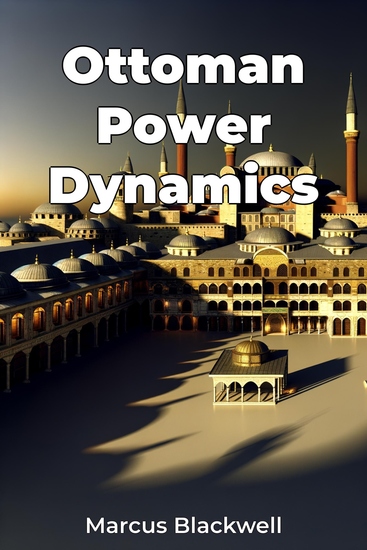
Ottoman Power Dynamics - cover

Ottoman Power Dynamics

Marcus Blackwell

Translator A AI

Publisher: Publifye

  • 0
  • 0
  • 0

Summary

"Ottoman Power Dynamics" masterfully traces the extraordinary transformation of the Ottoman Empire from a small Anatolian principality into one of history's most enduring powers, focusing on the sophisticated administrative systems that enabled its remarkable six-century reign.

 
The book illuminates how innovative governance structures, particularly under Sultan Mehmed II and Suleiman the Magnificent, created a resilient framework for ruling vast territories and diverse populations across three continents. At the heart of the narrative are three crucial elements that defined Ottoman success: the evolution of central authority, the development of sophisticated bureaucratic systems, and the integration of diverse populations through flexible administrative practices.

 
The book provides fascinating insights into unique Ottoman institutions, such as the devshirme system, which recruited talented Christian youth into state service, and the timar system of land management that supported their military structure. These administrative innovations demonstrate the empire's remarkable ability to balance central control with regional autonomy.

 
Drawing from extensive Ottoman archival sources, court documents, and contemporary accounts, the work presents a comprehensive analysis of how the empire maintained its power through a combination of military might and administrative adaptability. While the narrative spans from the empire's formation in 1299 to its golden age in the 16th century, it particularly emphasizes the revolutionary reforms following the conquest of Constantinople in 1453, showing how Ottoman governance systems influenced future state-building efforts and continue to offer relevant insights for understanding modern governmental organizations.
Available since: 01/30/2025.
Print length: 103 pages.

Other books that might interest you

  • The Pain We Carry Workbook - Heal Racial Trauma Reclaim Ancestral Wisdom and Ignite Your Soul’s Liberation - cover

    The Pain We Carry Workbook -...

    LMFT Natalie Y. Gutiérrez,...

    • 0
    • 0
    • 0
    If you are a person of color who has experienced repeated trauma from the toxic stress of—discrimination, racialized violence, racial stigmatization, traumatic grief, legacies of intergenerational trauma, poverty, sexual trauma, interpersonal violence, or the remnants of colonial and historical trauma—you may struggle with feelings of anger, rage, mistrust, fear, anxiety, depression, or shame. You may feel unsafe or uncomfortable in your own body, or find it difficult to build and keep close relationships. Sometimes you may feel alone in your pain. But you are not alone. 


    Written by an author of color and based on her pivotal book, The Pain We Carry, this workbook provides a practical approach to healing complex post-traumatic stress disorder (C-PTSD) as it is uniquely experienced by people of color. Using skills from internal family systems (IFS) therapy, the cultural empowerment approach to healing, ancestral wisdom, and more, you will discover ways to feel safer in your body, build self-compassion, reclaim your Self, and find personal liberation. 


    It's time to find relief from the trauma and burdens you have been carrying and start celebrating and rediscovering who you are. With this workbook, you will uncover your own strength and work toward healing your C-PTSD and live a life of empowerment, reflection, and perseverance.
    Show book
  • The Gulf Wars - Conflict in the Middle East - cover

    The Gulf Wars - Conflict in the...

    Nova Ashford

    • 0
    • 0
    • 0
    The Middle East, a region at the crossroads of Africa, Asia, and Europe, has a complex and multifaceted history that has shaped its modern political and social dynamics. Understanding the historical background of this area is essential for grasping the causes of its current conflicts, including the Gulf Wars. The region’s significance goes beyond its geographical location; it is home to some of the world’s oldest civilizations, such as the Sumerians, Egyptians, and Persians, which laid the foundation for much of human civilization, particularly in terms of writing, law, and governance. 
    The historical trajectory of the Middle East has been deeply influenced by the rise and fall of empires. In ancient times, the region was dominated by powerful empires such as the Persian Empire and the Ottoman Empire. The Ottoman Empire, in particular, played a central role in shaping the political landscape of the Middle East for over 400 years. Its collapse after World War I marked the beginning of a new era, characterized by the creation of modern nation-states and the imposition of arbitrary borders by Western powers. The dismantling of the Ottoman Empire led to the carving up of its territories under the Sykes-Picot Agreement, a secret 1916 accord between Britain and France that laid the groundwork for many of the modern-day conflicts in the region. 
    The aftermath of World War I also saw the emergence of European mandates in the Middle East. The British and French took control of territories such as Iraq, Palestine, and Syria, which created tensions among various ethnic and religious groups. The artificial borders drawn by colonial powers failed to account for the region's complex social fabric, where multiple ethnicities, religions, and cultures coexisted. This imposition of external governance set the stage for future conflicts, as regional communities struggled for autonomy and independence.
    Show book
  • Plato's Gorgias - cover

    Plato's Gorgias

    Plato

    • 0
    • 0
    • 0
    Gorgias of Leontini, a famous teacher of rhetoric, has come to Athens to recruit students, promising to teach them how to become leaders in politics and business. A group has gathered at Callicles' house to hear Gorgias demonstrate the power of his art. This dialogue blends comic and serious discussion of the best life, providing a penetrating examination of ethics. Is it better to suffer evil or to do evil?
     
    Is it better to do something wrong and avoid being caught or to be caught and punished? Is pleasure the same as goodness? As the characters in the dialogue pursue these questions, the foundations of ethics and the nature of the good life come to light.
    Show book
  • The Art of War - cover

    The Art of War

    Sun Tzu

    • 0
    • 0
    • 0
    The Art of War enjoys enduring popularity among readers. It is a classic study of strategy and how to shape your tactics to cope with an ever-evolving situation - in some cases how to fight without actually committing yourself to battle.
    Show book
  • Summary of Steven Pinker’s The Better Angels of Our Nature - cover

    Summary of Steven Pinker’s The...

    Falcon Press

    • 0
    • 0
    • 0
    Summary of Steven Pinker’s The Better Angels of Our Nature is a robust tour of progress in human civilization across several centuries. Despite commonly held perceptions, influenced by a news media which incessantly dwells on the worst aspects of society, humanity has become less, not more violent over time...
    Show book
  • School Rethink 20 - Putting Reinvention into Practice - cover

    School Rethink 20 - Putting...

    Juliet Squire, Michael B. Horn,...

    • 0
    • 0
    • 0
    In School Rethink 2.0, editors Frederick M. Hess, Michael B. Horn, and Juliet Squire gather leaders immersed in the nuts-and-bolts work of educational reinvention to present ten promising education improvements and ways to implement them. Contributors explain what it takes to reinvent schooling and the hurdles that emerge when tackling everything from curricula to staffing to assessment. These entrepreneurs and practitioners detail both the challenges and successes they've experienced in putting their ideas into practice, and they offer wise advice to administrators, policymakers, and educators who hope to adopt these approaches.Many of the approaches described in the book were driven by the COVID-19 pandemic, which forced the nation to rethink core tenets of schooling. Contributors find solutions in robust career and technical education and new staffing models. They champion best-fit environments achieved via school choice programs and variations in school size, from colossal, highly resourced school systems to microschools. And they highlight a range of alternative instructional models such as mastery-based learning, personalized instruction, and multimodal learning labs for math instruction. This collection offers a host of actionable solutions to help accommodate different learning needs.
    Show book