Join us on a literary world trip!
Add this book to bookshelf
Grey
Write a new comment Default profile 50px
Grey
Subscribe to read the full book or read the first pages for free!
All characters reduced
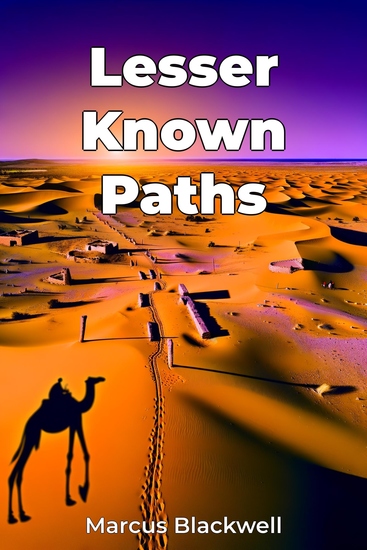
Lesser Known Paths - cover

Lesser Known Paths

Marcus Blackwell

Publisher: Publifye

  • 0
  • 0
  • 0

Summary

"Lesser Known Paths" unveils a fascinating exploration of overlooked historical trade routes and migration patterns that shaped human civilization alongside more famous networks like the Silk Road.

 
This comprehensive study examines three crucial but understudied pathways: the ancient maritime routes of the Indian Ocean, Central Asian grassland corridors, and trans-Saharan networks. Through a unique combination of archaeological findings, satellite imagery, and newly translated historical documents, the book reveals how these alternative routes were equally influential in facilitating cultural exchange and technological advancement across civilizations.

 
The book's innovative approach combines traditional historical analysis with modern scientific methods, including genetic studies, linguistic analysis, and climatological data. Spanning from 3000 BCE to 1500 CE, it focuses particularly on underrepresented regions and demonstrates how these lesser-known paths connected diverse cultures and economies.

 
The research challenges conventional narratives about historical connectivity by presenting compelling evidence from remote archaeological sites and previously undiscovered trade documents. Structured in three main sections, the work progresses from establishing methodological frameworks to examining specific case studies, such as Southeast Asian archipelago networks and Caucasus mountain passages, before synthesizing these findings to demonstrate their collective impact on world history.

 
This interdisciplinary approach, combining archaeology, climatology, linguistics, and geography, offers readers a fresh perspective on how alternative historical networks contributed to the development of human civilization, while providing relevant insights for understanding modern global connectivity patterns.
Available since: 01/08/2025.
Print length: 95 pages.

Other books that might interest you

  • History of Israel – Palestine Conflict - cover

    History of Israel – Palestine...

    Introbooks Team

    • 0
    • 0
    • 0
    The Israel – Palestine conflict is the ongoing conflict of Middle East, which finds its roots in mid-20th century will fall of the Ottoman Empire and migration of Jews. The conflict is attributable to 95% of the problems on Middle East. The conflict is between the Jews and the Arabs however it is not religious, but about the land. The Jews want Israel to be recognized as an independent Jewish state and the Palestinian want Jews to vacate their land. Both sides have been using all means possible to achieve this aim and have even gone to war thrice. The conflict is still active with no respite what so ever past 100 years or so. Many nations and UN have tried to resolve the issue but the intangible are too far from any solution. The conflict is also seen as one of the most difficult conflicts to resolve by both sides as well as international community.
    Show book
  • Speaking in Tongues - cover

    Speaking in Tongues

    J.M. Coetzee, Mariana Dimópulos

    • 0
    • 0
    • 0
    Language, historically speaking, has always been slippery. Two dictionaries provide two different maps of the universe: which one is true, or are both false? Speaking in Tongues—taking the form of a dialogue between Nobel laureate novelist J. M. Coetzee and eminent translator Mariana Dimópulos—examines some of the most pressing linguistic issues that plague writers and translators well into the twenty-first century. 


    The authors inquire if one can truly love an acquired language, and they question why certain languages, like Spanish, have gender differences built into them. They examine the threat of monolingualism and ask how we can counter, if at all, the global spread of the English language, which seems to maraud like a colonial power. They question whether it should be the duty of the translator to remove morally objectionable language. And in the conclusion, Coetzee even speculates whether it's only mathematics that can tell the truth about everything. 


    Drawing from decades of experience in the craft of language, both Dimópulos and Coetzee face the reality that when it comes to self-expression, some things will always get lost in translation. Speaking in Tongues finally emerges as an engaging and accessible work of philosophy, shining a light on some of the most important linguistic and philological issues of our time.
    Show book
  • The Dust Bowl - America's Great Depression - cover

    The Dust Bowl - America's Great...

    Nova Ashford

    • 0
    • 0
    • 0
    The Dust Bowl was one of the most devastating environmental disasters in American history, affecting the Great Plains during the 1930s. A combination of severe drought, poor agricultural practices, and economic hardship led to massive dust storms, which wiped out crops, destroyed farmland, and caused widespread suffering. The impact of the Dust Bowl was felt not only in the affected regions but throughout the nation, as it brought attention to the fragile relationship between human activity and the environment. 
    The Great Plains, which stretches across parts of Oklahoma, Texas, Kansas, Nebraska, and Colorado, was once a region of rich soil and expansive farmland. As settlers moved westward in the late 19th and early 20th centuries, the area became a major agricultural hub, known for wheat production. However, the rapid expansion of farming techniques, including over-plowing and monoculture farming, had unintended consequences. The deep-rooted grasses that once protected the soil from erosion were removed, leaving the land vulnerable to the forces of nature. 
    In the early 1930s, the region experienced a prolonged drought, which exacerbated the situation. Without the natural protection of grasslands, the dry, cracked soil was easily swept up by strong winds, creating massive dust storms that could last for days. These "black blizzards" blotted out the sun and coated everything in a thick layer of dust, suffocating both people and animals. The economic hardships of the Great Depression, which had already affected the nation, further intensified the crisis, leaving farmers struggling to survive.
    Show book
  • Fight for Free Speech The: Rock Icon Dee Snider Addresses a 1985 US Senate Hearing On Music Content Labeling - cover

    Fight for Free Speech The: Rock...

    Dee Snider

    • 0
    • 0
    • 0
    On September 19, 1985, a US Senate hearing was instigated by the Parents Music Resource Center (PMRC)--founded by Tipper Gore, wife of Senator and later Vice President Al Gore; and Susan Baker, wife of Treasury Secretary James Baker--who wanted to introduce a parental warning system that would label all music albums containing alleged offensive material. The system was to include letters identifying the type of objectionable content to be found in each album (O for occult themes, S for sex, D for drugs, V for violence, etc.).


    Dee Snider, lead singer and primary songwriter for the rock band Twisted Sister, John Denver, and Frank Zappa all testified against censorship and the proposed warning system. Such a system was never implemented, but the result of the hearing brought about what was known as the "Parental Advisory: Explicit Content" label.
    Show book
  • Thirteenth: Greatest of Centuries - cover

    Thirteenth: Greatest of Centuries

    James Joseph Walsh

    • 0
    • 0
    • 0
    It cannot but seem a paradox to say that the Thirteenth was the greatest of centuries. To most people the idea will appear at once so preposterous that they may not even care to consider it. A certain number, of course, will have their curiosity piqued by the thought that anyone should evolve so curious a notion. Either of these attitudes of mind will yield at once to a more properly receptive mood if it is recalled that the Thirteenth is the century of the Gothic cathedrals, of the foundation of the university, of the signing of Magna Charta, and of the origin of representative government with something like constitutional guarantees throughout the west of Europe. The cathedrals represent a development in the arts that has probably never been equaled either before or since. The university was a definite creation of these generations that has lived and maintained its usefulness practically in the same form in which it was then cast for the seven centuries ever since. The foundation stones of modern liberties are to be found in the documents which for the first time declared the rights of man during this precious period. (Summary from Preface)
    Show book
  • Hitler's Last Day - The Final Hours of the Führer - cover

    Hitler's Last Day - The Final...

    Richard Dargie

    • 0
    • 0
    • 0
    Have you ever wondered what was going on in Adolf Hitler's mind during his final hours in the Führerbunker? 
     
    What were his thoughts as radio contact with the outside world grew faint, Soviet explosions became louder and louder, and he began to feel his unassailable power ebbing away? 
     
    Did Hitler repent of his crimes against humanity or was he obsessed with thoughts of his imminent defeat and suicide? 
     
    With an inimitable cast of doomed characters, from Hitler himself to his mistress Eva Braun, mass-murderer Heinrich Himmler, cunning chief of Nazi propaganda Joseph Goebbels, and the manipulative Martin Bormann, this book captures all the drama and dread in the bunker as the Red Army remorselessly advanced into the heart of Berlin, and Hitler and his Thousand-Year Reich vanished into history.
    Show book