Join us on a literary world trip!
Add this book to bookshelf
Grey
Write a new comment Default profile 50px
Grey
Subscribe to read the full book or read the first pages for free!
All characters reduced
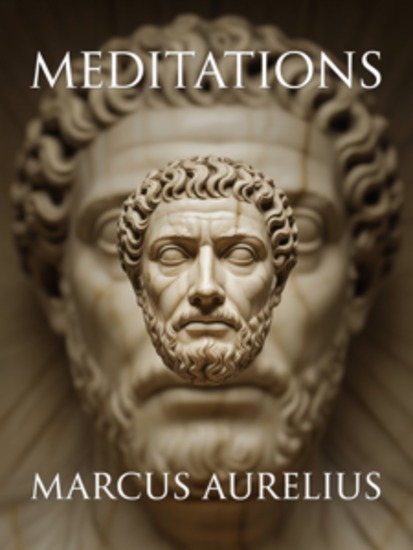
Meditations - cover

Meditations

Marcus Aurelius

Translator Ale. Mar. Sas

Publisher: ALEMAR S.A.S.

  • 0
  • 0
  • 0

Summary

"Meditations" by Marcus Aurelius is a philosophical work written in the 2nd century AD. This collection of personal writings offers insights into the Stoic philosophy and reflects the inner thoughts and reflections of the Roman Emperor as he navigates the complexities of leadership and personal virtue. The primary focus of the text is on self-reflection, ethical principles, and the importance of maintaining a rational mind amidst life's challenges. The opening of "Meditations" introduces the background of Marcus Aurelius, detailing his upbringing, education, and philosophical influences. It highlights his deep respect for family and mentors who shaped his character, instilling values such as gentleness, temperance, and duty. As the text unfolds, Marcus sketches his numerous debts of gratitude to those who influenced him, emphasizing a life of moderation and dedication to philosophy. He lays the groundwork for his meditations on the nature of the universe, the human condition, and the virtues of compassion and self-discipline, all of which frame his exploration of Stoicism throughout the work.
Available since: 10/01/2025.

Other books that might interest you

  • James Oglethorpe Father of Georgia - A Founder's Journey from Slave Trader to Abolitionist - cover

    James Oglethorpe Father of...

    Michael L. Thurmond, James F....

    • 0
    • 0
    • 0
    Founded by James Oglethorpe on February 12, 1733, the Georgia colony was envisioned as a unique social welfare experiment. Administered by twenty-one original trustees, the Georgia Plan offered England's "worthy poor" and persecuted Christians an opportunity to achieve financial security in the New World by exporting goods produced on small farms. Most significantly, Oglethorpe and his fellow Trustees were convinced that economic vitality could not be achieved through the exploitation of enslaved Black laborers. 


    James Oglethorpe, Father of Georgia uncovers how Oglethorpe's philosophical and moral evolution from slave trader to abolitionist was propelled by his intellectual relationships with two formerly enslaved Black men. Oglethorpe's unique "friendships" with Ayuba Suleiman Diallo and Olaudah Equiano, two of eighteenth-century England's most influential Black men, are little-known examples of interracial antislavery activism that breathed life into the formal abolitionist movement. 


    Utilizing more than two decades of meticulous research, fresh historical analysis, and compelling storytelling, Michael L. Thurmond rewrites the prehistory of abolitionism and adds an important new chapter to Georgia's origin story.
    Show book
  • My Autobiography - cover

    My Autobiography

    Davy Russell, Donn McClean

    • 0
    • 0
    • 0
    'An outstanding insight into the life and career of one of the greatest National Hunt jockeys. The bad days, the good days, the passion - it's all there' - Rachael Blackmore'Davy Russell's story has been the most fascinating of racing journeys, Donn McClean its classiest chronicler. It makes a National winning combination' - Brough Scott'Davy Russell is one of the most interesting characters in racing and one of the most successful National Hunt riders of our time. This is a superb book, one of the best sports books I've read' - Eamon DunphyFrom Davy Russell's early life in Youghal to his winning ride on Tiger Roll in the 2018 Grand National, this book has it all. Capturing the highs of an incredible career as a top jockey, from the adrenaline rush of winning the Grand National twice, the Cheltenham Gold Cup and the Grand Steeple-Chase de Paris, it also dwells on the devastating blows that Davy experienced through injury and shows his huge resilience and strength of character.In the book, Davy tells of his years on the point-to-point scene, his big move to England and his first Cheltenham victory in 2006, his experiences at Michael O'Leary's Gigginstown Stud as the number one rider, working with Gordon Elliot, his charity work with Hurling for Cancer Research, and his retirement. It is a truly remarkable journey written by the most entertaining jockey in the business.
    Show book
  • Between Square Buttes - cover

    Between Square Buttes

    Terry Courtright

    • 0
    • 0
    • 0
    Between Square Buttes is 35 short pieces that chronicle the American West over the last 50 years.  It is bird hunting, fly fishing, dog breeding, dog trialing, decline of habitat, loss of access, but mostly it is the story of the greatness that still exists in America today.  It started as a tribute to the last best place, Montana.  But in the end, it may be the beginning of the end of the last best place.  Told anecdotally, it brings to life the rivers, the plains, and the dogs that hunt these vast stretches of prairie.  And finally, it tells of the changes in land ownership in the West as more and more of it is being eaten up by developers and new landowners from all over the world who want a piece of it before it all goes away.  Revel in the rare beauty and incredible richness through the eyes and understanding of a man who has been there and done that.  Between Square Buttes will make you happy, make you sad, lift your spirit and break your heart as you follow the life of a serious fly fisherman and bird hunter who hunted and fished the best when it was the best and left the rest behind in search of more rivers, and newer land to hunt.
    Show book
  • Story of Vikram and Betal: Who is more courageous? - cover

    Story of Vikram and Betal: Who...

    Saurabh Kumar

    • 0
    • 0
    • 0
    This time too, King Vikramaditya brought down the betel tree hanging from a big tree and started moving forward with it. To save himself, Betal again told a story to the king. Betal says… 
    Once upon a time, there was a city named Kanakpur, whose king's name was Yashodhan. That king took great care of his subjects. There was also a Seth in the same city, whose daughter's name was Unmadini. She was very beautiful and talented, whoever saw her kept looking at her.
    Show book
  • To a Different Drum - An Adventure of Radical Obedience - cover

    To a Different Drum - An...

    Pauline Hamilton

    • 0
    • 0
    • 0
    "As I was tearing up the road with the accelerator pushed to the floor, familiar landmarks flashing by me, a kind of mad exhilaration possessed me. I had neither the time nor the inclination to reassess things now. I just wanted to reach my destination . . ." 


    Kicked out of college and hooked on drink and drugs, Pauline Hamilton drove recklessly towards a cliff near her home to end it all. At the last moment, her tire blew out, leaving her stunned in the stationary car. 


    Pauline's life changed forever. She turned at once to the God who had rescued her and, in grateful amazement, offered her whole life to Him. This dedication would eventually take her to China, where she would serve for over thirty adventure-packed years as a missionary. Through many trials Pauline never lost sight of the God who had promised never to let her go.
    Show book
  • Nerva-Antonine Dynasty The: The History and Legacy of the Emperors Who Ruled the Roman Empire at Its Peak - cover

    Nerva-Antonine Dynasty The: The...

    Editors Charles River

    • 0
    • 0
    • 0
    “The Five Good Emperors,” a reference to the five emperors who ruled the Roman Empire between 96 and 180 CE (Nerva, Trajan, Hadrian, Antoninus Pius, and Marcus Aurelius), was a term first coined by Machiavelli and later adopted and popularized by historian Edward Gibbon, who said that under these men, the Roman Empire “was governed by absolute power under the guidance of wisdom and virtue.”  
    	This period of 84 years is generally regarded as the high point of the Roman Empire, at least after Augustus, but what is uncertain and a matter of ongoing debate is whether the five emperors were personally responsible for the situation and the accompanying prosperity enjoyed throughout the empire at the time or if they were simply the beneficiaries of the Pax Romana, inaugurated by Augustus in the early part of the 1st century CE. In other words, historians have wondered whether anyone in power during those years would have enjoyed the same rewards.  
    	The description of these rulers as “good” is also a matter of interpretation, with some scholars suggesting they were only “good” in comparison to the preceding emperor (Domitian) and the emperor who followed Marcus Aurelius (Commodus). Both of them were horrible rulers in every aspect, making their near contemporaries look all the better.  
    	Regardless, it is clear that the era of the Five Good Emperors was one of unparalleled success and wealth, and the reasons Rome reached its zenith at this time are worthy of scrutiny. Perhaps most noteworthy is that none of these five emperors were blood relatives - while the final two are often referred to as the Antonines, they were not, in fact, related except by adoption, a practice that may in itself provide at least part of the answer to the question as to why this particular period was so magnificent.
    Show book