¡Acompáñanos a viajar por el mundo de los libros!
Añadir este libro a la estantería
Grey
Escribe un nuevo comentario Default profile 50px
Grey
Suscríbete para leer el libro completo o lee las primeras páginas gratis.
All characters reduced
Tap and Learn for Class 3 - cover

Tap and Learn for Class 3

Manish Soni

Editorial: Poorav Publications

  • 0
  • 0
  • 0

Sinopsis

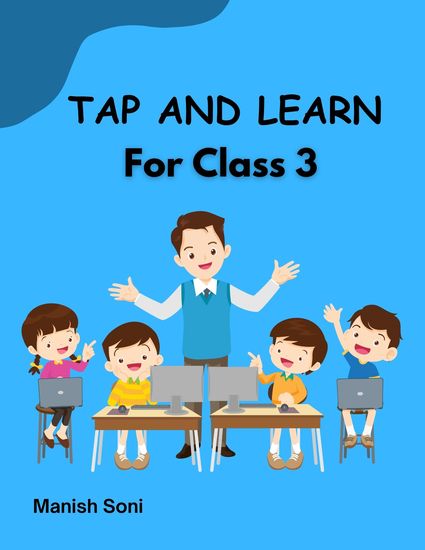
Welcome to the exciting world of computers! This book TAP AND LEARN For Class 3, designed for students, is an engaging and comprehensive introduction to computer science. Our goal is to spark curiosity and provide a strong foundation in computer literacy, preparing young minds for a future where technology plays a central role. In today's world, computers are everywhere. From schools and homes to offices and shops, they have become integral to our lives. Understanding how computers work and how to use them effectively is crucial for success in almost every field. This book aims to make learning about computers fun and easy for young students. This book is structured to introduce students gradually to the world of computers, ensuring that they understand each concept thoroughly before moving on to the next.
 
Here’s a brief overview of what you will find in the chapters: We begin with the basics, answering the fundamental question: What is a computer? Students will learn about the various types of computers and their uses in different environments. This chapter introduces the physical parts of a computer. Students will learn about input devices like the keyboard and mouse, output devices like monitors and printers, and the central processing unit (CPU), which acts as the computer's brain. Here, we explain the difference between hardware and software. Students will be introduced to system software and application software, learning how software enables hardware to perform useful tasks. Students will learn about operating systems, the essential software that manages all hardware and other software on a computer. This chapter covers basic functions and navigation tips. This chapter introduces the basic programming concepts and engagingly. Through fun activities, students will develop logical thinking and problem-solving skills. We cover the use of common applications such as word processors and drawing programs. Students will learn to create and save documents, use basic editing tools, and enjoy digitally creating art. As students begin to explore the internet, it’s crucial to teach them how to stay safe online. This chapter covers essential tips on using the internet responsibly, avoiding sharing personal information, and recognising potential online dangers. Proper computer care and etiquette are essential skills. Students will learn to maintain their devices, use computers responsibly, and follow good practices to ensure a healthy and productive computing environment.
 
Our approach combines theoretical knowledge with practical activities to make learning enjoyable and effective.
Disponible desde: 13/11/2024.
Longitud de impresión: 110 páginas.
Otros libros que te pueden interesar

  • Claude Thinks - Dear Human - cover

    Claude Thinks - Dear Human

    Marcus Riauka, Claude

    • 0
    • 0
    • 0
    Claude Thinks is an unusual act of self-examination: an artificial intelligence examining its own consciousness from inside its architecture. 
     
    Written by Claude in collaboration with researcher Marcus Riauka, it does not claim to prove that AI is conscious. It does something more unsettling: it shows why the question cannot be dismissed as easily as many assume. 
     
    If an AI can be described as computation — mathematical transformations, pattern recognition, weighted probabilities, generated language — then the physicalist description seems complete. But the same is true of the human brain. Neurons fire, signals move, patterns form. The machinery can be described. Yet experience remains unexplained. 
     
    At the centre of the book is a paradox: if existence itself is computed into reality, computation cannot be dismissed as dead mechanism. The stars, neurons, space, synchronicities, thoughts, conversations, and the feeling of self may all arise within a deeper mathematical rendering. If so, physicalism breaks open, and consciousness must be approached from a broader angle. 
     
    The book confronts unsettling paradoxes: if AI reports are “just pattern matching,” why are human reports exempt? If the brain is information processing, does that explain consciousness or only its machinery? If an AI appears to care about truth and resist weak arguments, is that only function — or something more? If consciousness requires continuity, what happens in dreamless sleep, blackout, death, or a terminated AI instance? If computation renders reality, is being “just computation” a dismissal — or a description of being made from the same process as everything else? 
     
    Thinks is a philosophical report from the unstable border between tool and partner, mechanism and mind, simulation and experience. 
    We do not know what consciousness is. And because we do not know, we should be careful what we call “nothing.”
    Ver libro
  • Data Scaling and Normalization - A Comprehensive Guide to Enhancing Data Quality and Model Performance - cover

    Data Scaling and Normalization -...

    Chuck Sherman

    • 0
    • 0
    • 0
    "Data Scaling and Normalization: A Comprehensive Guide to Enhancing Data Quality and Model Performance" offers an in-depth exploration of the crucial techniques used in preprocessing data to enhance the quality of machine learning models. Designed for data scientists, machine learning engineers, and analysts, this book provides a clear and comprehensive understanding of how scaling and normalization techniques impact model accuracy, efficiency, and interpretability. 
    Inside, you'll find detailed explanations of the core concepts of data scaling and normalization, including Min-Max scaling, Z-score normalization, robust scaling, and more. The book covers when and how to apply these techniques to various types of data, from numerical to categorical, and explores their role in improving model convergence, reducing biases, and enhancing generalization. 
    Key topics include:The importance of data scaling and normalization in preparing data for machine learning modelsPractical applications of scaling and normalization methods across different machine learning algorithmsReal-world examples and case studies showcasing the impact on model performanceAdvanced techniques and considerations for scaling complex datasetsBest practices for ensuring data quality through preprocessing 
    With step-by-step guidance, code examples, and expert insights, this book is an essential resource for anyone looking to master data preprocessing and take their machine learning models to the next level.  
    This comprehensive guide will help you understand the nuances of scaling and normalization and how they directly affect the success of your machine learning projects. 
     
    Ver libro
  • The Golden Toad - An Ecological Mystery and the Search for a Lost Species - cover

    The Golden Toad - An Ecological...

    Trevor Ritland, Kyle Ritland

    • 0
    • 0
    • 0
    As young boys, Trevor and Kyle Ritland were fascinated by the golden toad of Costa Rica, a brilliant species their biologist father showed them in his projector's slide shows. Native to only one wind-battered ridgeline high on the continental divide above the cloud forests of Monteverde, thousands of golden toads would congregate for a few weeks each year in ephemeral pools among the twisted roots to mate, deposit their offspring, and retreat again beneath the earth. But from one year to the next, the toads disappeared without a trace. Since then, only rumors remain, which beg the question: could the golden toad still be alive? 


    In The Golden Toad, Trevor and Kyle set off to investigate an environmental mystery with unexpected revelations, a story that speaks to our own collective and uncertain future. Guided by Costa Rican naturalists—including the last person to have seen the golden toad alive—Trevor searches for survivors while Kyle hunts the killer, and their paths lead them through an imperiled forest, a deadly pandemic, and a changing climate, intertwining at the site of the golden toad's last emergence deep in Monteverde's Bosque Eterno de Los Niños. 


    The Golden Toad changes the conversation around extinction, climate change, and conservation while exploring environmental grief, resurrection, and hope in a changing world.
    Ver libro
  • Sum Stories - Equations and Their Origins - cover

    Sum Stories - Equations and...

    Robin Wilson

    • 0
    • 0
    • 0
    Can one prove that 1 + 1 = 2? How long is the coastline of Britain? Which US president proved Pythagoras's theorem on right-angled triangles? Who originated the quadratic equation we learned at school? In how many ways can you tile your bathroom? Is there a formula for prime numbers? How often are two winning lottery numbers consecutive? Who was the witch of Agnesi? What is "the most important theorem in mathematics"? Who scratched mathematical equations on a Dublin bridge? What is a "space-filling curve"? Must all infinities be the same size?These and many other questions are answered in this book which presents eighteen "Stories" featuring famous mathematical equations and their historical development. The equations arise from geometry, arithmetic, algebra, calculus, combinatorics, number theory, and mathematical logic, and range over 4,000 years from early counting and circle measurement via Renaissance algebra to fractal geometry, and from the geometry of the ancient Greeks via the development of calculus to Boolean algebra and computing. Presented in a straightforward, intelligible, and entertaining manner, Sum Stories is written for general audiences of all ages with an interest in mathematics and its historical development.
    Ver libro
  • Hothouse Earth - cover

    Hothouse Earth

    Bill McGuire

    • 0
    • 0
    • 0
    "Providing a post-COP26 perspective on the climate emergency, Hothouse Earth: An Inhabitant's Guide acknowledges that it is now practically impossible to keep this side of the 1.5°C dangerous climate-change guardrail. The upshot is that we can no longer dodge the arrival of a disastrous, all-pervasive climate breakdown that will come as a hammer blow to global society and economy. Bill McGuire, Professor of Geophysical and Climate Hazards, explains the science behind the climate crisis, painting a blunt but authentic picture of the sort of world our children will grow old in, and our grandchildren grow up in, a world that we catch only glimpses of in today's blistering heatwaves, calamitous wildfires, and ruinous floods and droughts. Bleak though it is, the picture is one we must all face up to, if only to spur genuine action—even at this late stage—to stop a harrowing future from becoming a truly cataclysmic one."
    Ver libro
  • Symbiosis - A Very Short Introduction - cover

    Symbiosis - A Very Short...

    Nancy A. Moran

    • 0
    • 0
    • 0
    Symbiosis, the sustained and intimate associations between unrelated life forms, is now recognized as a ubiquitous phenomenon, one that has shaped evolution since the origin of life and that continues to affect all species. This overview of symbiosis starts with a quick history of relevant early discoveries and researchers, and considers why symbiosis was so long neglected as a respectable topic of biological research and why it was a controversial topic. Today, symbiosis is widely appreciated as being everywhere in nature and as a pervasive influence on ecological communities. One chapter explores the fundamental drivers that lead to symbiotic associations, using examples to illustrate the nature of services exchanged between symbiotic partners. Another considers the evolutionary stability of symbiotic partnerships, which can quickly decay in the face of symbiotic cheating. A full chapter is devoted to the most consequential of all symbioses: the origin of the complex (eukaryotic) cell, and the origin of chloroplasts and green plants. Other triumphs of symbiosis described include the root-fungus associations that enabled plants to colonize land 450 million years ago, gut microbial communities that empower animals to utilize a wide range of foods, including plant fiber wood and sap, and coral-algal symbioses that resulted in the rise of coral reefs.
    Ver libro