Junte-se a nós em uma viagem ao mundo dos livros!
Adicionar este livro à prateleira
Grey
Deixe um novo comentário Default profile 50px
Grey
Assine para ler o livro completo ou leia as primeiras páginas de graça!
All characters reduced
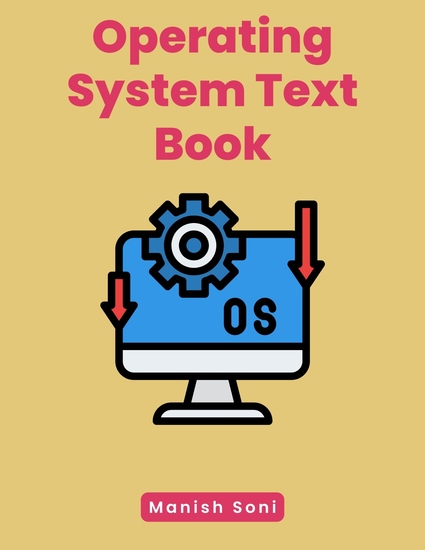
Operating System Text Book - cover
LER

Operating System Text Book

Manish Soni

Editora: Poorav Publications

  • 0
  • 0
  • 0

Sinopse

Welcome to the Operating System Text Book! As you hold this book in your hands or view it on your screen, you are embarking on a journey into the fundamental underpinnings of modern computing. Operating Systems are the silent orchestrators behind the scenes, the unsung heroes that enable our computers and devices to perform the myriad of tasks we take for granted.This book is designed to be your guide through the intricate and often fascinating landscape of Operating Systems. Whether you are a student delving into the subject for the first time or a seasoned professional seeking to deepen your understanding, this book aims to provide you with a comprehensive and UpToDate reason.Operating Systems are the bridge between hardware and software, the guardians of resources, and the facilitators of user experiences. They are the complex software layers that manage memory, process scheduling, file systems, networking, and so much more. Understanding how they work is crucial for anyone in the field of computer science, software engineering, or IT.Beyond the technical aspects, Operating Systems offer a rich history, reflecting the evolution of computing itself. From the early days of batch processing and punch cards to the modern, interconnected world of cloud computing and mobile devices, the story of Operating Systems is intertwined with the story of technology and innovation.This book is divided into several chapters, each dedicated to a specific aspect of Operating Systems. We'll start with the fundamentals, exploring the core concepts and principles that underpin all Operating Systems. From there, we'll dive into the architecture of Operating Systems, discussing topics such as process management, memory management, and file systems.We will also explore how Operating Systems have evolved over time, from the early mainframes to the rise of personal computing and the emergence of mobile and embedded systems. Additionally, we'll delve into contemporary challenges and trends, including virtualization, containerization, and the role of Operating Systems in cloud computing.This book is intended for a diverse audience, including students, educators, professionals, and anyone curious about the inner workings of the technology that powers our digital world. Whether you are pursuing a degree in computer science, preparing for certification exams, or simply eager to deepen your knowledge, you will find valuable insights within these pages.Each chapter is structured to provide a clear and systematic exploration of its respective topic. You can read this book cover to cover or skip to specific chapters that pique your interest. Throughout the text, you will find practical examples, diagrams, and case studies to help reinforce the concepts discussed.
Disponível desde: 13/11/2024.
Comprimento de impressão: 373 páginas.

Outros livros que poderiam interessá-lo

  • Battlefields of The Future: The Evolution of the Technology of War 2025-2125 - cover

    Battlefields of The Future: The...

    Dr. Nick Coman, I. A.I.

    • 0
    • 0
    • 0
    A 36‑lecture audio course on how wars are actually fought in the machine age—from seabed cables and city power grids to low‑Earth orbit, cislunar space, and the neural loop between a human and a weapon. We break the kill chain open: sensing and space‑based cueing; edge compute and target fusion; communications that survive jamming; and the things that do damage—mines, missiles, loitering munitions, directed energy, electromagnetic pulse, and code. 
    We make the stack legible for operators and serious thinkers alike: synthetic aperture radar becomes SAR; high‑altitude long endurance becomes HALE; link budgets and laser crosslinks stop being magic and start being math you can reason about in words. You will see how orbital “stalkers” shadow satellites, why stratospheric platforms matter when air defenses make manned ISR bleed, how decoys and digital camouflage fracture an adversary’s picture, and where the automation boundary really sits when AI runs parts of the kill web with a human on the loop. 
    Engineering reality, not brochure fog, sets the pace. We trace power budgets, attrition math, and reconstitution timelines; map chokepoints in chips, propellants, optics, batteries, and shipyards; and follow sanctions, export controls, and standards as operational constraints, not afterthoughts. 
    The glidepath is explicit. 2025 to 2035: proliferated space, cheap autonomy, hard lessons from electronic warfare. 2035 to 2050: directed‑energy baselines, resilient meshes, smarter decoys. 2050 to 2075 and beyond: cislunar logistics with teeth, human performance management that is governed not ghoulish, brain–computer interfaces that shorten loops without erasing judgment. 
    Rigorous, unsentimental, and built for the intellectually ambitious, this course is an operator’s guide to modern combat systems—how they are built, how they break, and how they win.
    Ver livro
  • Cybersecurity Essentials - Protecting Your Digital World - cover

    Cybersecurity Essentials -...

    Olive Sanchez

    • 0
    • 0
    • 0
    "Cybersecurity Essentials: Protecting Your Digital World" is a highly recommended book that will help readers fully grasp the ideas and methods of cybersecurity. Today, digital technology is an important part of both personal and business life. This book gives important information on how to protect yourself from the changing types of online threats. 
    The first part of the book goes over the basics of cybersecurity and talks about different types of threats, such as malware, scams, ransomware, and social engineering. It looks at important cybersecurity systems and standards, like ISO/IEC 27001 and NIST, giving readers a strong background in risk management and following the rules. 
    A lot of attention is paid to the real parts of protecting digital settings, like network security, endpoint protection, and application security. To protect their systems and data, readers will learn how to use effective tools like firewalls, intruder detection systems, and encryption. Data protection and identity management are also talked about in detail, and the book gives advice on how to keep private data safe and control who can see it. 
    "Cybersecurity Essentials" not only gives expert advice but also stresses how important it is to be aware of security issues and know how to handle them. It gives useful tips on how to get ready for and handle cyberattacks and makes people more aware of security issues in businesses. 
    This book gives you the information and tools you need to understand the complicated world of cybersecurity and protect your digital life, whether you are a cybersecurity expert, a business boss, or someone who just wants to make your own life safer. 
     
    Ver livro
  • General Relativity - A Comprehensive Guide to Einstein's Theory of Gravitation - cover

    General Relativity - A...

    Mark Hedges

    • 0
    • 0
    • 0
    General Relativity, formulated by Albert Einstein in 1915, is a theory of gravitation that revolutionized our understanding of space, time, and gravity. Unlike Newton’s theory of gravitation, which treated gravity as a force between masses, General Relativity posits that gravity is a result of the curvature of spacetime caused by the presence of mass and energy. This chapter serves as an introduction to the fundamental principles of General Relativity and the key concepts that underpin this theory. 
    One of the central ideas of General Relativity is the equivalence principle, which asserts that there is no distinguishable difference between acceleration due to gravity and acceleration due to other forces. This insight led Einstein to the realization that gravity could be described not as a force, but as a manifestation of the curvature of spacetime. Spacetime, a four-dimensional continuum, is distorted by mass and energy, and this curvature dictates how objects move within it. Objects follow the “straightest” possible paths, known as geodesics, which are curved in the presence of massive objects. 
    Another cornerstone of General Relativity is the concept of curved spacetime. The presence of mass and energy alters the fabric of spacetime, much like a heavy ball placed on a stretched rubber sheet deforms the sheet’s surface. The more massive an object is, the more it warps spacetime. This warping of spacetime is what we perceive as gravity. For example, the Earth orbits the Sun not because the Sun exerts a force on Earth in the traditional sense, but because the Sun’s mass curves spacetime, and the Earth follows the geodesic path within that curvature.
    Ver livro
  • The Effluent Society - cover

    The Effluent Society

    Norman Thelwell

    • 0
    • 0
    • 0
    Artist Norman Thelwell is best known for his cartoons depicting plump, petulant ponies and their young riders, but The Effluent Society shows another aspect of his work and character. Thelwell was passionate about the countryside and nature. During his life he became increasingly concerned about the impact of development, pollution and society's treatment of the environment. When The Effluent Society was first published in 1971, his concerns were way ahead of their time. Today, environmental and conservation issues are in the mainstream and have become a global priority.
    
    Although the cartoons focus on a serious topic there is no mistaking Thelwell's inimitable style. He used his talent and humour to convey a powerful message: the need to protect the environment. He also takes a wry look at modern life and so-called progress. Thelwell admitted that out of all his books, The Effluent Society was the one that gave him the greatest 'personal satisfaction' and, as such, the re-issue of this title is a fitting tribute to the artist.
    Ver livro
  • AI And The Future of Education - Teaching in the age of Artificial Intelligence - cover

    AI And The Future of Education -...

    Priten Shah

    • 0
    • 0
    • 0
    Among teachers, there is a cloud of rumors, confusion, and fear surrounding the rise of artificial intelligence. This book is a timely response to this general state of panic, showing you that AI is a tool to leverage, not a threat to teaching and learning. By understanding what AI is, what it does, and how it can be used to enhance education, you can let go of anxiety and uncertainty, and learn to embrace it. 


    Along with tremendous opportunities, AI presents some challenges for the field of education. In this book, Priten Shah, a Harvard MEd with a robust background in educational innovation, helps you face these challenges, so you can gain the skills you need to use AI effectively in your classroom. Thanks to this thorough consideration of ethical considerations and practical approaches, you can develop your own strategy for leveraging AI in administrative tasks, lesson design, professional development, and beyond. 


    This book will teach you to: understand what AI and machine learning are, and learn about new developments like ChatGPT; discover strategies for engaging students more fully using AI; automate administrative tasks, grading and feedback, and assessments; use AI in innovative ways to promote higher-order thinking skills; and examine ethical considerations of AI, including the achievement gap, privacy concerns, and bias.
    Ver livro
  • Microservices with Spring Boot and Spring Cloud - Develop modern resilient scalable and highly available apps using microservices with Java Spring Boot 30 and Spring Cloud - cover

    Microservices with Spring Boot...

    Tejaswini Jog

    • 0
    • 0
    • 0
    Microservices has emerged as a powerful solution to build flexible, scalable, and resilient applications. This Book is the go-to-guide to understanding, designing, and implementing microservice architectures using Spring Boot. It takes you on a journey through the intricacies of microservices to create robust and efficient microservice-based applications.
    This book helps you to understand the motivations and the entire process behind migrating from monolithic to microservice architectures. It covers essentials like REST basics, advanced topics such as centralized configuration, inter-service communication, Eureka Server, resilience mechanisms, security, and Docker deployment.
    Readers will be equipped to effortlessly find and access instances within a microservice architecture without disrupting clients. You will delve into distributed tracing and its importance in monitoring the interactions among microservices. Finally, we will discuss strategies for ensuring the reliability of your microservices architecture.
    Whether you're new to microservices or seeking to enhance your existing expertise, this book is your comprehensive guide to navigating the intricacies of modern application development. Embark on your microservices journey today and unlock the potential of Spring Boot in crafting efficient, scalable, and resilient software solutions.
    Ver livro