Join us on a literary world trip!
Add this book to bookshelf
Grey
Write a new comment Default profile 50px
Grey
Subscribe to read the full book or read the first pages for free!
All characters reduced
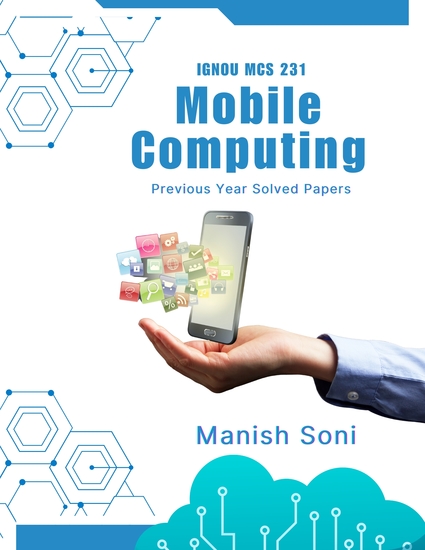
IGNOU MCS 231 Mobile Computing Previous Year Solved Papers - cover

IGNOU MCS 231 Mobile Computing Previous Year Solved Papers

Manish Soni

Publisher: Poorav Publications

  • 0
  • 0
  • 0

Summary

The study of algorithms is fundamental to the field of computer science and engineering, and it forms the backbone of software development, data processing, and problem-solving. The course MCS-231: Mobile Computing, offered by the Indira Gandhi National Open University (IGNOU), is pivotal for students pursuing a degree in computer science. The rigorous curriculum of this course requires students to not only understand the theoretical aspects of algorithms but also to apply this knowledge in solving complex computational problems. To assist students in their journey of mastering this subject, this book presents a comprehensive collection of previous years' unsolved papers of the MCS-231 course. The rationale behind compiling these unsolved papers is to provide students with a valuable resource that will enhance their understanding of the subject and prepare them effectively for examinations. These papers serve as an essential tool for self-assessment, allowing students to gauge their knowledge, identify areas that require further study, and practice solving problems within the time constraints typically imposed by examinations. Moreover, working through these papers helps students develop the analytical thinking and problem-solving skills necessary to excel in the field of Mobile Computing.This book is meticulously organized to cater to the needs of students at various levels of understanding. Each paper included in this compilation is carefully selected from different years to represent a broad spectrum of topics covered in the MCS-231 syllabus. The problems range from basic algorithmic challenges to more complex scenarios that test a student’s ability to design efficient and effective algorithms. By attempting these unsolved papers, students will not only reinforce their theoretical knowledge but also gain hands-on experience in tackling real-world algorithmic problems. In addition to serving as an academic resource, this book is also intended to instil confidence in students as they prepare for their examinations. The exposure to a variety of problems will familiarize students with the types of questions that are likely to appear in exams, enabling them to approach their studies with a strategic mindset. This book encourages a deeper exploration of the subject, prompting students to engage with the material beyond the standard textbook content and to think critically about the design and analysis of algorithms.
 
We would like to express our gratitude to the students and educators who have contributed to the development of this book. Their insights and feedback have been invaluable in ensuring that this compilation meets the highest standards of academic excellence. As you embark on your journey through the world of algorithms, we hope that this book will be a reliable companion in your studies, helping you to unlock the full potential of your capabilities in the field of computer science
Available since: 11/13/2024.
Print length: 30 pages.

Other books that might interest you

  • The Miracle of Our Universe - A New View of Consciousness God Science and Reality - cover

    The Miracle of Our Universe - A...

    Marsha Sims, Bernard Haisch

    • 0
    • 0
    • 0
    Without consciousness there is nothing. Have you ever wondered why and how the world around you came to exist, and whether there might be an afterlife experience awaiting you after our physical bodies die? Might there actually be a God and a heaven of some sort? The hypothesis presented in this book is that our seemingly physical universe of matter and energy is a virtual simulation which is thought into existence by a universal consciousness which we call God. 


    A reason for a universal consciousness to do such a thing could be to experience and evolve itself through the free will actions of its offspring. This would entail thinking into existence a virtual universe so as to interact with such a universe and each other. Literally everything is consciousness in action, resulting in a gigantic cosmic simulation. We and other creatures are offspring of this God consciousness. 


    The Miracle of Our Universe explores the forefront of science and spirituality research, including: Are near-death experiences real? What is the Zero-Point Field? What kind of being could God be? Is there some place that God could have come from? How does the Big Bang figure into this? Is there an afterlife and what could it be like? What is the purpose of life? Is consciousness all there is? Is the Universe a virtual reality? Why is Hell impossible?
    Show book
  • HBR Guide to Generative AI for Managers - cover

    HBR Guide to Generative AI for...

    Elisa Farri, Gabriele Rosani

    • 0
    • 0
    • 0
    Leverage gen AI to save time, innovate faster, and lead effectively. 


    You're probably aware that generative AI can output quality text and create stunning images in seconds. But smart managers are now using gen AI for high-level work—problem-solving, driving innovation, strategic thinking, and dozens of other applications. Managers who develop their generative AI capabilities will soon be leaping ahead of those who don't. Fortunately, you can start today and see immediate results. 


    The HBR Guide to Generative AI for Managers is packed with practical tips, prompts, and case studies to accelerate and improve countless aspects of your work. 


    You'll learn how to run smart experiments; boost your productivity; determine the right collaboration mode—a co-pilot or a co-thinker; dialogue with AI for better decision-making; be aware of the risks and avoid traps; and capitalize on your gen AI-enabled mindset.
    Show book
  • AI Time Machine – The Art of Prompting - The Brightest Minds from History Unlock the Secrets to Perfect Prompts with Humor - cover

    AI Time Machine – The Art of...

    Nikolay Gul

    • 0
    • 0
    • 0
    This audiobook is narrated by an AI Voice.   
    Extended Audiobook Edition — Includes Bonus Chapters 
    What if Socrates, Leonardo da Vinci, Ada Lovelace, and Mark Twain sat at your table and showed you how to master modern AI? 
    AI Time Machine – The Art of Prompting is a seatbelt-optional ride through history’s sharpest minds, blended with practical frameworks and laugh-out-loud commentary. 
    Pull up a chair at a roundtable where philosophers, scientists, and satirists debate how to get reliable results from AI—while a mischievous machine chimes in with glitches, sarcasm, and hard truths. The result is a one-of-a-kind guide to prompting that’s as entertaining as it is useful. 
    What you’ll learn 
    10+1 Timeless Laws: clarity, context, roles, constraints, iteration, analogy, Socratic looping, inversion, bias disruption, ethics, and the Glitch Law. 
    Reusable Templates you can drop into marketing, sales, writing, research, or study. 
    Prompt Labs & Pro Tips at the end of each law for same-day practice. 
    Bonus Chapters: the Prompt Multiverse, the Future-Echo Contract, and case files imagining AI in the Age of Steam. 
    Who it’s for 
    Marketers & Entrepreneurs – persuasive copy, research, and campaigns that save time. 
    Students & Educators – clearer questions, better answers. 
    Writers & Creatives – role-play, analogies, and humor to spark ideas. 
    Tech Leaders & Professionals – strategy-first prompts you can trust. 
    A smart, funny companion for anyone who wants AI to work with them, not against them.
    Show book
  • Harnessing Disruption - Building the Tech Future Without Breaking Society - cover

    Harnessing Disruption - Building...

    Sarah Kreps

    • 0
    • 0
    • 0
    In Harnessing Disruption, Sarah E. Kreps—a national security expert and military veteran—offers a fresh, clear-eyed framework for understanding the social and political dynamics that shape technological change. From nuclear weapons to AI, cryptocurrency, and social media, breakthrough innovations rarely arrive without backlash. Disruption is not collapse. History shows it is part of a recurring pattern.With unmatched insight and authority, Kreps traces a five-stage cycle that technologies follow: emergence, early warnings, crisis, agenda-setting, and institutional response. Drawing on decades of research and real-world policy experience, she argues that disruption is neither inherently dangerous nor inherently self-correcting. Rather, it's a process we can steer, if we learn to see the signs and act decisively.Harnessing Disruption challenges fatalistic narratives that cast AI and other technologies as uncontrollable forces. It makes the case for cautious optimism: that institutions can adapt, societies can recalibrate, and technologies can be governed in ways that protect both innovation and the public good. Timely, incisive, and grounded in both historical precedent and contemporary case studies, this book provides the tools for anyone to understand where we are in the cycle of disruption and how to shape what comes next.
    Show book
  • Waste Empire - Pollution Fast Fashion And The Circular Economy Revolution - cover

    Waste Empire - Pollution Fast...

    Davis Truman

    • 0
    • 0
    • 0
    Fast fashion has taken the world by storm, delivering trendy, affordable clothing at breakneck speed. But behind the allure lies a darker truth — one of environmental devastation, exploitative labor practices, and staggering waste. Waste Empire unravels the global impact of this multibillion-dollar industry, exposing how fast fashion fuels pollution and exacerbates climate change. 
    This compelling and insightful book explores the hidden cost of our obsession with disposable clothing, from toxic dyes polluting rivers to mountains of textile waste clogging landfills. It takes readers on a journey through the supply chains of major brands, revealing the human and ecological toll of unchecked consumerism. 
    But Waste Empire is not just a tale of destruction. It also illuminates a path forward, showcasing the revolutionary potential of the circular economy. Through real-world examples, innovative strategies, and interviews with thought leaders, the book highlights solutions that prioritize sustainability, ethical practices, and environmental stewardship. 
    Whether you’re a conscious consumer, industry professional, or sustainability advocate, Waste Empire offers a gripping look at the urgent need to transform the fashion industry — and a hopeful blueprint for a future where style meets sustainability.
    Show book
  • Physics - Exploring the Laws of Nature from Quantum to Cosmic Scales - cover

    Physics - Exploring the Laws of...

    Jeron Iris

    • 0
    • 0
    • 0
    Physics is the branch of science that seeks to understand the fundamental nature of the universe. It explores the properties of matter, energy, space, and time, and the interactions between them. From the smallest particles to the vastness of space, physics provides a framework for explaining how the world works. The discipline is built on the foundation of empirical observation, experimentation, and mathematical analysis. 
      
    At its core, physics is concerned with the laws that govern the behavior of objects, forces, and energy. These laws, which have been refined over centuries, are expressed in mathematical equations that predict outcomes with remarkable accuracy. Whether analyzing the motion of a falling apple or the behavior of distant galaxies, physics offers a universal language to describe the phenomena around us. One of its main goals is to uncover the underlying simplicity of nature, finding connections between seemingly different phenomena through the discovery of unifying principles. 
      
    The study of physics began in ancient civilizations, where early thinkers like Aristotle and Archimedes laid the groundwork for future developments. However, it wasn’t until the Renaissance period that physics began to emerge as a distinct scientific discipline, driven by figures such as Galileo Galilei and Isaac Newton. Newton's laws of motion and universal gravitation revolutionized the way we understand movement and forces, forming the basis for classical mechanics.
    Show book