¡Acompáñanos a viajar por el mundo de los libros!
Añadir este libro a la estantería
Grey
Escribe un nuevo comentario Default profile 50px
Grey
Suscríbete para leer el libro completo o lee las primeras páginas gratis.
All characters reduced
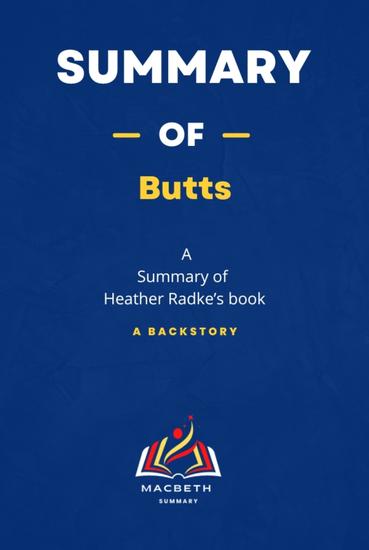
Summary of Butts A Backstory Summary by Heather Radke'book - cover

Summary of Butts A Backstory Summary by Heather Radke'book

MACBETH Summary

Editorial: BookRix

  • 0
  • 0
  • 0

Sinopsis

DISCLAIMER
 
This book does not in any capacity mean to replace the original book but to serve as a vast summary of the original book.
Summary of Butts A Backstory Summary by Heather Radke'book
IN THIS SUMMARIZED BOOK, YOU WILL GET:
 

- Chapter astute outline of the main contents.
- Fast & simple understanding of the content analysis.
- Exceptionally summarized content that you may skip in the original book 
Butts: A Backstory by Heather Radke is one of the most anticipated books of 2022. She explores how butts have come to signify so much more: sex, desire, comedy, shame. The book spans nearly two centuries and examines the central importance of race through figures like Sarah Bartmann and Josephine Baker.
Disponible desde: 03/12/2022.
Longitud de impresión: 10 páginas.

Otros libros que te pueden interesar

  • What to the Slave is the Fourth of July? - cover

    What to the Slave is the Fourth...

    Frederick Douglass

    • 0
    • 0
    • 0
    In 1852, Frederick Douglass, former slave and, by then, a leading figure in the abolitionist movement was asked by the Rochester Ladies' Anti-Slavery Association to address the group for their July 4th celebration at Corinthian Hall in Rochester, New York.Delivered, in fact, on the 5th of July, the speech caused an immediate sensation and swiftly became a seminal rallying cry of the abolitionist movement in America. The audience in Rochester included none other than President Millard Fillmore (along with a group of politicians from Washington) as well as some of the most important leaders of the abolitionist movement at the time.Through the years, Douglass' powerful words have only grown in stature, resonance and importance. His timeless message and elegant prose have made this speech - here presented in its unabridged, original format - one of the greatest orations in history.
    Ver libro
  • 1999 - The Year Low Culture Conquered America and Kickstarted Our Bizarre Times - cover

    1999 - The Year Low Culture...

    Ross Benes

    • 0
    • 0
    • 0
    From pro wrestling and Pokémon to Vince McMahon and Jerry Springer, this look at the low culture of the late '90s reveals its profound impact and how it continues to affect our culture and society today. 


    According to Benes, there are many lessons to learn from the year that low culture conquered the world. Talk shows and reality TV foreshadowed the way political movements grab power by capturing our attention. Pro wrestling mastered the art of "kayfabe"—the agreement to treat something as real and genuine when it is not—before it spread throughout American society, as political contests, corporate public relations campaigns, and nonprofit fundraising schemes have become their own wrestling matches that require a suspension of disbelief. Beanie Babies and Pokémon demonstrate capitalism's resiliency as well as its vulnerabilities. Legal and technological victories obtained by early internet pornographers show how the things people are ashamed of have the ability to influence the world. Insane Clown Posse's creation of loyal Juggalos illustrates the way religious and political leaders are able to generate faithful followers by selling themselves as persecuted outsiders. And the controversy over video game violence reveals how every generation finds new scapegoats. 1999 is not just a nostalgic look at the past. It is also a window into our contentious present.
    Ver libro
  • Unmasking the Klansman - The Double Life of Asa and Forrest Carter - cover

    Unmasking the Klansman - The...

    Dan T. Carter

    • 0
    • 0
    • 0
    Unmasking the Klansman may read like a work of fiction but is actually a biography of Asa Carter, one of the South's most notorious white supremacists (and secret Klansman). In the early 1960s Carter became a secret adviser to George Wallace and wrote the Alabama governor's infamous 1963 inauguration speech vowing "segregation now, segregation tomorrow, segregation forever." When Carter disappeared from Alabama in 1972, few knew that he had assumed a new identity in Abilene, Texas, masquerading as a Cherokee American novelist. Using the name "Forrest" Carter, he published three successful Western novels, including The Rebel Outlaw, which Clint Eastwood made into a movie. His last book, The Education of Little Tree (a fake biography of his supposed Indian childhood) posthumously became a number one bestseller in 1991. 


    Author Dan T. Carter uncovered "Forrest" Carter's true identity while researching his biography of Georgia Wallace and in a New York Times op-ed he exposed Carter's deception. Although the difficulties of uncovering the full story of the secretive Carter initially led him to abandon the project, in 2018 he gained access to more than two hundred interviews by the late Anniston newsman, Fred Burger. These recordings and his two decades of exhaustive research finally brought Asa Carter's story into focus. Unmasking the Klansman is the result.
    Ver libro
  • Bottom Shelf: How a Forgotten Brand of Bourbon Saved One Man's Life - cover

    Bottom Shelf: How a Forgotten...

    Fred Minnick

    • 0
    • 0
    • 0
    A forgotten bottle. A buried legacy. And one man determined to uncover the truth about his favorite bourbon.
     
    Before he became one of the most influential voices in American whiskey, Fred Minnick was a combat veteran wrestling with the invisible wounds of war. What started as a quiet exploration of taste and ritual soon became something more―a way to calm his mind, reconnect with his senses, and slowly rebuild a life.
     
    Today, Fred's palate shapes the industry. His reviews move markets, his instincts set trends. So when he casually named a dusty 1969 bottle of Old Crow as his all-time favorite in an interview, the response was seismic: prices soared from $40 to $3,000 almost overnight. But behind the buzz was a deeper mystery. Once revered by presidents, poets, and distillers alike, Old Crow had been stripped of its legacy and banished to the bottom shelf. Why was one of bourbon's most iconic brands abandoned―and what really happened to the whiskey itself?
     
    Part memoir, part whiskey-world investigation, Bottom Shelf unearths the forgotten history of America's most misunderstood bourbon―and reveals how one man's search for flavor became a fight to rediscover meaning, purpose, and truth in a world full of half-truths and tall tales.
    Ver libro
  • Perfect Your Writing - How to be a stylish insightful and convincing writer - cover

    Perfect Your Writing - How to be...

    William Strunk Jr., Mark Twain,...

    • 0
    • 0
    • 0
    Are you keen to perfect your writing? This audiobook will teach you how to be a stylish, insightful and convincing writer. This compilation includes Twain's On the Decay of the Art of Lying, Strunk's The Elements of Style, and Bennett's The Author's Craft - all in one.The Elements of Style by William Strunk Jr first clarifies the writer's understanding of how to - correctly. In it, Strunk has laid a detailed, essential map, one he believed pays off, for in unlocking the secrets of style, one opens the terrain for mastery of literature.Now over a century since its first publication, the book is anything but outdated, as it is still widely used today – just testament to Strunk’s timeless knowledge and mastery with the pen."The skilled observer ... does not have to change his mind." – Arnold Bennett.The Author's Craft is Arnold Bennett’s four-part writing tutorial. As an esteemed journalist, novelist and playwright, he believed truly 'Seeing Life' primed the pen, out of which 'Writing Novels', 'Writing Plays' and 'The Artist and The Public' emerge. In the exposition, he expands on how to see the world, and how to not overlook the details most miss… These skills and techniques give rise to the craft he feels the author is really trying to achieve: art.Mark Twain’s “On the Decay of the Art of Lying” was his wryly told essay on why he felt the world needs educated lying, published in 1880 for a meeting of the Historical and Antiquarian Club of Hartford, Connecticut. The way he saw it, everyone lies at some point in their lives. Twain decided that lying could be a valuable skillset in various different arenas - provided you knew how to do it well, and didn’t try to hurt anybody. As he put it, "What chance has the ignorant uncultivated liar against the educated expert? What chance have I against Mr. Per—against a lawyer? Judicious lying is what the world needs."
    Ver libro
  • Death Ray The: The History and Conspiracy Theories Surrounding Nikola Tesla’s Futuristic Weapon - cover

    Death Ray The: The History and...

    Charles River Editors

    • 0
    • 0
    • 0
    Nikola Tesla was one of history’s greatest scientists, and though he is best known for his pioneering work with electricity, the fact that he is mostly remembered solely for that actually does a disservice to his legacy. Born a Serb in the Austrian Empire, Tesla came to the United States and worked in a laboratory for none other than the Wizard of Menlo Park, Thomas Edison. 
    Having established AC as an electrical supply system, Tesla became a global celebrity, and his devices and inventions fascinated people. Tesla tinkered with everything from X-rays to wireless communications and even attempted a primitive form of the radio. While Tesla was not able to successfully execute the devices and concepts he foresaw, his forward thinking in fields like wireless communication certainly proved prescient, and his futuristic devices and his later reputation for eccentricity helped create the “mad scientist” image that still remains a pop culture fixture. Tesla seemed to have come to grips with this aspect of his legacy late in life, noting, “The scientific man does not aim at an immediate result. He does not expect that his advanced ideas will be readily taken up." 
    During World War I, in December 1915, Tesla gave an interview to The New York Times in which he claimed he was working on something entirely new, a weapon that would use electrical power to instantly destroy a distant target. He explained that this weapon was “so far developed that great destructive effects can be produced at any point on the globe, determined beforehand and with great accuracy.” Tesla called this new weapon the “Teleforce,” and he would continue working on this project for the rest of his life, but he consistently refused to give details of its operation. Many people believed it was impractical, but with Tesla, it was never possible to be entirely certain.
    Ver libro