¡Acompáñanos a viajar por el mundo de los libros!
Añadir este libro a la estantería
Grey
Escribe un nuevo comentario Default profile 50px
Grey
Suscríbete para leer el libro completo o lee las primeras páginas gratis.
All characters reduced
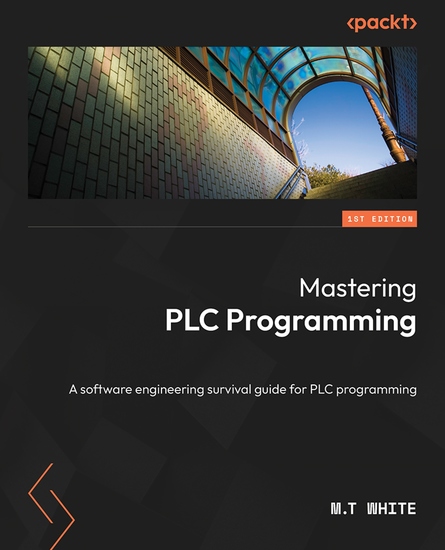
Mastering PLC Programming - The software engineering survival guide to automation programming - cover

Mastering PLC Programming - The software engineering survival guide to automation programming

M. T. White

Editorial: Packt Publishing

  • 0
  • 0
  • 0

Sinopsis

Object-oriented programming (OOP) is a new feature of PLC programming that has taken the automation world by storm. This book provides you with the necessary skills to succeed in the modern automation programming environment.The book is designed in a way to take you through advanced topics such as OOP design, SOLID programming, the software development lifecycle (SDLC), library design, HMI development, general software engineering practices, and more. To hone your programming skills, each chapter has a simulated real-world project that’ll enable you to apply the skills you’ve learned. In all, this book not only covers complex PLC programming topics, but it also removes the financial barrier that comes with most books as all examples utilize free software. This means that to follow along, you DO NOT need to purchase any PLC hardware or software.By the end of this PLC book, you will have what it takes to create long-lasting codebases for any modern automation project.
Disponible desde: 24/03/2023.
Longitud de impresión: 388 páginas.


Otros libros que te pueden interesar

  • Life Among The Ants - cover

    Life Among The Ants

    Vance Randolph

    • 0
    • 0
    • 0
    Beneath our feet lies a world of farmers, builders, soldiers, nurses, and explorers. 
     
    In Life Among the Ants, Vance Randolph offers an engaging introduction to the remarkable biology and social organization of one of nature’s most successful insects. 
     
    Beginning with the ant’s anatomy, senses, and internal systems, Randolph explains how queens establish new colonies, how ants develop through complete metamorphosis, and how workers, soldiers, and other specialized castes cooperate to keep their communities alive. 
     
    The journey continues through some of the ant world’s most fascinating societies. Discover harvesting ants that gather and store seeds, leaf-cutting ants that cultivate fungus, honey ants that preserve food within living members of the colony, and ants that tend aphids for their sweet honeydew. Randolph also examines army ants, territorial conflict, and the extraordinary behavior of species that raid neighboring colonies. 
     
    Originally published as an accessible work of popular science, Life Among the Ants combines natural history with vivid observations of cooperation, adaptation, survival, and social behavior. 
     
    Narrated by Kris Keppeler, this classic exploration offers curious listeners an illuminating glimpse into the complex civilizations thriving just beneath the surface of the natural world.
    Ver libro
  • Science - from Civizilation in The United States - cover

    Science - from Civizilation in...

    Robert H. Lowie

    • 0
    • 0
    • 0
    What makes a nation scientific: its inventions, or its willingness to pursue knowledge without an immediate profit? 
     
    In this incisive essay from *Civilization in the United States*, anthropologist Robert H. Lowie examines America’s complicated relationship with scientific achievement. 
     
    Lowie acknowledges the country’s important researchers and practical accomplishments, but challenges the belief that commercial invention alone represents scientific greatness. America excels at applying discoveries to machines, products, and industry, he argues, while frequently neglecting the patient theoretical work on which those applications depend. 
     
    Pure scientists face limited funding, low professional status, exhausting teaching and administrative duties, and pressure to produce results that appeal to wealthy patrons or business-minded institutions. Universities often prize organization, efficiency, and publicity above the independent thinkers whose creativity gives scientific institutions their value. 
     
    Lowie also warns against intellectual conformity. Genuine discovery requires more than technical skill: it demands broad education, academic freedom, philosophical reflection, and what he calls “reasoned nonconformism”—the courage to question accepted authorities without abandoning evidence or disciplined thought. 
     
    Originally published in 1922, *Science* is a thoughtful critique of commercialism, institutional bureaucracy, and the cultural conditions required for lasting innovation. 
     
    Narrated by John Riddle.
    Ver libro
  • Paleozoic Era The: The History of the Geologic and Evolutionary Changes that Began Over 500 Million Years Ago - cover

    Paleozoic Era The: The History...

    Editors Charles River

    • 0
    • 0
    • 0
    The current view of science is that Earth is around 4.6 billion years old, and the first 4 billion years of its development are known as the Precambrian period. For the first billion years or so, there was no life in Earth. Then the first single-celled life-forms, early bacteria and algae, began to emerge. It’s unclear where they came from or even if they originated on this planet at all, but this gradual development continued until around four billion years ago when suddenly (in geological terms) more complex forms of life began to emerge.  
    	Scientists call this time of an explosion of new forms of life the Paleozoic Era, and it stretched from around 541 to 250 million years ago. In the oceans and then on land, new creatures and plants began to appear in bewildering variety, and by the end of this period, life on Earth had diversified into a myriad of complex forms that filled virtually every habitat and niche available in the seas and on the planet’s only continent, Pangea. 
    	The Precambrian Period is divided into three eons: the Hadean, the Archaean, and the Proterozoic. One layer of carbon in rocks that date to the Archaean Eon, found on islands west of Greenland, seems to have fossilized tracks that may have been left by some form of organic life, but scientists simply are not certain. The oldest confirmed remains of life date from the same eon and were found in rocks in Western Australia, which were found to contain fossilized bacteria estimated to be 3.46 billion years old. It seems likely that there were thousands, perhaps even millions of forms of life in these early periods, and most seem to have been microscopic in size and very simple in developmental terms.
    Ver libro
  • Euclid: The Life and Legacy of the Ancient Greek Mathematician Who Pioneered Geometry - cover

    Euclid: The Life and Legacy of...

    Charles River Editors

    • 0
    • 0
    • 0
    Of the many mathematical advances made by the Greeks, none rival those established by Euclid of Alexandria, who likely remains the most famous ancient mathematician despite the fact little is actually known about his life. He revolutionized geometry, mathematics, and astronomy in Alexandria, Egypt, around 300 BCE, yet left almost no clues about his life story. Historians know he was a trailblazing mathematician and dabbled in astronomy because he wrote many books on these topics, and a 13-book treatise of his has survived, along with four other books. Thus, it’s clear what Euclid learned and knew, but virtually nothing is known about how his life unfolded or what he was like as a person.  
    	To this day for many students, geometry class was the first time discovering that mathematics is more than calculating numbers. Some may have expected to study shapes, sizes, positions, and the properties of space, but perhaps for the first time, a geometry class required proving why the calculations were true through rigorous, logical arguments using definitions, postulates, and theorems. For countless students, it is excruciating, while others find it fascinating. Either way, the person to thank (or blame) for that is Euclid.  
    	Often called the “Father of Geometry,” Euclid’s influence is so pervasive that his book, The Elements, was the primary math manual for over 2,000 years. It was not a “textbook” in the modern sense, as it did not have problem sets, word problems, or diagrams for practice, but it was a foundational reference and logical guide that students had to read, memorize, and demonstrate. In both the Western and Islamic worlds, Euclid’s Elements was the standard geometry text for almost every educated person until the 19th century.
    Ver libro
  • The Digital Factory - The Human Labor of Automation - cover

    The Digital Factory - The Human...

    Moritz Altenried

    • 0
    • 0
    • 0
    The Digital Factory reveals the hidden human labor that supports today’s digital capitalism. 
      
    The workers of today’s digital factory include those in Amazon warehouses, delivery drivers, Chinese gaming workers, Filipino content moderators, and rural American search engine optimizers. Repetitive yet stressful, boring yet often emotionally demanding, these jobs require little formal qualification, but can demand a large degree of skills and knowledge. This work is often hidden behind the supposed magic of algorithms and thought to be automated, but it is in fact highly dependent on human labor. 
      
    The workers of today’s digital factory are not as far removed from a typical auto assembly line as we might think. Moritz Altenried takes us inside today’s digital factories, showing that they take very different forms, including gig economy platforms, video games, and Amazon warehouses. As Altenried shows, these digital factories often share surprising similarities with factories from the industrial age. As globalized capitalism and digital technology continue to transform labor around the world, Altenried offers a timely and poignant exploration of how these changes are restructuring the social division of labor and its geographies as well as the stratifications and lines of struggle.
    Ver libro
  • Artificial Intelligence with Python for Beginners - Comprehensive Guide to Building AI Applications - cover

    Artificial Intelligence with...

    James Ferry

    • 0
    • 0
    • 0
    "Artificial Intelligence with Python for Beginners: A Practical Guide to Building AI Applications" is your gateway to understanding and harnessing the power of artificial intelligence using Python. Whether you're a novice programmer, a student eager to explore the world of AI, or a professional looking to expand your skill set, this book offers a comprehensive introduction to the fundamentals of AI and practical guidance on building AI applications. 
    Starting with the basics of Python programming, you'll learn essential concepts and techniques that form the foundation of AI development. From there, you'll delve into the exciting world of machine learning, exploring supervised and unsupervised learning algorithms using popular libraries such as Scikit-learn. Through hands-on projects, you'll gain experience in data analysis, predictive modeling, and evaluation, preparing you to tackle real-world problems with confidence. 
    The journey continues with a deep dive into deep learning, where you'll discover the power of neural networks for tasks like image classification and natural language processing. Using TensorFlow and Keras, you'll build and train neural networks from scratch, mastering essential techniques for model architecture design, training, and evaluation. 
    As you progress, you'll explore advanced topics such as reinforcement learning, diving into algorithms that enable agents to learn through trial and error. Through practical projects and step-by-step tutorials, you'll develop skills in problem-solving, decision-making, and optimization, equipping you to tackle a wide range of AI challenges. 
    Throughout the book, emphasis is placed on hands-on learning, with plenty of code examples, exercises, and projects to reinforce your understanding. By the end, you'll have the knowledge and confidence to build your own AI applications, from predictive models and recommendation systems to intelligent agents and chatbots.
    Ver libro