¡Acompáñanos a viajar por el mundo de los libros!
Añadir este libro a la estantería
Grey
Escribe un nuevo comentario Default profile 50px
Grey
Suscríbete para leer el libro completo o lee las primeras páginas gratis.
All characters reduced
Frontiers in Anti-Cancer Drug Discovery: Volume 5 - cover

Frontiers in Anti-Cancer Drug Discovery: Volume 5

M. Iqbal Choudhary Atta-ur-Rahman

Editorial: Bentham Science Publishers.

  • 0
  • 0
  • 0

Sinopsis

Frontiers in Anti-Cancer Drug Discovery” is an Ebook series devoted to publishing the latest and the most important advances in Anti-Cancer drug design and discovery. Eminent scientists write contributions on all areas of rational drug design and drug discovery including medicinal chemistry, in-silico drug design, combinatorial chemistry, high-throughput screening, drug targets, recent important patents, and structure-activity relationships. The Ebook series should prove to be of interest to all pharmaceutical scientists involved in research in Anti-Cancer drug design and discovery. Each volume is devoted to the major advances in Anti-Cancer drug design and discovery. The Ebook series is essential reading to all scientists involved in drug design and discovery who wish to keep abreast of rapid and important developments in the field.
The fifth volume of the series features chapters on the following topics:
-Nutraceuticals and natural food products for cancer treatment
-Pharmacogenomics in Anti-cancer treatment
-Cancer stem cells
-Potassium channel targeting for brain tumor treatment
-Sorafenib in the management of hepatocellular carcinoma
…and more.
Disponible desde: 15/03/2024.


Otros libros que te pueden interesar

  • Construction - Handbook for Project Management and Building Technology - cover

    Construction - Handbook for...

    Phil Gilberts

    • 0
    • 0
    • 0
    Construction management involves overseeing the planning, design, and construction of a project, ensuring it's completed on time, within budget, and to the desired quality standards. It involves coordinating various stakeholders, managing resources, and mitigating risks throughout the construction process. 
      
    Construction management encompasses a wide range of responsibilities and tasks aimed at efficiently executing construction projects. This includes: 
      
    Project Planning: Developing comprehensive project plans outlining the scope, schedule, budget, and resources required for successful completion. 
      
    Contract Administration: Administering contracts, managing subcontractors, and resolving disputes to maintain positive relationships and ensure contractual obligations are fulfilled. 
      
    Communication and Stakeholder Management: Facilitating effective communication among project team members, clients, regulatory agencies, and other stakeholders to promote collaboration and address concerns. 
      
    Health and Safety: Implementing safety measures and protocols to protect workers, visitors, and the public from hazards and ensure compliance with health and safety regulations. 
      
    Overall, construction management plays a critical role in orchestrating all aspects of a construction project to deliver a successful outcome that meets client objectives while adhering to time, cost, and quality constraints.
    Ver libro
  • Introduction to Software Development - From Idea to Application - cover

    Introduction to Software...

    Craig Dames

    • 0
    • 0
    • 0
    Software development is the process of designing, building, testing, and maintaining software applications that solve specific problems or perform particular tasks. It involves various stages, starting from the initial idea to the final deployment of an application. To understand software development, it's essential to look at the different components that make it a structured and iterative process. 
    At its core, software development is about problem-solving. It’s a way to create programs that automate tasks, facilitate communication, or offer solutions to real-world problems. The process typically follows a lifecycle known as the Software Development Life Cycle (SDLC), which includes phases like planning, designing, coding, testing, and maintenance. Each stage of the SDLC is crucial because it helps ensure that the software is built systematically, efficiently, and in alignment with user needs. 
    In any software development project, there are various roles that contribute to the process. The most well-known roles are software developers, but there are many others who play vital parts. These include project managers, who oversee the project and ensure it stays on track, and business analysts, who work to ensure that the software meets the needs of its users. Designers are responsible for creating user-friendly interfaces and experiences, while testers ensure that the software is functioning correctly and free of bugs.
    Ver libro
  • White Lions: Guardians of the Earth At a Time of Crisis - cover

    White Lions: Guardians of the...

    Linda Tucker

    • 0
    • 0
    • 0
    African lion populations have decreased by nearly 70% in the past 50 years. Were it not for some courageous activists that number might be even more catastrophic. Under the spiritual guidance of a wise medicine woman who saved her life in the African wilderness, Linda Tucker abandoned her high-powered career to return to the pride lands and follow her destiny as an appointed “keeper of the white lions.” African Sangomas, who are the indigenous African priests, recognize white lions as the direct messengers of the divine—embodying a sacred essence that balances our planet’s ecosystems, and brings true leadership among living beings. Working tirelessly against the enormous forces that are decimating this precious species Linda Tucker reveals her quest to save the white lions from extinction. (hosted by Justine Willis Toms)
    Ver libro
  • The Buck that Buries its Poo - And 101 Other Fascinating Facts About SA's Wildlife - cover

    The Buck that Buries its Poo -...

    Quinton Coetzee

    • 0
    • 0
    • 0
    Is a zebra black with white stripes or white with black stripes? And why do flamingos stand on one leg while bats hang upside down? Did you know that a chameleon's tongue can shoot out at five times the acceleration of a fighter jet?
    In The Buck That Buries its Poo, naturalist Quinton Coetzee answers these and many other intriguing wildlife questions. He also dispels countless myths and elucidates some of the legends that surround creatures in the South African bush we thought we knew all about. For example, bats do not get tangled in people's hair (because they are far too adept at flying) and elephants are not afraid of mice (but they do fear bees!).
    Other tall tales you might hear around the campfire are that lions roll in animal dung, entrails or carcasses to disguise their scent, and that rhinos have a predilection for stamping out fires. What is true, though, is that hyenas are more closely related to cats than to dogs. This handy guide is based on Coetzee's own research and that of others, and his experience gleaned over decades living close to nature and wildlife. It seeks to unravel the mysteries of nature in Africa – from mammals and birds to arthropods and plants – with fascinating information and fun trivia. It is a book that will enlighten and entertain.
    PS: Zebras are black with white stripes!
    Ver libro
  • NIST CSF 20 - Your essential introduction to managing cybersecurity risks - cover

    NIST CSF 20 - Your essential...

    Andrew Pattison

    • 0
    • 0
    • 0
    A concise introduction to the NIST CSF 2.0The NIST CSF (Cybersecurity Framework) 2.0 is designed to protect organizations from cyber attacks. Although the CSF was developed to help US organizations involved in infrastructure to systematically organize their critical activities and ensure they remain up to date, Version 2.0 states that "The CSF is designed to be used by organizations of all sizes and sectors, including industry, government, academia, and nonprofit organizations, regardless of the maturity level of their cybersecurity programs." NIST 2.0 is an effective and flexible framework that is well-known across the US, and increasingly across the rest of the world. It also aligns closely with ISO 27001 and ISO 22301, and all three standards can operate concurrently.This audiobook will help you understand how to:- Begin implementing the NIST CSF 2.0 in your organization- Build a cybersecurity program, adapt an existing one, or review existing security practices- Integrate the NIST CSF 2.0 with other frameworks such as ISO 27001 and ISO 22301Organizations that comply with the NIST CSF 2.0, ISO 27001, and ISO 22301 demonstrate their commitment to cybersecurity to current and prospective stakeholders.
    Ver libro
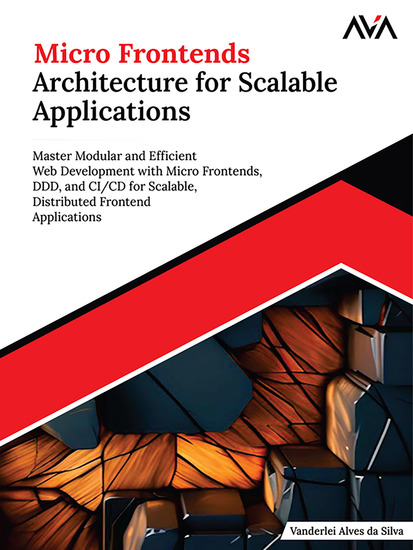
  • Micro Frontends Architecture for Scalable Applications - Master Modular and Efficient Web Development with Micro Frontends DDD and CI CD for Scalable Distributed Frontend Applications - cover

    Micro Frontends Architecture for...

    Vanderlei Silva

    • 0
    • 0
    • 0
    Unleash Agility and Scale with Micro Frontend Architecture.
    Book Description
    As modern web applications grow in complexity, micro frontend architecture offers a scalable, modular approach that helps teams work independently, accelerate delivery, and maintain long-term flexibility. Micro Frontends Architecture for Scalable Applications provides a comprehensive, hands-on guide to implementing micro frontends effectively in real-world projects.
    The book starts by defining frontend and backend development, exploring what is considered a valuable architecture, and introducing various frontend architecture patterns.
    Next, it dives into micro frontends and concepts like Domain-Driven Design, Decentralized Governance, and Independent Deployments. It explains how these principles enable highly observable (easy-to-monitor) micro frontends and covers in-depth discussions on integration strategies, their advantages and disadvantages.
    Communication and routing are thoroughly explored, including Container Applications, State Management, and Cross-Application Communication. The book also addresses UI/UX considerations and how micro frontends interact with varying backend patterns.
    The final part focuses on best practices for testing (unit, integration, and end-to-end), deployment strategies, and essential security measures. It concludes with a real-world case study and insights into the future of micro frontends—highlighting emerging trends, evolving architectures, and the growing impact of artificial intelligence.
    Table of Contents
    1. A Tale of Two Worlds
    2. Valuable Architecture
    3. Frontend Architectural Patterns
    4. Micro Frontend Foundations
    5. Integration Strategies
    6. Communication and Routing
    7. UI/UX and Design System
    8. Backend Patterns
    9. Testing Strategies
    10. Deployment Strategies
    11. Observability
    12. A Micro Frontend Adoption       
    
    Index
    Ver libro