Junte-se a nós em uma viagem ao mundo dos livros!
Adicionar este livro à prateleira
Grey
Deixe um novo comentário Default profile 50px
Grey
Assine para ler o livro completo ou leia as primeiras páginas de graça!
All characters reduced
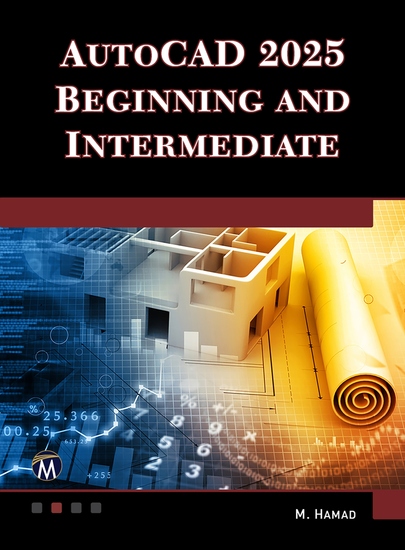
AutoCAD 2025 Beginning and Intermediate - Master essential drafting techniques with AutoCAD 2025 - cover
LER

AutoCAD 2025 Beginning and Intermediate - Master essential drafting techniques with AutoCAD 2025

M Hamad

Editora: Packt Publishing

  • 0
  • 0
  • 0

Sinopse

This book serves as a comprehensive introduction and guide to AutoCAD 2025. Whether you are starting from scratch or seeking to expand your existing knowledge, this resource provides practical skills and an in-depth understanding of essential drafting and design concepts. Its clear instructions and practical examples ensure an engaging learning experience.Covering everything from basic commands to advanced techniques, the book includes detailed chapters on layers, dimensions, plotting, and more. Explore the creation and manipulation of 2D and 3D objects, parametric constraints, and customization tools. With guidance on CAD standards, dynamic blocks, and external referencing, this book bridges the gap between foundational skills and professional-level proficiency.By the end of this journey, readers will have acquired the tools to design, draft, and model with confidence. Learn to optimize workflows, integrate CAD standards, and bring projects to completion effectively and efficiently.
Disponível desde: 24/01/2025.
Comprimento de impressão: 743 páginas.

Outros livros que poderiam interessá-lo

  • The Age of Reason - cover

    The Age of Reason

    Thomas Paine

    • 0
    • 0
    • 0
    "Thomas Paine's "The Age of Reason" is a thought-provoking work that both defends Deism and challenges the world's major monotheistic religions. Let's delve into its fascinating aspects:    Overview:  "The Age of Reason" is a book by English and American political activist Thomas Paine.  It argues for the philosophical position of deism, which emphasizes reason, natural religion, and skepticism toward institutionalized religion.  The book was published in three parts: in 1794, 1795, and 1807.  While it became a best-seller in the United States, British audiences received it with more hostility due to fears of increased political radicalism after the French Revolution.  Key Themes:  Deism: Paine's work follows in the tradition of 18th-century British deism. Deists advocated for free rational inquiry, religious toleration, and an end to religious persecution.  Natural Law: Deists believed that all things in the universe, including God, must obey the laws of nature. They rejected miraculous accounts and insisted on reason and rationality.  Bible Critique: Paine challenges the legitimacy of the Bible, viewing it as an ordinary piece of literature rather than a divinely-inspired text.  Appealing Style: By presenting deistic arguments in an engaging and irreverent style, Paine made deism accessible to the masses.  "The Age of Reason" remains a significant work that shaped intellectual discourse and inspired free thinkers."
    Ver livro
  • Biomedical Engineering - The Fundamentals of Biotechnology - cover

    Biomedical Engineering - The...

    Phil Gilberts

    • 0
    • 0
    • 0
    Biochemical engineering integrates the principles of biology, chemistry, and engineering to develop processes for the large-scale production of valuable biochemicals. This interdisciplinary field plays a crucial role in industries such as pharmaceuticals, biotechnology, food and beverage, and environmental engineering. 
      
    One of the fundamental aspects of biochemical engineering is fermentation, which involves the controlled growth of microorganisms like bacteria, yeast, or fungi to produce desired compounds. These microorganisms can be genetically engineered or selected for their ability to synthesize specific products, such as antibiotics, vitamins, or biofuels. 
      
    Biocatalysis is another key area within biochemical engineering, focusing on the use of enzymes or whole cells to catalyze chemical reactions. By harnessing the specificity and efficiency of biological catalysts, biocatalysis offers environmentally friendly and cost-effective solutions for chemical synthesis and manufacturing processes. 
      
    Bioseparation techniques are essential for isolating and purifying target biomolecules from complex mixtures produced during fermentation or biocatalytic reactions. These techniques include filtration, chromatography, centrifugation, and membrane processes, which enable the recovery of high-purity products for further downstream processing.
    Ver livro
  • Alchemy - A Search for God - cover

    Alchemy - A Search for God

    Maja D'Aoust

    • 0
    • 0
    • 0
    Alchemy is one of the world's most ancient practices of unification with spirit, God, Goddess, or whatever term you wish to assign to a greater consciousness. 
    In this work, which comprises a series of lectures delivered in the early 2000's, Maja D'Aoust takes us on a journey to explore the history of what Alchemy is in different cultures, timelines and creative practices, to shed some light on this often misunderstood spiritual technique.  Delving into Taoism, Kabbalah, European sources such as Paracelsus, and examining the science behind the implications of making homunculi and Golems, this volume is a thorough, scholarly researched, deep dive into one of the most esoteric subjects a seeker can come across.  With references and quotes by some of the greatest historical multicultural authors in the field, you won't want to miss this enlightening journey into understanding the Alchemical wisdom traditions.
    Ver livro
  • GitHub Copilot - A comprehensive guide to GitHub Copilot - cover

    GitHub Copilot - A comprehensive...

    Et Tu Code

    • 0
    • 0
    • 0
    Unlock the power of GitHub Copilot, the revolutionary AI pair programming tool that helps you write better code faster! 
    This comprehensive guide takes you by the hand and shows you how to get started with GitHub Copilot, leveraging its advanced features to streamline your coding workflow. 
    From setup and configuration to advanced techniques for debugging, testing, and refactoring, this book covers it all. 
    Learn how to use GitHub Copilot's intelligent suggestions, code completion, and error detection capabilities to improve your coding speed and accuracy. Discover how to integrate Copilot with your favorite IDEs, including Visual Studio Code, IntelliJ, and more.
    Ver livro
  • A Life Worth Living - cover

    A Life Worth Living

    Simon Ingram

    • 0
    • 0
    • 0
    Sometimes, looking at your past can give you the strength to move forward. As the classic symptoms of Parkinsons disease began to take control of Simon's life, he became a shadow of his former self. After months of fighting to keep the disease in check, Simon finally found the strength to tell his family and even managed to book an appointment with a neurologist. Sadly, at a time when he needed an experienced health care professional to help him fight his corner, what he got was a cold, uncaring man who clearly had no time for his situation. However, his initial assessment proved to be 100% accurate; at just 36 years of age, Simon was told he had Parkinsons disease. The desire to produce a written account of his life for his immediate family and friends led to A Life Worth Living. Ingram looks back at his life, often with humour and pathos, and decides that the way to keep going is to appreciate the life he has led. The only way to fight is to appreciate what battles he has already fought and won. After all, what else makes a life worth living? Ingram's first-hand account of his life from his early childhood to teen years to his first signs of the debilitating disease give an insider's look at not just a 'disease' but a man.
    Ver livro
  • Race for Nuclear Weapons during World War II The: The History and Legacy of Both Sides’ Efforts to Build an Atomic Bomb - cover

    Race for Nuclear Weapons during...

    Editors Charles River

    • 0
    • 0
    • 0
    Before the Second World War, military conflicts were fought under orthodox conditions, usually termed “conventional warfare,” but several innovations had significantly changed combat, leading inextricably to the race for a nuclear weapon in the 1930s and 1940s. Conflicts had been fought by armies on horseback with guns of varying sophistication since the 16th century, but mechanized warfare and machine guns changed this calculus and set the stage for future combat by the end of World War I. Other sinister changes entered the fray during this conflict, such as chemical weapons like chlorine and mustard gas. The total warfare brought about by World War I and ensuing wars like the Spanish Civil War made the quest for the most powerful weapons somewhat necessary. 
    The Manhattan Project would ultimately yield the “Little Boy” and “Fat Man” bombs that released more than 100 Terajoules of energy at Hiroshima and Nagasaki, but as it turned out, the Axis were not far behind with their own nuclear weapons program. When the Nazis’ quest for a nuclear weapon began in earnest in 1939, no one really had a handle on how important nuclear weapons would prove to war and geopolitics. The attacks on Hiroshima and Nagasaki in August 1945, along with the Cold War-era tests and their accompanying mushroom clouds, would demonstrate the true power and terror of nuclear weapons, but in the late 1930s these bombs were only vaguely being thought through, particularly after the successful first experiment to split the atom by a German scientist. The nuclear age itself was in its infancy, barely 35 years old, but within a few short years the advent of nuclear war loomed over the world and the prospect of the enemy winning the nuclear race kept Allied leaders awake at night.
    Ver livro