Junte-se a nós em uma viagem ao mundo dos livros!
Adicionar este livro à prateleira
Grey
Deixe um novo comentário Default profile 50px
Grey
Assine para ler o livro completo ou leia as primeiras páginas de graça!
All characters reduced
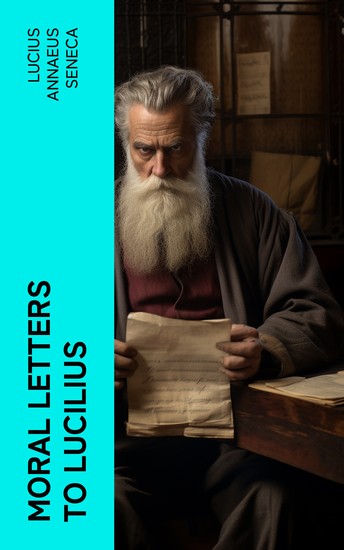
Moral Letters to Lucilius - Epistulae Morales ad Lucilium - cover
LER

Moral Letters to Lucilius - Epistulae Morales ad Lucilium

Lucius Annaeus Seneca

Tradutor Richard Mott Gummere

Editora: e-artnow

  • 0
  • 0
  • 0

Sinopse

The Epistulae Morales ad Lucilium, also known as the Moral Epistles, is a collection of 124 letters which were written by Seneca the Younger at the end of his life, during his retirement, and written after he had worked for the Emperor Nero for fifteen years. They are addressed to Lucilius, the then procurator of Sicily, although he is known only through Seneca's writings. Although these letters deal with Seneca's eclectic form of Stoic philosophy, they also give us valuable insights into daily life in ancient Rome.
Disponível desde: 20/12/2023.
Comprimento de impressão: 724 páginas.

Outros livros que poderiam interessá-lo

  • Philosophy in Ancient Greece: The History and Legacy of the Greeks’ Philosophical Schools of Thought - cover

    Philosophy in Ancient Greece:...

    Editors Charles River

    • 0
    • 0
    • 0
    In virtually all fields of human endeavor, ancient Greece was so much at the forefront of dynamism and innovation that the products of its most brilliant minds remain not only influential but entirely relevant to this day. In the field of medicine, the great physician Hippocrates not only advanced the practical knowledge of human anatomy and caregiving but changed the entire face of the medical profession. The great philosophers of Athens, men like Aristotle, Socrates, and Plato, interrogated themselves with startling complexity about the nature of good and evil, questioned the existence of divinity, advocated intelligent design, and went so far as to argue that all life was composed of infinitesimal particles.  
    	Although the school of philosophy started by Socrates and championed by Plato and Aristotle continues to be the most famous, other schools of thought began to branch, including the Epicureans and Cynics. In the 3rd century B.C., Stoicism arose in response to and under the influence of these older schools, combining many of the best theories from each into a more cohesive whole. With a greater flexibility and more practical application to everyday life, Stoicism quickly became a very popular school of thought, a growth made exponential by its introduction to the Romans.  
    Today, very few have heard of him, but he became a major philosophical and religious figure through the publication of his thoughts, travels, and miracles by Philostratus the Elder (c. 170-247 A.D.), written about a century after Apollonius of Tyana’s death. Philostratus the Elder’s works were based on the works of other writers (Maximus of Aegae, Damis, and Moeragenes), and miracles attributed to Apollonius were often compared to those of Jesus, who lived around the same time. 
    Ver livro
  • Most Famous Silent Film Actors The: The History of the Actors Who Helped Shape Hollywood in the Roaring Twenties - cover

    Most Famous Silent Film Actors...

    Editors Charles River

    • 0
    • 0
    • 0
    Only a select few actors become international stars in their time, but none had as unique a career as Charlie Chaplin. Chaplin was the first true film star, and he managed to do so even when films were still silent. He has been honored with too many awards to count, and the fact that his name remains instantly recognizable nearly a century after his first film is a testament to his influence. Chaplin is known for the singular blend of pathos and humor evinced by his films, and it is not uncommon for audiences to laugh and cry at alternate points of a Chaplin film, a trait that continues to endear audiences even to this day. 
    In the 1920s, the burgeoning movie industry was starting to come into its own, and alongside actor and director Charlie Chaplin, Buster Keaton was at the peak of Hollywood. It’s no surprise that Keaton was so effective in silent films, because he had been practicing comedy in his family’s vaudeville acts as “The Little Boy Who Can’t Be Damaged”, becoming a popular performer by the age of 5. Indeed, his physical form of comedy, which initially involved having his father throwing him around the stage, translated well onto the screen, and some of his slapstick and other comic gags remain legendary even today, in part because Keaton practiced his own stunts.  
    Everything about Rudolph Valentino, from his body to the characters he played, was exotic. His career may have been abbreviated by his premature death at the age of 31, but Valentino popularized the (somewhat racist) stereotype of the “Latin lover” in Hollywood, and even his name was markedly more out of the ordinary than those of other actors. In an era dominated by hyper-masculine actors like Douglas Fairbanks, or comedians such as Charlie Chaplin and Buster Keaton, Valentino had a more ethnic and mysterious appeal, and he was lusted after by women to a degree that remains unsurpassed in the industry.
    Ver livro
  • Political Choice in a Polarized America - How Elite Polarization Shapes Mass Behavior - cover

    Political Choice in a Polarized...

    Joshua N. Zingher

    • 0
    • 0
    • 0
    What motivates citizens to support one party over the other? Do they carefully weigh all of the relevant issues and assess which party or candidate best matches their own positions? Or do people look at politics as something more akin to a team sport—the specifics do not matter as long as you know what side your team is on? Answering these questions requires us to think about how much the average American knows about politics. Many scholars of public opinion believe that the majority of Americans only pay passing attention to politics. Thus the electorate's apparent lack of political competence presents a direct challenge to normative theories of democracy. How are citizens supposed to exert control over the government if they have no idea what is going on? 


    In Political Choice in a Polarized America, Joshua N. Zingher argues that these fears are overblown. Not only do individuals have core beliefs about what the government should or should not do, but individuals have become more likely to support the party that best matches their policy attitudes by both identifying as a member of that party and voting for that party in elections. However, as Zingher demonstrates, voters' ability to match their attitudes to a party or candidate varies according to signals sent by elites and increases as parties become more polarized.
    Ver livro
  • Urban Lowlands - A History of Neighborhoods Poverty and Planning - cover

    Urban Lowlands - A History of...

    Steven T. Moga

    • 0
    • 0
    • 0
    Interrogates the connections between a city’s physical landscape and the poverty and social problems that are often concentrated at its literal lowest points.In Urban Lowlands, Steven T. Moga looks closely at the Harlem Flats in New York City, Black Bottom in Nashville, Swede Hollow in Saint Paul, and the Flats in Los Angeles, to interrogate the connections between a city’s actual landscape and the poverty and social problems that are often concentrated at its literal lowest points. Taking an interdisciplinary perspective on the history of US urban development from the nineteenth to the mid-twentieth century, Moga reveals patterns of inequitable land use, economic dispossession, and social discrimination against immigrants and minorities. In attending to the landscapes of neighborhoods typically considered slums, Moga shows how physical and policy-driven containment has shaped the lives of the urban poor, while wealth and access to resources have been historically concentrated in elevated areas—truly “the heights.” Moga’s innovative framework expands our understanding of how planning and economic segregation alike have molded the American city.
    Ver livro
  • Couple Relations - A Contemporary Introduction - cover

    Couple Relations - A...

    Mary Morgan

    • 0
    • 0
    • 0
    In this book, Mary Morgan provides a comprehensive understanding of couple relations. 
    Taking a psychoanalytic perspective, Morgan explores some of the fundamental tensions in being part of a couple: between being an individual and a couple, relating, non–relating, and the narcissistic problem in tolerating the otherness and alienness of one’s partner. She guides the reader through managing feelings of both separateness and intimacy, issues around sex and sexuality, the tension between love and hate, and the importance of curiosity. She also elucidates key discoveries of unconscious processes in a couple relationship made by couple psychoanalysts, including unconscious choice of partner, the couple projective system, shared unconscious phantasy and beliefs, unconscious alliances, the couple’s own transference relationship, and how the real "presence" of an other is seen as an "interference" acting on the preconceptions of the other subject. 
    Through Morgan’s accessible and holistic approach, drawing on decades of clinical experience, this book is an essential resource for all psychoanalytic and psychodynamic psychotherapists, counselors working with couples, and researchers and students in Gender Studies, social sciences, psychology, and the humanities.
    Ver livro
  • Settler Militarism - World War II in Hawai'i and the Making of US Empire - cover

    Settler Militarism - World War...

    Juliet Nebolon

    • 0
    • 0
    • 0
    Under martial law during World War II, Hawai'i was located at the intersection of home front and war front. In Settler Militarism, Juliet Nebolon shows how settler colonialism and militarization simultaneously perpetuated, legitimated, and concealed one another in wartime Hawai'i for the purposes of empire building in Asia and the Pacific Islands. She demonstrates how settler militarism operated through a regime of racial liberal biopolitics that purported to protect all people in Hawai'i, even as it intensified the racial and colonial differentiation of Kanaka Maoli, Asian settlers, and white settlers. Nebolon identifies settler militarism's inherent contradiction: It depends on life, labor, and land to reproduce itself, yet it avariciously consumes, via violent and extractive projects, those same lives and natural resources that it needs to subsist. From vaccination and blood bank programs to the administration of internment and prisoner-of-war camps, Nebolon reveals how settler militarism and racial liberal biopolitics operated together in the service of capitalism. Collectively, the social reproduction of these regimes created the conditions for the late-twentieth-century expansion of United States military empire.
    Ver livro