¡Acompáñanos a viajar por el mundo de los libros!
Añadir este libro a la estantería
Grey
Escribe un nuevo comentario Default profile 50px
Grey
Suscríbete para leer el libro completo o lee las primeras páginas gratis.
All characters reduced
Moral Letters to Lucilius - Epistulae Morales ad Lucilium - cover

Moral Letters to Lucilius - Epistulae Morales ad Lucilium

Lucius Annaeus Seneca

Traductor Richard Mott Gummere

Editorial: Good Press

  • 0
  • 0
  • 0

Sinopsis

In "Moral Letters to Lucilius," Seneca, a preeminent Stoic philosopher, embarks on a rich epistolary discourse with his friend Lucilius, exploring the depths of ethical living and the human condition. Through a series of 124 letters, Seneca employs a conversational and reflective literary style that marries personal anecdote with rigorous philosophical argument. The letters grapple with themes of virtue, death, and the importance of self-examination in a tumultuous world, echoing the larger Hellenistic context of moral philosophy, where the quest for wisdom and tranquility was paramount. Seneca, born in Corduba (modern-day Córdoba, Spain) and later serving as a statesman in Rome, faced personal and political turmoil that deeply informed his philosophy. His experiences, including exile and the observation of human vice within the corridors of power, shaped his understanding of Stoicism as a practical guide for resilient living. Seneca's writings are imbued with urgency; he aims to lead his readers toward a life untouched by external chaos, fostering inner peace through rational thought. This compelling collection is a must-read for anyone intrigued by moral philosophy, ethics, or the Stoic tradition. It serves not only as a philosophical treatise but also as a window into the mind of a man who sought to navigate the complexities of life with wisdom. "Moral Letters to Lucilius" will engage those seeking both intellectual stimulation and profound personal insight.
Disponible desde: 01/12/2023.
Longitud de impresión: 724 páginas.
Otros libros que te pueden interesar

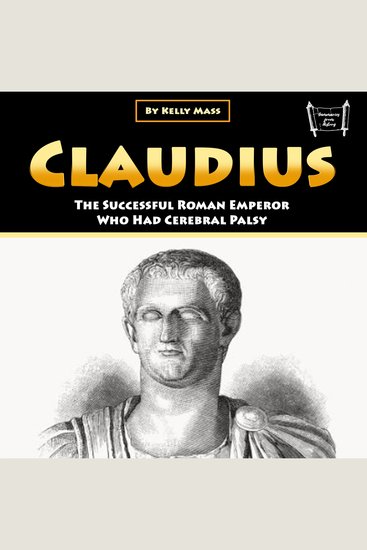
  • Claudius - The Successful Roman Emperor Who Had Cerebral Palsy - cover

    Claudius - The Successful Roman...

    Kelly Mass

    • 0
    • 0
    • 0
    Tiberius Claudius Caesar Augustus Germanicus, better known as Emperor Claudius, ruled the Roman Empire from 41 to 54 AD. Born in Lugdunum (modern-day Lyon, France), in 10 BC, Claudius was the son of Drusus and Antonia Minor, both prominent figures in the Roman elite. His birthplace marked a significant departure from previous emperors, as he was the first Roman Emperor born outside Italy. Though Claudius’ family was rooted in the ancient Sabine people, his upbringing would not follow the traditional path of an elite Roman, largely due to his physical infirmities. He suffered from a limp and mild deafness, conditions that led his family to deem him unfit for public life and dismiss him from military and political endeavors. 
    Growing up in the shadows of more capable and ambitious relatives, Claudius was largely ignored by the Roman aristocracy. His health issues, though perhaps a result of childhood illness, kept him out of sight and out of mind during the brutal purges of Tiberius and Caligula. This absence from political life proved advantageous, as it spared him the many assassination attempts that claimed the lives of his more prominent family members. In a twist of fate, following the assassination of Caligula in 41 AD, the Praetorian Guard, upon finding him hiding in fear, declared Claudius the new emperor. As the only remaining adult male in his family, Claudius ascended to the throne, despite his perceived weakness. 
    Despite initial doubts about his ability to rule, Claudius quickly proved to be a capable and intelligent administrator. He worked tirelessly to stabilize the Roman Empire, which had suffered under the excesses of Caligula’s reign. One of his first actions was to restore the empire’s finances, expanding the imperial bureaucracy to include freedmen, and re-establishing order in the imperial administration.
    Ver libro
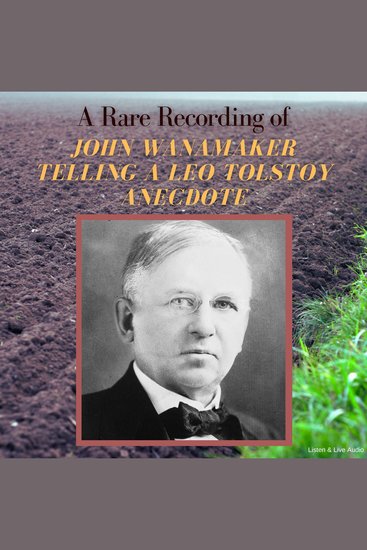
  • A Rare Recording of John Wanamaker Telling a Leo Tolstoy Anecdote - cover

    A Rare Recording of John...

    John Wanamaker

    • 0
    • 0
    • 0
    Unable to make the 1908 Pennsylvania German Society's annual gathering due to illness, their president-- businessman, religious leader, and politician, John Wanamaker--sent in a message he recorded "through this wonderful invention of Mr. Edison on the Edison phonograph." This recording recalls an anecdote of Leo Tolstoy's, in which the Russian writer stopped at the roadside and asked a farmer who was ploughing, "Friend, what would you do today if you knew positively you would die tomorrow?" 
     
    John Wanamaker (July 11, 1838 - December 12, 1922), born in Philadelphia, was a religious, civic, and political figure, as well as, founder of one of the first American department stores. He was considered a proponent of advertising and a "pioneer in marketing." In addition, Wanamaker served as U.S. Postmaster General from 1889 to 1893 during the term of U.S. President Benjamin Harrison.
    Ver libro
  • Jane Austen - A Literary Celebrity - cover

    Jane Austen - A Literary Celebrity

    Peter J. Leithart

    • 0
    • 0
    • 0
    Jane Austen is famous for such books as Persuasion, Pride and Prejudice, and Emma. Now learn about the author’s journey through a life spent making up stories that touched the lives of millions. 
    Jane Austen is now what she never was in life, and what she would have been horrified to become--a literary celebrity. “Janeia” is the author’s term for the mania for all things Austen. Dive into Jane Austen: A Literary Celebrity and discover:how it all began and Austen’s love of poetryher early masterpieces and the inspiration behind the storiesher road to getting published and the health decline that led to her death 
    This biography is perfect for:Jane Austen fans and collectorsmen and women who have enjoyed Austen-inspired films and TV series adaptationsanyone interested in learning about the varied sides of Austen’s character and the characters she created 
    Jane Austen: A Literary Celebrity is a fascinating look at a woman who never meant to be famous.
    Ver libro
  • The Mind Games THEY Play - cover

    The Mind Games THEY Play

    Halbert Ward

    • 0
    • 0
    • 0
    Decode Mind Games Like a Pro: 
    Your Ultimate Guide to Spotting, Resisting, and Thriving Amid Manipulation Tactics 
    What's mind control, you ask? 
    It's the skill that can propel you forward in life, giving you the ability to understand, influence, and navigate the minds of those around you. Whether it's decoding your boss's intentions or enhancing personal relationships, this book is your guide to mastering the art. 
    In "The Mind Games THEY Play," Halbert Ward takes you on a fascinating journey through the intricacies of human psychology, offering 11 proven strategies to unravel the secrets of manipulation and fortify yourself against it. 
    Ward explores the depth of human connection, emphasizing that excellence isn't just about intelligence, it's about forming genuine bonds and possessing a high emotional quotient. Through the pages of this book, you'll discover how to read minds, interpret signals, and build meaningful personal and business relationships. 
     "The Mind Games THEY Play" is not about turning people into robots. It's about knowing what's up, reading the room, and making connections that count. It's also about connecting with people, rocking your emotional intelligence, and navigating life like a champ. From accelerating your career path to keeping your love life drama-free, this book has got your back. 
    So, if you're ready to decode the mysteries of human behavior, stand tall in the face of manipulation, and become a people-whisperer extraordinaire, This book is your go-to guide. Let the Mind Games...begin! 
    Get Your Copy Now! 
    Ver libro
  • A Measure Short of War - A Brief History of Great Power Subversion - cover

    A Measure Short of War - A Brief...

    William C. Wohlforth, Jill Kastner

    • 0
    • 0
    • 0
    In 2016, the United States was stunned by evidence of Russian meddling in the US presidential elections. But it shouldn't have been. Subversion—domestic interference to undermine or manipulate a rival—is as old as statecraft itself. The basic idea would have been familiar to Sun Tzu, Thucydides, Elizabeth I, or Bismarck. 


    It came as a surprise in 2016 because the sole superpower had fallen asleep at the wheel. But what's really new? Have we entered a new age of vulnerability? To answer these questions, and to protect ourselves against future subversion, we need a clear-eyed understanding of what it is and how it works. 


    In A Measure Short of War, Jill Kastner and William C. Wohlforth provide just that, taking the listener on a compelling ride through the history of subversion, exploring two thousand years of mischief and manipulation to illustrate subversion's allure, its operational possibilities, and the means for fighting back against it. With vivid examples from the ancient world, the great-power rivalries of the nineteenth century, epic Cold War struggles, and more, A Measure Short of War shows how prior technological revolutions opened up new avenues for subversion, and how some democracies have been fatally weakened by foreign subverters while others have artfully defended themselves—and their democratic principles.
    Ver libro
  • Carlist Wars The: The History and Legacy of the Spanish Civil Wars in the 19th Century - cover

    Carlist Wars The: The History...

    Editors Charles River

    • 0
    • 0
    • 0
    Thinking of Spain as a modern nation state today distorts the complicated reality that the Iberian Peninsula faced in the past. Spain was a nation in progress, consisting of regions united under the Spanish crown, but with strong regional identities based on different historical and cultural experiences. The largest entities were the kingdoms of León and Castile, but Spain also included the kingdoms of Navarre, Andalusia, Granada, Jaén, Aragon, and Valencia. There were also the principalities of Asturias and Catalonia, the lordship of Vizcaya, and both Guipúzcoa and Alava were “exempted provinces.” Navarre, Aragon, and Catalonia had separate Cortes, which were versions of parliaments (Parker 18-19). This complex system of entities granted privilege to local power structures over the concept of a unified nation and made administration difficult, because there were few standards that applied to all of Spain. Many of the regions had special laws that respected and allowed traditional institutions, administrative patterns, and cultural patterns. These local and regional rights were called fueros and were fiercely defended against centralization. The fueros originated as rights agreed to when the regions joined the Spanish crown. Before becoming king, the king-designate had to swear to maintain and respect the fueros. This meant that the rights of the king were to a considerable extent limited. 
    Inevitably, liberals and centralizing monarchs alike tried to change the situation over the years, which produced political tensions. The Carlists promised to maintain the older system, which is why they were so firmly backed in the Basque regions by most of the peasants and nobility. The Carlist claimants were strong Catholics and were strongly supported by the Church, and thus by the more fervently Catholic portions of the population. 
    Ver libro