¡Acompáñanos a viajar por el mundo de los libros!
Añadir este libro a la estantería
Grey
Escribe un nuevo comentario Default profile 50px
Grey
Suscríbete para leer el libro completo o lee las primeras páginas gratis.
All characters reduced
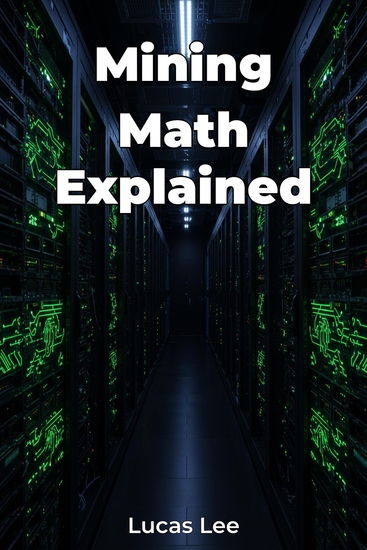
Mining Math Explained - cover

Mining Math Explained

Lucas Lee

Traductor A AI

Editorial: Publifye

  • 0
  • 0
  • 0

Sinopsis

Mining Math Explained dives into the mathematical heart of cryptocurrency mining, revealing the complex algorithms and cryptographic principles that power blockchain technology. The book explores the essential role of hash functions, showcasing how their properties, such as collision resistance, guarantee a secure and tamper-proof ledger. It further examines the concept of difficulty adjustment, a crucial mechanism that ensures consistent block creation rates despite fluctuating network power, maintaining network stability and preventing malicious control. The book traces the evolution of crypto mining, highlighting key social and economic influences. It emphasizes the importance of understanding the mathematical foundations for anyone involved in the cryptocurrency field, be they developers, investors, or researchers. Beginning with fundamental mathematical concepts, the book progresses through hash functions, difficulty adjustment, Proof-of-Work, and Proof-of-Stake, concluding with emerging trends like cloud mining. Real-world examples and data are used throughout to illustrate key points and provide a data-driven understanding. What sets this book apart is its commitment to clear, accessible explanations, making complex concepts understandable to a broad audience interested in computers and technology, even without advanced mathematical expertise. The book avoids technical jargon, focusing on intuitive explanations and visual aids to demystify the intricacies of cryptocurrency mining, network security, and decentralized mining.
Disponible desde: 22/02/2025.
Longitud de impresión: 101 páginas.


Otros libros que te pueden interesar

  • The Fabric of Cosmos - Unraveling the Mystery of Dark Matter - cover

    The Fabric of Cosmos -...

    Dirk Fallon

    • 0
    • 0
    • 0
    The story of dark matter begins not in the distant reaches of the universe, but in the questions that humans have asked for centuries. What is the universe made of? Why do galaxies behave the way they do? As our tools for observing the cosmos improved, so did our understanding—but with every answer came more mystery. In the early 20th century, astronomers began to notice strange things. Galaxies were spinning in ways that defied the laws of physics, at least as we understood them. The stars on the outer edges of galaxies were moving far too fast to be held together by the gravity from visible matter alone. There had to be something else out there, something invisible, something we couldn’t detect with telescopes. This was one of the first big hints that something massive and unseen—what we now call dark matter—was shaping the universe. 
    Modern cosmology was born when scientists started to view the universe not just as a collection of stars and planets, but as a dynamic, evolving structure governed by deep physical laws. Einstein’s theory of general relativity reshaped our understanding of space, time, and gravity. Suddenly, the universe was a place where space could bend, expand, and even accelerate. These ideas led to the Big Bang theory and the realization that the cosmos had a beginning and has been changing ever since. But as astronomers began mapping out galaxies and measuring their movements, inconsistencies popped up. The math didn’t add up unless we assumed that most of the mass in the universe was missing from our view. That mass didn’t emit light, didn’t reflect it, and didn’t absorb it. It was dark, but it was there.
    Ver libro
  • Construction - Handbook for Project Management and Building Technology - cover

    Construction - Handbook for...

    Phil Gilberts

    • 0
    • 0
    • 0
    Construction management involves overseeing the planning, design, and construction of a project, ensuring it's completed on time, within budget, and to the desired quality standards. It involves coordinating various stakeholders, managing resources, and mitigating risks throughout the construction process. 
      
    Construction management encompasses a wide range of responsibilities and tasks aimed at efficiently executing construction projects. This includes: 
      
    Project Planning: Developing comprehensive project plans outlining the scope, schedule, budget, and resources required for successful completion. 
      
    Contract Administration: Administering contracts, managing subcontractors, and resolving disputes to maintain positive relationships and ensure contractual obligations are fulfilled. 
      
    Communication and Stakeholder Management: Facilitating effective communication among project team members, clients, regulatory agencies, and other stakeholders to promote collaboration and address concerns. 
      
    Health and Safety: Implementing safety measures and protocols to protect workers, visitors, and the public from hazards and ensure compliance with health and safety regulations. 
      
    Overall, construction management plays a critical role in orchestrating all aspects of a construction project to deliver a successful outcome that meets client objectives while adhering to time, cost, and quality constraints.
    Ver libro
  • The Indisputable Existence of Santa Claus - The Mathematics of Christmas - cover

    The Indisputable Existence of...

    Thomas Oléron Evans, Hannah Fry

    • 0
    • 0
    • 0
    How do you apply game theory to select who should be on your Christmas shopping list? What equations should you use to decorate the Christmas tree? Will calculations show Santa is getting steadily thinner—shimmying up and down chimneys for a whole night—or fatter—as he munches on cookies and milk in billions of houses across the world?In The Indisputable Existence of Santa Claus, distinguished mathematicians Hannah Fry and Thomas Oléron Evans demonstrate, with eminent clarity, how applied mathematics are so thoroughly interwoven throughout our everyday lives by explaining mathematical concepts through one very merry motif: Christmas. In their quest to provide mathematical proof for the existence of Santa, the authors take listeners on a festive journey through a traditional holiday season, wherein every activity, from wrapping presents to playing board games to cooking the perfect turkey, is painstakingly and hilariously analyzed. Because who hasn't always wondered how to set up a mathematically perfect Secret Santa?Lighthearted and diverting with Christmasy equations, Markov chains, and matrices, The Indisputable Existence of Santa Claus brightens up the bleak midwinter with a stockingful of mathematical marvels.
    Ver libro
  • Machine Learning System Design for Beginners - Building Machine Learning Systems A Beginner's Guide to Design and Implementation - cover

    Machine Learning System Design...

    James Ferry

    • 0
    • 0
    • 0
    Designing and building machine learning (ML) systems can seem daunting for beginners, but understanding the foundational steps and principles can simplify the process. At its core, ML system design involves a series of well-defined steps that guide the transformation of raw data into valuable insights through predictive models. Here’s a beginner’s guide to understanding and implementing these steps effectively. 
    The first step in designing an ML system is problem definition. Clearly defining the problem you aim to solve is crucial. This involves understanding the business context, identifying the goals, and determining the type of problem—whether it is classification, regression, clustering, or another ML task. A well-defined problem ensures that the subsequent steps are aligned with the desired outcomes. 
    Once the problem is defined, the next step is data collection and preprocessing. Data is the backbone of any ML system, and its quality significantly impacts the performance of the models. Collect data from various sources and ensure it is relevant to the problem. Data preprocessing involves cleaning the data to handle missing values, removing duplicates, and normalizing the data. It also includes feature engineering, which involves selecting, modifying, or creating new features that enhance the predictive power of the model. 
    Finally, the deployment and monitoring phase ensures that the ML model is operational and continues to perform well over time. Deploy the model to a production environment where it can make real-time predictions or be used in batch processing. Implement monitoring systems to track the model’s performance and detect any drift in data distribution that might require retraining the model. Regularly update the model with new data to maintain its accuracy and relevance. 
     
    Ver libro
  • Database Management Mastery - Data at Your Fingertips: Modern Approaches to Database Management - cover

    Database Management Mastery -...

    Samuel Parker

    • 0
    • 0
    • 0
    If you want to get the most out of modern database management systems, you should read Database Management Mastery: Data at Your Fingertips: Modern Approaches to Database Management. This book is a must-have resource. It's written for business people, students, and tech fans all at the same time. 
    Data is more than just a resource in today's digital world; it's what drives growth, innovation, and decisions. When someone reads this book, they will have the knowledge to create, run, and improve databases that are secure, scalable, and highly efficient. This article gives a fair look at both old and new technologies by talking about relational databases like MySQL and PostgreSQL, as well as non-relational systems like MongoDB and Cassandra. 
    You will learn what you need to know to model data correctly, make queries run faster, keep data safe, and use cloud-based solutions in this course. The use of real-life case studies and insights that can be put into action shows how to apply best practices and solve practical problems in many different industries. 
    If you are new to database management or an old pro, Database Management Mastery is the book for you. It will help you understand the basics, technologies, and trends that will shape the future of database management. It is necessary to have this resource in order to turn data into a valuable asset and improve your skills to the next level.
    Ver libro
  • Humanity Reimagined - Where We Go From Here - cover

    Humanity Reimagined - Where We...

    Martin Fiore

    • 0
    • 0
    • 0
    For years, executive Martin Fiore has been advising leaders from a wide range of industries about technological trends that are reshaping the world of business, from artificial intelligence and the rise of autonomous systems to human/machine convergence. Now, in Humanity Reimagined, Fiore explores how these trends are disrupting industries, changing the world of work, transforming the economy, and creating both threats and opportunities for leaders at all levels, from entrepreneurs nurturing start-up businesses to C-suite leaders at the world’s biggest corporations.  
    Fiore’s main focus is on what we can do to ensure that the forces of change now sweeping the planet will protect and enhance the most cherished qualities of human life rather than undermining them. He offers thoughtful recommendations for addressing many of the big issues that today’s transformational technologies are raising, from the threats to privacy posed by misuse of big data to the infiltration of autonomous systems by racial and gender bias. Most important, Fiore provides advice on how to prepare for an unpredictable future that business leaders, policy makers, and individuals forging their careers will find both practical and inspiring.  
    “Fiore combines perceptive forecasting of change with an understanding of how the world and public already has shifted, making a compelling case that making the best of the future demands improving upon the leadership of the past.”—BookLife Reviews 
    “For those looking for a glimpse at the future, this book isn’t a bad place to start. An encouraging, unflinching look at the tech changes to come.”—Kirkus Reviews
    Ver libro