Join us on a literary world trip!
Add this book to bookshelf
Grey
Write a new comment Default profile 50px
Grey
Subscribe to read the full book or read the first pages for free!
All characters reduced
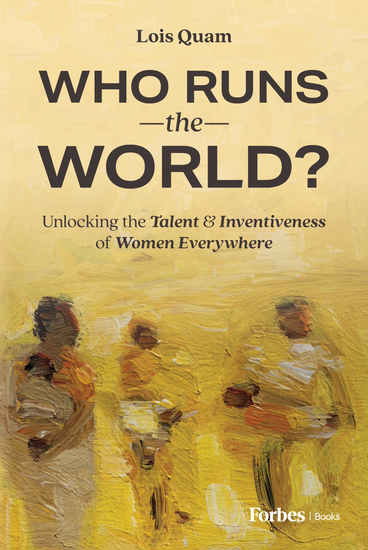
Who Runs the World? - Unlocking the Talent and Inventiveness of Women Everywhere - cover

Who Runs the World? - Unlocking the Talent and Inventiveness of Women Everywhere

Lois Quam

Publisher: Forbes Books

  • 0
  • 0
  • 0

Summary

Women and girls across the world are often made to feel as if the challenges, limitations, and barriers they face are personal, belonging to them alone. When, in fact, they affect us all. The issues are systemic, societal, and global – and we have the power to create change.In Who Runs the World?, author Lois Quam emphasizes the need to unlock the immense potential of women and girls globally. Quam argues that empowering women is the long-needed step for justice and the progress needed to address the growing challenges we face today.Throughout the book, she speaks to the barriers – personal and systemic – that block the humanity and talent of half the all the world’s people – women.Who Runs the World? sheds light on the path to change and the vital role women and girls play in addressing global challenges. Join the movement to unlock all the world’s talent and contribute to a more equitable and thriving world.
Available since: 03/05/2024.
Print length: 208 pages.

Other books that might interest you

  • Historical Mysteries - Unraveling the Secrets of the Past (9 in 1) - cover

    Historical Mysteries -...

    John Harpoon

    • 0
    • 0
    • 0
    This book contains 9 mysterious cases and stories from real life: 
    - The Amelia Earhart Mystery 
    - The Shakespeare Conundrum 
    - Rewriting the History of the Black Death 
    - Royal Tragedy Revisited 
    - History's Most Eccentric Rulers 
    - History of Assassins 
    - The Most Enigmatic Woman in History 
    - The Most Fascinating Man in the World 
    - The Great Beyond
    Show book
  • Vedic Philosophy of the Kali Yuga - Through the Lens of Gnostic Wisdom - cover

    Vedic Philosophy of the Kali...

    HENRY ROMANO

    • 0
    • 0
    • 0
    According to Vedic philosophy, there are four eras in every world cycle. They represent a gradual decline from enlightenment (Satya Yuga) to chaos and ignorance (Kali Yuga) before it starts again. Each of these eras lasts roughly 2160 years. 
    You're probably familiar with the four ages of Hindu philosophy: Satya Yuga, Treta Yuga, Dwapara Yuga, and Kali Yuga. The golden age is when pure knowledge is widespread, and people live in harmony. The dark age is when everything goes wrong—the World falls into chaos, and humanity descends into ignorance. But what happens next? 
    What is the meaning of "the end of the world"?
    Show book
  • Loyalty - The Faithful Allegiance - cover

    Loyalty - The Faithful Allegiance

    Esther Jameson

    • 0
    • 0
    • 0
    Loyalty is a concept that resonates deeply with human nature, transcending time, culture, and geography. It is often regarded as one of the highest virtues, forming the foundation of relationships, societies, and organizations. At its core, loyalty is an unwavering allegiance to a person, cause, or institution, and it involves a commitment that goes beyond mere obligation. It is about dedication, trust, and an emotional bond that fosters a sense of responsibility and attachment. 
    Defining loyalty can be complex because it manifests in various forms and is subject to different interpretations depending on the context. In personal relationships, loyalty can mean remaining faithful to a partner, supporting friends through tough times, or staying committed to family. In a broader societal context, it can refer to allegiance to a nation, loyalty to a set of values, or even devotion to an idea or belief system. Despite these differences, the essence of loyalty remains consistent: it is the willingness to stand by someone or something, even in difficult or challenging times. 
    One important aspect of loyalty is trust. Without trust, loyalty cannot truly exist. Trust is the foundation upon which loyalty is built, and it is what keeps the bond strong over time. Loyalty requires faith that the person or cause to which one is loyal will not betray that trust. This mutual trust creates a sense of security and dependability, making loyalty a powerful force that binds individuals together.
    Show book
  • New Moons For Sam - Becoming Kiwi - Life of a New Zealand Diplomat - cover

    New Moons For Sam - Becoming...

    Peter Hamilton

    • 0
    • 0
    • 0
    A personal, intimate, memoir spanning 70 years, in three parts, describing my childhood in the UK and New Zealand, my 35 years as a New Zealand diplomat, and the hundreds of amazing individuals I met on the way, from farming folk to Kings, Queens and Presidents. Part One is the story of an English boy growing up on a farm in rural Devon and Somerset in an extended family, and then, aged 9, moving to rural New Zealand. It covers my school years, my year as a volunteer teacher, aged 17, at an all boys school, in the South Pacific Kingdom of Tonga and my year as a university student in a still divided Germany. Part Two describes my career as a junior, then senior, New Zealand diplomat, and my postings in Fiji, Canada, Geneva, Samoa, Germany and Singapore, the last three as Ambassador. Part Three argues that New Zealand should become a republic in the Commonwealth, with its own Head of State. It describes, too, my liberating journey from Anglicanism to freedom from any religion. I have aimed to tell the memoir with a sense of humour, humility and (for the most part) optimism!
    Show book
  • Vlad the Impaler - Facts about the Cruel Dictator we Know as Dracula - cover

    Vlad the Impaler - Facts about...

    Kelly Mass

    • 0
    • 0
    • 0
    Not too many people realize that the story of Dracula was based on a really sadistic ruler in Romania. Vlad the Impaler, or Vlad the Third, was a merciless despot who tried to make an example out of his opponents by impaling them and displaying them in public. He also enjoyed bathing in dead people’s blood and did some other gross, inhumane things. He was the terror of Eastern Europe for many years. 
    What made this tyrant so effective at warfare, so vicious in his raids, and so brutal when he captured enemies? 
    How was his relationship with the Pope in Rome? 
    Which other conquerors were fighting him at the time? 
    Why was there so much friction with the Ottoman Empire? 
    Learn about this, as well as his background, his marriage, his death, and his legacy. Find out why vampire stories have been derived from this dictator, and why he has been listed as one of the evilest people in history.
    Show book
  • Bloody Verrieres - The I SS-Panzerkorps Defence of the Verrieres-Bourguebus Ridges: Volume I: Operations Goodwood and Atlantic July 18–22 1944 - cover

    Bloody Verrieres - The I...

    Arthur W. Gullachsen

    • 0
    • 0
    • 0
    South of the Norman city of Caen, the twin features of the Verrières and Bourguebus ridges were key stepping stones for the British Second Army in late July 1944. To capture this vital ground, Allied forces would have to defeat arguably the strongest German armored formation in Normandy: the I. SS-Panzerkorps "Leibstandarte." The resulting battles of late July and early August 1944 saw powerful German defensive counterattacks south of Caen inflict tremendous casualties, regain lost ground, and at times defeat Anglo-Canadian operations in detail. 


    These defeats and the experience of meeting an enemy with near-equal resources exposed a flawed Anglo-Canadian offensive tactical doctrine that was overly dependent on the supremacy of its artillery forces. Furthermore, weaknesses in Allied tank technology inhibited their armored forces from fighting a decisive armored battle. Confronted with the full force of the Panzerwaffe, Anglo-Canadian doctrine at times floundered. In response, the Royal Artillery and Royal Canadian Artillery units pummeled the German tankers and grenadiers, but despite their best efforts, ground could not be captured by concentrated artillery fire alone. 


    This is a detailed account of the success of I. SS-Panzerkorps' defensive operations, aimed at holding the Vèrrieres-Bourgebus ridges in late July 1944.
    Show book