¡Acompáñanos a viajar por el mundo de los libros!
Añadir este libro a la estantería
Grey
Escribe un nuevo comentario Default profile 50px
Grey
Suscríbete para leer el libro completo o lee las primeras páginas gratis.
All characters reduced
Helsinki Essence - cover

Helsinki Essence

Logan Bell

Traductor A AI

Editorial: Publifye

  • 0
  • 0
  • 0

Sinopsis

Helsinki Essence explores how Helsinki's architecture, history, and culture intertwine to shape a unique urban identity, deeply rooted in Nordic traditions yet embracing modern design. The book examines Helsinki not just as a location, but as a living embodiment of Finnish values, revealing how historical events have shaped its urban landscape. For example, Helsinki’s evolution from a Swedish fortress town to the capital of an independent nation significantly influenced its urban planning.

 
The book progresses by first introducing Helsinki's historical and cultural context, then delving into the golden age of Finnish architecture and design, highlighting figures like Alvar Aalto. It analyzes contemporary Helsinki, addressing current challenges such as sustainability.

 
The book posits that Helsinki's synthesis of historical influences, design philosophy, and cultural values has created an urban environment that mirrors Finnish identity. The impact of Nordic design principles, such as functionalism and simplicity, on the city's urban landscape is a key focus, demonstrating how Helsinki Essence offers a comprehensive view of the city's cultural and historical significance.
Disponible desde: 20/02/2025.
Longitud de impresión: 59 páginas.


Otros libros que te pueden interesar

  • How to Get Rid of a Narcissist - 7 Proven Strategies to Identify Confront and Free Yourself from Narcissistic Influence and Reclaim Your Health and Emotional Well-being - cover

    How to Get Rid of a Narcissist -...

    Whitney Barton

    • 0
    • 0
    • 0
    Narcissists Holding You Back?  
    Kick them to the Curb and Get Back on Track! 
    Tired of being surrounded by people using you for their benefit?   
    Feeling lost due to Narcissistic Abuse and longing to find yourself or be human again?  
    Want to flee from all this Narcissistic abuse and manipulation but clueless about how to start?  
    If all these hit close to home, then please keep reading.  
    Being entangled in a Narcissistic web is no easy feat. Combined with your past experiences with various types of abuse, family pressure, and low self-esteem, victims are easily trapped in a quicksand-like life that without any help, can cause them a lifetime of damage in all forms.  
    Don't let yourself or any of your loved ones be snared by this type of situation any longer. Let Whitney Barton enlighten you on what to do. With her newest addition, "How to Get Rid of a Narcissist", Barton unveils what narcissists are, how they maneuver into someone else's life, what makes them tick, and the impact of their actions on someone else's life. Together, she will show you the way how to break free from their grasp to your healing recovery.  
    Remember, no matter what happens do not not resort to blaming yourself. Let "How to Get Rid of a Narcissist" help you find your way out to happiness. Keep one handy or hand this over to a friend who needs it. Together you can paddle your way to safety, recovery, and a lifetime free from Narcissistic PTSD.  
    Fight your way out of this hellhole, together! 
    Get Your’s Today!
    Ver libro
  • Slipstream the autobiography of an air craftsman - cover

    Slipstream the autobiography of...

    EUGENE E. WILSON

    • 0
    • 0
    • 0
    To the world at large, Berlin Airlift headlines only highlighted another crisis in the "cold war." Yet behind those headlines lay an epochal event: commercial air transports—not combat aircraft—had become the spearhead of United States foreign policy.This dramatic incident brought renewed hope to air craftsmen who, nearly a half century earlier, had embarked on a starry-eyed crusade to utilize the airplane for the benefit of mankind. In World War I, they had helped smash the German Kaiser, only to find Hitler rising phoenixlike in his boots. Two decades later, they had strafed Hitler to earth, only to discover a colossal portrait of Joseph Stalin looming beyond a smoke curtain. Still later, as atomic bombs and lethal bacteria became weapons, they were asking themselves, "what next?" when the Berlin Airlift came up with the answer: air cargo, air commerce, air industry, air finance—air power for peace!
    Ver libro
  • The Viking Saint - Olaf II of Norway - cover

    The Viking Saint - Olaf II of...

    John Carr

    • 0
    • 0
    • 0
    The Vikings and sainthood are not concepts normally found side by side. But Norway’s King Olaf II Haraldsson (c. 995-1030) embodied both to an extraordinary degree. As a battle-eager teenager he almost single-handedly pulled down London Bridge (as in the nursery rhyme) and took part in many other Viking raids. Olaf lacked none of the traditional Viking qualities of toughness and audacity, yet his routine baptism grew into a burning missionary faith that was all the more remarkable for being combined with his typically Viking determination and energy – and sometimes ruthlessness as well. His overriding mission was to Christianize Norway and extirpate heathenism. His unstinting efforts, often at great peril to his life, earned him the Norwegian throne in 1015, when he had barely reached his twenties. For the next fifteen years he labored against immense odds to subdue the rebellious heathen nobles of Norway while fending off Swedish hostility. Both finally combined against Olaf in 1030, when he fell bravely in battle not far from Trondheim, still only in his mid-thirties. After his body was found to possess healing powers, and reports of them spread from Scandinavia to Spain and Byzantium, Olaf II was canonized a saint 134 years later. He remains Norway’s patron saint as well as a legendary warrior. Yet more remarkably, he remains a saint not only of the Protestant church but also of the Roman Catholic and Greek Orthodox Churches – perhaps the only European fighting saint to achieve such acceptance.
    Ver libro
  • Rare Recording of Mahatma Gandhi A - Volume 2 - cover

    Rare Recording of Mahatma Gandhi...

    Mahatma Gandhi

    • 0
    • 0
    • 0
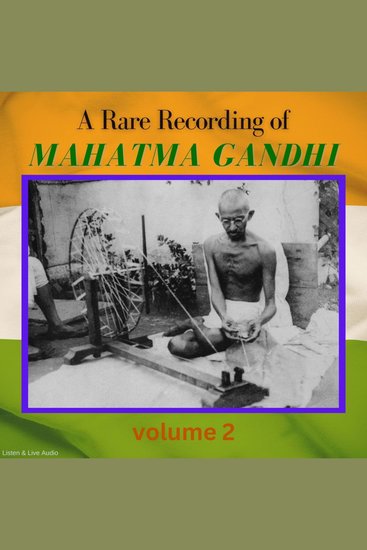
    Mahatma Gandhi (October 2, 1869 - January 30, 1948) was an Indian lawyer, anti-colonial nationalist, and political ethicist who employed nonviolent resistance to lead the successful campaign for India's independence from British rule. He inspired movements for civil rights and freedom across the world.
    Ver libro
  • The Hindenburg Disaster - A History from Beginning to End - cover

    The Hindenburg Disaster - A...

    Hourly History

    • 0
    • 0
    • 0
    In 1937, passengers could cross the Atlantic in unprecedented luxury aboard the world’s most advanced aircraft. The Hindenburg was a marvel that defied belief. Stretching over 800 feet (245 meters)—longer than three jumbo jets placed end to end—this colossal airship represented the pinnacle of 1930s technology. Thirteen stories tall and powered by engines that propelled it at nearly 80 mph (125 km/h), it could ferry passengers between Europe and the Americas in half the time of the fastest ocean liner. 
    For those who could afford it, the Hindenburg offered an experience like no other. Passengers dined in an elegant restaurant with panoramic windows, relaxed in opulent lounges while a pianist played a grand piano, and retired to private cabins heated by the ship’s engines. From its 1936 launch through early 1937, this floating palace carried nearly 3,000 passengers across 200,000 miles (320,000 kilometers)—including 17 Atlantic crossings—without a single injury. There was only one thing that made prospective passengers a little nervous: the Hindenburg stayed aloft thanks to 7 million cubic feet (200,000 cubic meters) of hydrogen gas—one of the most explosive substances known to humanity. Every spark, every electrical discharge, every moment of static electricity posed a mortal threat to everyone aboard. 
    On May 6, 1937, in just 32 seconds, that threat became reality. This is the story of the Hindenburg disaster.
    Ver libro
  • Avars and Magyars The: The History of the Medieval Ethnic Groups that Settled in Hungary - cover

    Avars and Magyars The: The...

    Editors Charles River

    • 0
    • 0
    • 0
    The Avars entered Eastern Europe from the Central Asian steppes in the 6th century, and like the Huns before them and the Cumans and Magyars after them, the Avars were raiders and warriors who lived on their horses. The Avars’ impact on Europe was immediately felt, and from the Byzantine Empire to the Merovingian Kingdom in Gaul, some of Europe’s strongest powers had to learn how to deal with these new people through a combination of diplomacy and warfare. Eventually, the Avars established themselves in what is today Hungary and played an important role in the development of European history during its transitional period by earning a reputation as a fearsome and sometimes avaricious group. The medieval sources described the Avars as efficient and brutal horseback warriors who could devastate entire kingdoms in a matter of days and leave just as quickly. 
    Of all the steppe peoples in the medieval period, perhaps none were more important to European history than the Magyars. Like the Huns and Avars before them and the Cumans and Mongols after them, the Magyars burst into Europe as a destructive, unstoppable horde, taking whatever they wanted and leaving a steady stream of misery in their wake. They used much of the same tactics as the other steppe peoples and lived a similar, nomadic lifestyle. The Magyars also had many early cultural affinities with other steppe peoples, following a similar religion and ideas of kingship and nobility, among other things. That said, as similar as the Magyars may have been to other steppe nomads before and after them, they were noticeably different in one way: the Magyars settled down and became a part of Europe and Western Civilization in the Middle Ages. The Magyars exploded onto the European cultural scene in the late 9th century as foreign marauders, but they made alliances with many important kingdoms in less than a century.
    Ver libro