¡Acompáñanos a viajar por el mundo de los libros!
Añadir este libro a la estantería
Grey
Escribe un nuevo comentario Default profile 50px
Grey
Suscríbete para leer el libro completo o lee las primeras páginas gratis.
All characters reduced
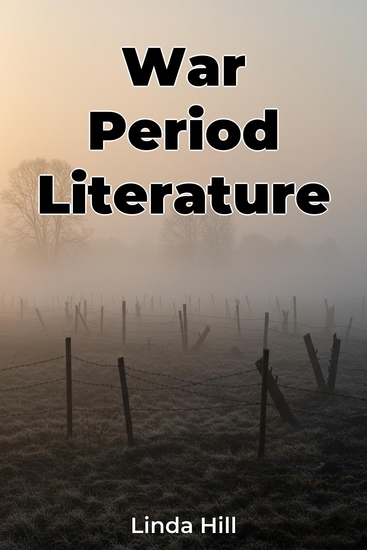
War Period Literature - cover

War Period Literature

Linda Hill

Traductor A Ai

Editorial: Publifye

  • 0
  • 0
  • 0

Sinopsis

"War Period Literature" delves into how global conflicts shape human expression, using literature as a lens to understand wartime experiences. It argues that literature serves as a crucial historical record, often providing deeper insights than official accounts. For instance, the book explores how psychological theories of trauma help us understand PTSD themes in war narratives, or how political ideologies influence war representation in literature.

 
The book progresses by first establishing "war literature" as a genre, then examining specific historical periods like World War I, World War II, and the Cold War, showcasing diverse writer responses. Finally, it analyzes recurring themes such as trauma, heroism, and disillusionment. This approach reveals the unique perspectives and literary styles that emerged during each era, demonstrating literature's adaptability in capturing the impact of war on individuals and societies. It’s a valuable resource for understanding military history and the cultural impact of war.
Disponible desde: 06/05/2025.
Longitud de impresión: 82 páginas.


Otros libros que te pueden interesar

  • Essays On Transcendence - cover

    Essays On Transcendence

    Ralph Waldo Emerson

    • 0
    • 0
    • 0
    Ralph Waldo Emerson was an American essayist, lecturer, philosopher, abolitionist, and poet who led the transcendentalist movement of the mid-19th century. He was seen as a champion of individualism and a prescient critic of the countervailing pressures of society, and his ideology was disseminated through dozens of published essays and more than 1,500 public lectures across the United States.Emerson gradually moved away from the religious and social beliefs of his contemporaries, formulating and expressing the philosophy of transcendentalism in his 1836 essay "Nature". Following this work, he gave a speech entitled "The American Scholar" in 1837, which Oliver Wendell Holmes Sr. considered to be America's "intellectual Declaration of Independence."Emerson wrote most of his important essays as lectures first and then revised them for print. His first two collections of essays, Essays: First Series and Essays: Second Series, represent the core of his thinking. They include the well-known essays "Self-Reliance", "The Over-Soul", "Circles", "The Poet", and "Experience." Together with "Nature", these essays made the decade from the mid-1830s to the mid-1840s Emerson's most fertile period. Emerson wrote on a number of subjects, never espousing fixed philosophical tenets, but developing certain ideas such as individuality, freedom, the ability for mankind to realize almost anything, and the relationship between the soul and the surrounding world. Emerson's "nature" was more philosophical than naturalistic: "Philosophically considered, the universe is composed of Nature and the Soul." Emerson is one of several figures who "took a more pantheist or pandeist approach by rejecting views of God as separate from the world."
    Ver libro
  • The Life Of Buddha - cover

    The Life Of Buddha

    Sripad Jagannatha Dasa

    • 0
    • 0
    • 0
    Gautama Buddha, also known as Siddhartha Gautama, was a spiritual teacher who lived in ancient India between the 6th and 4th centuries BCE. He is the founder of Buddhism, one of the major religions of the world. Buddha was born into a royal family, but he renounced his luxurious lifestyle at the age of 29 to seek the truth about life and the nature of suffering. He spent six years as a wandering ascetic before attaining enlightenment at the age of 35. The Buddha's teachings, known as the Dharma, revolve around the Four Noble Truths, which explain the nature of suffering and the path to its cessation. The core message of Buddhism is that suffering arises from craving and attachment, and that liberation can be attained through the practice of the Eightfold Path, which includes meditation, mindfulness, ethical conduct, and wisdom. 
     
    The Buddha's teachings have had a profound impact on the spiritual and cultural history of Asia and beyond. His teachings spread rapidly throughout India and other parts of Asia, and they continue to inspire millions of people today. The Buddha's emphasis on non-violence, compassion, and the importance of the present moment has also resonated with many in the West. In addition to his spiritual teachings, the Buddha also provided practical guidance on social and ethical issues. He advocated for the abolition of caste distinctions, the treatment of animals with compassion, and the importance of community and social harmony. 
     
    Buddha's teachings continue to be relevant and inspiring today. His teachings on the nature of suffering, impermanence, and the importance of self-awareness are particularly relevant in today's fast-paced and materialistic world.
    Ver libro
  • A Rare Recording of T Lobsang Rampa - cover

    A Rare Recording of T Lobsang Rampa

    T. Lobsang Rampa

    • 0
    • 0
    • 0
    T. Lobsang Rampa (April 8, 1910 - January 25,1981) was a bestselling author of books with paranormal and occult themes. He was born Cyril Henry Hoskin and claimed that his body hosted the spirit of a Tibetan lama by the name of T. Lobsang Rampa. His best-known book, "The Third Eye," was a global bestseller. He went on to write another 18 books on meditation, religion, and the occult. In this recording, Rampa teaches some basic meditation techniques.
    Ver libro
  • Writing Archetypal Character Arcs - The Hero's Journey and Beyond - cover

    Writing Archetypal Character...

    K.M. Weiland

    • 0
    • 0
    • 0
    The Six Transformational Character Arcs of the Human Life 
    Ready to take your story’s character arcs and themes to the next level? This latest book from veteran writing teacher and story theorist K.M. Weiland ventures far beyond the popular and pervasive Hero’s Journey to explore six important archetypal character arcs, representing key moments of initiation in the human experience:The MaidenThe HeroThe QueenThe KingThe CroneThe Mage 
    Found in every genre from fantasy to drama to romance to adventure, these transformational stories are the secret of powerhouse fiction—as shown through a wide variety of real-story examples throughout the book. 
    Writing Archetypal Character Arcs will teach you:The archetypal beats for each of the six journeysWhich archetypes are right for your particular storyThe best way to use archetypes in a seriesHow to choose the right archetypes for supporting charactersHow to use archetypes to identify your story’s theme 
    You will also learn how to deepen your stories by implementing shadow archetypes (the negative sides of each positive archetype), resting or “flat” archetypes (the fixed stage between each of the main arcs), and archetypal antagonists (the epic antagonistic forces that oppose each of the positive archetypes in their journeys). The Hero’s Journey is just the beginning. 
    Learning about archetypal character arcs will change the way you view stories—and life—forever.
    Ver libro
  • Tulsi Devi - Mistress Of Vrndavana - Divine Servant Of Sri Sri Radha Krsna - cover

    Tulsi Devi - Mistress Of...

    Radha Krsna Das

    • 0
    • 0
    • 0
    "Dear Tulsī, you are much beloved by Lord Kṛṣṇa because your leaves are always at His lotus feet. Dear mālatī flower, dear mallikā flower, dear jasmine flower, all of you must have been touched by Kṛṣṇa while He was passing this way after giving us transcendental enjoyment. Have you seen Mādhava passing this way? O mango trees, O trees of jackfruit, O pear trees and āsana trees! O blackberries and bael trees and trees of the kadamba flower—you are all very pious trees to be living on the bank of the Yamunā. Kṛṣṇa must have passed through this way. Will you kindly let us know which way He has gone?" The Srimad Bhagavatam 
     
    Tulsi Devi (Vrinda - Holy Basil) is a sacred plant in Hindu belief. She is regarded as an earthly manifestation of the goddess Srimati Tulsi Devi, and is as an avatar of Lakshmi, and thus the consort of Vishnu. The offering of her leaves is mandatory in the worship of Bhagavan Sri Krishna. Tulsi is regarded as the holiest of all plants and a bridge between heaven and earth. A traditional prayer teaches the creator Brahma and the Ganges resides in her branches, all holy pilgrimage centers in her roots, all deities are in her stem and leaves, and the Vedas are found in the upper part of her branches. The Tulsi herb is a center of household devotion, and is often referred to as the "women's deity" and "a symbol of wifehood and motherhood." Vaishnavites consider it as the manifestation of god in the plant kingdom. Tulsi Devi is one of Krishna’s most intimate servants coming to bless us all with extraordinary fortune. She has delicate purple and green leaves, flower tassels (like miniature temple spires), and an arresting, sweet fragrance famous for attracting the minds of yogis to Krishna’s service via Bhakti Yoga. Tulasi’s wood is carved into the Japa beads on which devotees chant Krishna’s holy name.
    Ver libro
  • Donald Writes No More - The Life of Donald Goines the Godfather of Street Lit - cover

    Donald Writes No More - The Life...

    Eddie Stone

    • 0
    • 0
    • 0
    For the fiftieth anniversary of his murder, this gritty, engrossing, definitive biography of the legendary Black writer Donald Goines—the Godfather of Urban Street Lit and "one of hip hop's greatest inspirations" (The Source Magazine)—is back. 


    Addict, thief, pimp, pusher, player—and most notably, groundbreaking writer. Donald Goines was all of these. 


    As a kid, Donald Goines was the product of a middle-class family. After high school, he joined the Air Force—and discovered the heroin that would rule the remainder of his life. On the streets, he turned to writing when he was straight enough to keep at it. He used the language of the streets and he wrote of its people. Goines's success was immediate and exciting. But eventually those same streets claimed him. He was murdered as he sat writing a new book. Yet his legacy continues, as a revolutionary in the literary world and also in music, with major hip-hop artists including 50 Cent, Nas, and Jay-Z all crediting Goines's novels as influences. Here is his complete story.
    Ver libro