Junte-se a nós em uma viagem ao mundo dos livros!
Adicionar este livro à prateleira
Grey
Deixe um novo comentário Default profile 50px
Grey
Assine para ler o livro completo ou leia as primeiras páginas de graça!
All characters reduced
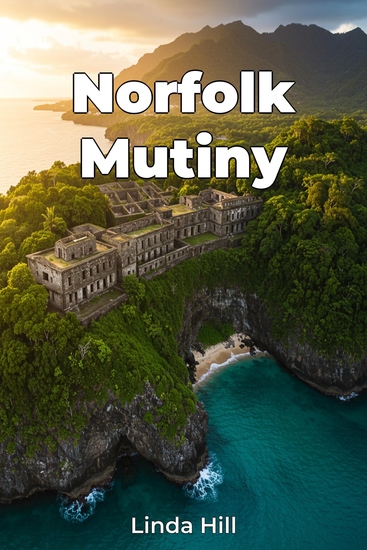
Norfolk Mutiny - cover
LER

Norfolk Mutiny

Linda Hill

Tradutor A AI

Editora: Publifye

  • 0
  • 0
  • 0

Sinopse

Norfolk Mutiny explores the multifaceted history of Norfolk Island, a remote Pacific outpost shaped by the infamous Mutiny on the Bounty, its subsequent settlement by mutineers and their Polynesian companions, and its grim role as a brutal penal colony. The book examines how extreme circumstances forged a unique society on this tiny island.

 
Consider that the mutiny on the HMS Bounty, triggered by Captain Bligh's tyranny and the allure of Tahiti, set in motion a chain of events leading to the establishment of a unique Anglo-Polynesian community. Later, descendants of the Bounty mutineers relocated from Pitcairn Island due to overcrowding, bringing their distinct culture and language to Norfolk Island.

 
The book traces the island's history from the initial Bounty mutiny and the establishment of the Pitcairn settlement to the penal colony years, detailing the harsh conditions endured by convicts and the administrative structures in place. It culminates with the Pitcairn Islanders' resettlement and their efforts to build a new community while grappling with the legacy of their predecessors.

 
Drawing on British Admiralty documents, convict records, and oral histories, Norfolk Mutiny provides a comprehensive and accessible account of Norfolk Island's past, highlighting themes of resilience, adaptation, and the negotiation of identity in this isolated environment.
Disponível desde: 20/03/2025.
Comprimento de impressão: 55 páginas.

Outros livros que poderiam interessá-lo

  • The Republic - Plato - cover

    The Republic - Plato

    Plato

    • 0
    • 0
    • 0
    The Republic is a Socratic dialogue, authored by Plato around 375 BCE, concerning justice, the order and character of the just city-state, and the just man.It is Plato's best-known work, and one of the world's most influential works of philosophy and political theory, both intellectually and historically. 
    In the dialogue, Socrates discusses the meaning of justice and whether the just man is happier than the unjust man with various Athenians and foreigners. He considers the natures of existing regimes and then proposes a series of hypothetical cities in comparison, culminating in Kallipolis , a utopian city-state ruled by a philosopher-king. They also discuss ageing, love, theory of forms, the immortality of the soul, and the role of the philosopher and of poetry in society. The dialogue's setting seems to be the time of the Peloponnesian War
    Ver livro
  • Allied Invasions of France in 1944 The: The History and Legacy of the Campaigns that Began the Liberation of Western Europe from the Nazis - cover

    Allied Invasions of France in...

    Editors Charles River

    • 0
    • 0
    • 0
    By the end of D-Day, the Allies had managed to successfully land 170,000 men, including over 75,000 on the British and Canadian beaches, 57,000 on the American beaches, and over 24,000 airborne troops. Thanks to Allied deception, the German army had failed to react to prevent the Allies from making the most of their landings. Just one division, the Hitlerjugend, would arrive the following day. Despite a fearsome and bloody day, the majority of the Allied forces had held their nerve, and most importantly, achieved their objectives. This ensured Operation Overlord was ultimately successful, and victory in Europe would be achieved within less than a year. 	Churchill was not overstating the achievements of the invasion when he described the plan “the greatest thing we have ever attempted”. The greatest armada the world had ever seen had landed 170,000 soldiers on the heavily defended beaches of Normandy in just 24 hours. More remarkable was the fact that the operation was a success on every major level. Deception, tactical surprise and overwhelming force had contributed to the establishment of an adequate beachhead. Confusion and dissent had stopped the Germans massing for any great counterattack. The Atlantic Wall which Hitler had placed so much faith in had been breached, and the race to Paris was on. The landings in Normandy and the campaign that followed were successful, but that very success brought its own problems.  
    	While D-Day is one of the most famous events of the war, it is widely overlooked that about two months after the landings in Normandy, there was a second Allied landing in France. On August 15, 1944, a combined US-French force landed in southern France on the beaches of the Côte d'Azur as part of Operation Dragoon. In just over four weeks of fighting, the Allied landing led to the liberation of most of southern France and to one of the most audacious and successful Allied operations of World War II. 
    Ver livro
  • Bond Of Blood - cover

    Bond Of Blood

    Martin Hicks

    • 0
    • 0
    • 0
    Bond of Blood tells the story of two Irish brothers, each of whom makes the life-changing journey to the new world as the second half of the 19th century draws on. Thomas and Michael Casey are linked by blood, but find themselves on opposite sides of the US Civil War conflict.Martin Hicks lives in Fraserburgh, Scotland and began writing after a career in education. He has published a series of US Civil War books, and "Bond of Blood" is his eighth title.By the same author: A Gathering of Soldiers Hard Passage North The Rappahannock Line Mirage of Victory The Bitterest Enemy A Season for Killing A Deepening Twilight
    Ver livro
  • History of the Middle East - Various Aspects of the Region (6 in 1) - cover

    History of the Middle East -...

    Kelly Mass

    • 0
    • 0
    • 0
    This book consists of 6 titles, all related to history stories and events from the Middle East, both modern and ancient: 
    1 - Darius the Great: Biography of the Persian Ruler during the Achaemenid Empire 
    2 - History of Iran: Events, Turning Points, Religion, and Empirical Conquests 
    3 - Islamic Golden Age: A History of Economic, Cultural, and Artistic Growth 
    4 - Osman I: Biography of the Founder of the Ottoman Dynasty 
    5 - Saddam Hussein: Warmonger, Invader, Dictator, and Oil Trader 
    6 - The Kurds: History of a Forgotten Ethnic Minority 
    Get this discounted bundle of books now!
    Ver livro
  • The Silencing of Ruby McCollum - Race Class and Gender in the South - cover

    The Silencing of Ruby McCollum -...

    Tammy D. Evans

    • 0
    • 0
    • 0
    The Silencing of Ruby McCollum refutes the carefully constructed public memory of one of the most famous—and under-examined—biracial murders in American history. On August 3, 1952, African American housewife Ruby McCollum drove to the office of Dr. C. LeRoy Adams, beloved white physician in the segregated small town of Live Oak, Florida. With her two young children in tow, McCollum calmly gunned down the doctor during "an argument over a medical bill." Soon, a very different motive emerged, with McCollum alleging horrific mental and physical abuse at Adams's hand. In reaction to these allegations and an increasingly intrusive media presence, the town quickly cobbled together what would become the public façade of Adams's murder—a more "acceptable" motive for McCollum's actions. To ensure this would become the official version of events, McCollum's trial prosecutors voiced multiple objections during her testimony to limit what she was allowed to say. 


    Employing multiple methodologies to achieve her voice, Evans analyzes the texts surrounding the affair to suggest that an imposed code of silence demands not only the construction of an official story but also the transformation of a community's citizens into agents who will reproduce and perpetuate this version of events, improbable and unlikely though they may be.
    Ver livro
  • What We Don't Do - Inaction in the Face of Suffering and the Drive to Do More - cover

    What We Don't Do - Inaction in...

    Nick Cooney

    • 0
    • 0
    • 0
    When we think about whether we are good people leading a good life, we usually think about actions. Bad people do bad things that hurt others. Good people do good things that help others, and they avoid doing bad things. Simple. 


    But while our actions certainly have consequences, today our inactions have far greater and far graver consequences. Bad actions can result in the suffering of a few or several dozen others; inaction can result in the extreme misery of thousands. 


    For nearly our entire history as a species, we lived in small groups with minimal resources, leaving our ability to help others limited. Thanks to massive global populations, huge wealth disparities, and modern technologies, the average person now has more power to improve the lives of others than nearly anyone who has ever lived. But the flip side of that great power is the dizzyingly high cost of inaction, in which lives can hang in the balance with each dollar and hour of time we spend. 


    This is a book about what we don't do. It's about our failures to act and the suffering others endure as a result. It's also about the incredible good that can be achieved when we cultivate an internal drive to do more.
    Ver livro