¡Acompáñanos a viajar por el mundo de los libros!
Añadir este libro a la estantería
Grey
Escribe un nuevo comentario Default profile 50px
Grey
Suscríbete para leer el libro completo o lee las primeras páginas gratis.
All characters reduced
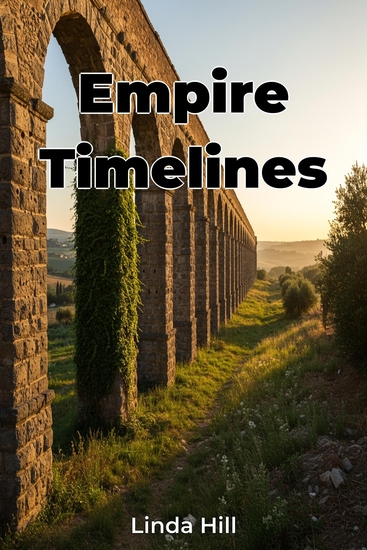
Empire Timelines - cover

Empire Timelines

Linda Hill

Traductor A Ai

Editorial: Publifye

  • 0
  • 0
  • 0

Sinopsis

Empire Timelines explores the cyclical nature of empires, examining the political, economic, and military factors influencing their rise and fall throughout world history. The book argues that an empire's ability to adapt in these key areas is crucial for long-term survival. It highlights how political legitimacy, whether through popular support or other means, is vital for maintaining power, and how economic sustainability, driven by innovation and resource management, ensures an empire can support its ambitions. 

 
The book uses case studies of prominent empires like the Roman Empire, the Mongol Empire, and the British Empire to illustrate these dynamics. For example, the Mongol Empire's vast trade networks contributed significantly to its economic strength.

 
By focusing on adaptability, Empire Timelines offers a fresh perspective on imperial history, moving beyond simple narratives of rise and fall. Each chapter builds upon the previous one, culminating in a comparative analysis and insights applicable to contemporary global power structures.
Disponible desde: 29/03/2025.
Longitud de impresión: 59 páginas.

Otros libros que te pueden interesar

  • History of Scotland: An Enthralling Overview of Important Events and Figures - cover

    History of Scotland: An...

    Billy Wellman

    • 0
    • 0
    • 0
    The History of Scotland—The Tiny Nation That Changed the World! 
    Do you know the whole story of Scotland? Journey through the rich heritage of a nation that has significantly shaped the world in this enthralling history book. Discover the fascinating events and iconic figures that have made Scotland a beacon of culture, innovation, and resilience. 
    Here is just a glimpse of what you will find in this audiobook:Ancient Beginnings: Who were the first people to call Scotland home? Explore the enigmatic ruins of Skara Brae and the dawn of Scottish civilization.Clash of Cultures: Delve into the interactions between the ancient Romans and the fierce inhabitants of Caledonia. What secrets do these early encounters hold?Formation of a Kingdom: Understand the pivotal connections between the Picts and the Gaels in creating the Kingdom of Alba.Regal Lineages: From Kenneth I to Mary, Queen of Scots, meet the kings and queens who defined Scottish royalty.Religious Revolutions: How did the Church of Scotland come to be, and what is Presbyterianism? Learn about John Knox’s influence and the short-lived dominance of the Kirk.Highland Feuds and Heroes: Witness the bloody clan feuds and the indomitable spirit of the Highlanders.Union with England: Explore the controversial union with England and its lasting impacts on Scottish identity.Historic Tragedies: The haunting massacre of Glencoe—what really happened on that fateful night? 
    Embark on an unforgettable journey through the annals of Scotland. Scroll up and click the “add to cart” button to immerse yourself in the remarkable history of this extraordinary nation!
    Ver libro
  • Crisis of Command - How We Lost Trust and Confidence in America's Generals and Politicians - cover

    Crisis of Command - How We Lost...

    Stuart Scheller

    • 0
    • 0
    • 0
    Combat-decorated Marine officer Stuart Scheller speaks out against the debacle of the Afghan pullout as the culmination of a decades-long and still-ongoing betrayal of military members by top leadership, from generals to the commander in chief, comes to light. 


    Lieutenant Colonel Stuart Scheller was the perfect Marine. Battle tested. A leader. Decorated for valor. Yet when the United States acted like the Keystone Cops in a panicked haphazard exit from Afghanistan for political reasons, Scheller spoke out, and the generals lashed out. In fact, they jailed him to keep him quiet, claiming he lost the "trust and confidence" bestowed upon him by the Marines—when the faith and trust is exactly what our generals and even our commander-in-chief betrayed by exercising such reckless and derelict policies. Now Scheller is free from the shackles of the Marine Corps and can speak his mind. And in Crisis of Command, that he does. He holds our generals' feet to the fire. The same generals who play frivolously with the lives of our service men and women for political gain. The same generals who lied to political leaders to further their own agendas and careers. Stuart Scheller is here to say that the buck stops here. Accountability starts now. It's time to demand accountability and stand up for our military. In this book, Stuart Scheller shows us how.
    Ver libro
  • The Silk Road - Trade and Cultural Exchange - cover

    The Silk Road - Trade and...

    Jun Liu

    • 0
    • 0
    • 0
    The origins of the Silk Road trace back more than two thousand years, to a time when empires rose and sought to expand their influence through exploration, diplomacy, and commerce. The foundation of this vast trade network was laid during the Han Dynasty in China, around the 2nd century BCE. Under Emperor Wu of Han, the empire was looking to form alliances and open communication with regions to the west, particularly to counter nomadic threats like the Xiongnu. In pursuit of this goal, the emperor commissioned a young diplomat named Zhang Qian to journey westward, initiating one of the earliest formal missions that would lead to the opening of trade routes between East and West. 
    Zhang Qian’s expeditions proved to be pivotal. Although his initial mission was met with capture and delays, he eventually succeeded in reaching Central Asia and returning with valuable intelligence about distant peoples and lands. His reports detailed the cultures, resources, and military strength of regions far beyond China’s borders, sparking interest in trade and fostering diplomatic relationships. These journeys laid the groundwork for sustained interaction between distant civilizations and demonstrated the strategic and economic potential of linking east to west. 
    As the Han Dynasty expanded its territory and influence, it secured key routes and established military garrisons along the western frontier. These efforts ensured the safety of merchants and travelers, allowing goods to flow more freely across borders. The Silk Road was not a single road, but rather a network of interconnected paths that stretched from China through Central Asia, reaching all the way to the Mediterranean. It connected cities like Chang’an (modern-day Xi’an), Samarkand, and Antioch, forming a bridge between major civilizations of the time.
    Ver libro
  • The Rise of the Ottoman Empire - A New Power Emerges - cover

    The Rise of the Ottoman Empire -...

    Harris Ropes

    • 0
    • 0
    • 0
    The story of the Ottoman Empire begins not with grandeur and empire-building, but with the survival and adaptation of a small Turkic tribe navigating the collapse of greater powers. In the late 13th century, the Anatolian region was a mosaic of fragmented states, weakened by internal conflict and external invasions. Among these groups were the Turks, originally Central Asian nomads, who had migrated westward in waves over centuries. Their destiny would shift dramatically with the decline of the Seljuk Sultanate of Rum and the vacuum left by the Mongol invasions, creating space for new leadership to emerge. 
    The Seljuks had once dominated much of Anatolia, but their weakening rule after the Mongol defeat at the Battle of Köse Dağ in 1243 left the region divided among various beyliks, or small principalities. One such principality was led by a chieftain named Ertuğrul, who had settled near the Byzantine frontier. Upon his death, leadership passed to his son, Osman, a bold and ambitious leader who would become the namesake of the Ottoman dynasty. Osman’s emergence marked a turning point, as his military successes and political acumen allowed him to consolidate power and expand his territory, laying the foundation for what would become the Ottoman Empire. 
    Osman I’s rise coincided with a period of instability within the Byzantine Empire, which was plagued by civil wars and weakened borders. Taking advantage of this, Osman led raids into Byzantine lands, gradually carving out a small but growing domain. More than just a warrior, Osman capitalized on the frontier spirit, attracting ghazis—Muslim warriors motivated by the idea of fighting non-Muslims. These fighters brought not only military strength but also religious legitimacy to Osman’s rule, enabling him to establish a principality that combined spiritual purpose with political ambition.
    Ver libro
  • Marcus Aurelius - The Stoic Emperor - cover

    Marcus Aurelius - The Stoic Emperor

    Donald J. Robertson

    • 0
    • 0
    • 0
    Experience the world of Roman emperor Marcus Aurelius and the tremendous challenges he faced and overcame with the help of Stoic philosophy 
     
    This novel biography brings Marcus Aurelius (121–180 CE) to life for a new generation of readers by exploring the emperor’s fascinating psychological journey. Donald J. Robertson examines Marcus’s relationships with key figures in his life, such as his mother, Domitia Lucilla, and the emperor Hadrian, as well as his Stoic tutors. He draws extensively on Marcus’s own Meditations and correspondence, and he examines the emperor’s actions as detailed in the Augustan History and other ancient texts. 
     
    Marcus Aurelius struggled to reconcile his philosophy and moral values with the political pressures he faced as emperor at the height of Roman power. Robertson examines Marcus’s attitude toward slavery and the moral dilemma posed by capturing enemies in warfare; his attitude toward women; the role of Stoicism in shaping his response to the threat of civil war; the treatment of Christians under his rule; and the naming of his notorious son Commodus as his successor.  
     
    Throughout, the Meditations is used to shed light on the mind of the emperor—his character, values, and motives—as Robertson skillfully weaves together Marcus’s inner journey as a philosopher with the outer events of his life as a Roman emperor. 
     
    Donald J. Robertson, a cognitive-behavior psychotherapist and writer, is a founding member of the organization Modern Stoicism and the president and founder of the Plato’s Academy Centre nonprofit. The author of How to Think Like a Roman Emperor: The Stoic Philosophy of Marcus Aurelius and Stoicism and the Art of Happiness, he lives in Canada and Greece.
    Ver libro
  • Bhagavad Gita - The Song Of God - cover

    Bhagavad Gita - The Song Of God

    Sir Edward Arnold

    • 0
    • 0
    • 0
      
    The Gita is a talk between prince Arjuna and his charioteer Krishna. At the start of the Dharma Yudhha (righteous war) between the Pandavas and Kauravas, Arjuna is filled with great moral dilemma and despair about the violence and death the war will cause in the battle against his own kin. He wonders if he should renounce and seeks Krishna's counsel, whose answers constitute the Bhagavad Gita. Krishna counsels Arjuna to "fulfill his Kshatriya (warrior) duty to uphold the Dharma" through "selfless action".The Krishna–Arjuna dialogues cover a broad range of spiritual topics, touching upon ethical dilemmas and philosophical issues that go far beyond the war Arjuna faces. According to some, Bhagavad Gita is written by Lord Ganesha and was told to him by Vyasa. The setting of the Gita is a great battlefield. The Bhagavad Gita presents a synthesis of ideas about dharma, theistic bhakti, and the yogic ideals of moksha.The text covers jnana, bhakti, karma, and Raja Yoga. The Gita's call for selfless action inspired many leaders of the Indian independence movement including Mahatma Gandhi; the latter referred to it as his "spiritual dictionary.
    Ver libro