Junte-se a nós em uma viagem ao mundo dos livros!
Adicionar este livro à prateleira
Grey
Deixe um novo comentário Default profile 50px
Grey
Assine para ler o livro completo ou leia as primeiras páginas de graça!
All characters reduced
Focus Power - cover
LER

Focus Power

Lila Santoro

Tradutor A AI

Editora: Publifye

  • 0
  • 0
  • 0

Sinopse

"Focus Power" addresses the pervasive struggle to maintain focus in a world teeming with distractions. It provides a science-backed approach to enhancing concentration and boosting productivity. Did you know that our brains are wired to seek novelty, making constant digital stimulation exceptionally distracting? The book argues that focus isn't just innate; it's a skill we can cultivate through understanding our brain's attentional systems.

 
The book begins by diving into the neuroscience of attention, exploring the brain regions involved in concentration and distraction, before offering practical techniques like mindfulness and time management. Real-world examples and case studies illustrate how to minimize digital distractions and create optimal work environments. The book also emphasizes the power of attention regulation, illustrating how even small changes to your environment can significantly impact your ability to concentrate.

 
"Focus Power" progresses systematically, starting with the science and moving to practical application. It empowers readers to take control of their attention, offering tools and strategies applicable across various settings. By blending research with actionable advice, this book provides a unique and valuable resource for anyone seeking to thrive in an increasingly demanding world.
Disponível desde: 15/03/2025.
Comprimento de impressão: 91 páginas.


Outros livros que poderiam interessá-lo

  • Headcase - cover

    Headcase

    Onley James

    • 0
    • 1
    • 0
    Asa Mulvaney is half of a psychopathic whole. He and his twin brother live together, party together…kill together. In the Mulvaney family, murder is the family business and business is good. So, when an experiment separates Asa and his brother, Asa is forced to navigate the world on his own for the first time in his life. 
    Zane Scott is a small-time crime blogger, but he dreams of a byline in a major paper and his suspicions surrounding Thomas Mulvaney are about to make that dream a reality. When an invitation to a boring fundraiser lands him not beside Thomas, as he had hoped, but Asa Mulvaney, they share an intensely passionate encounter that leaves Zane trapped in a cage of his own making. 
    At a nearby college, a cluster of suicides isn’t what it seems. When Asa’s father asks him to look into it, he sees the perfect opportunity to exploit his little crime reporter and make him fall in line. And Asa needs him to fall in line. Zane is suspicious of Asa’s motives and half-convinced he’s dead either way, but he won’t say no to a chance to peek behind the Mulvaney family curtains. 
    As the two unravel a sinister plot, Asa’s obsession with Zane grows and Zane finds being Asa’s sole focus outweighs almost anything, maybe even his career—which is good for Asa because loving a Mulvaney is a full-time job. Can he convince Zane that he’s worth navigating a family of psychopaths and tolerating an almost too close for comfort twin? Or will Zane learn the hard way that the Mulvaney boys always get what they want? Always.
    Ver livro
  • Innovations of World War I The: The History of the Technological Advances that Defined the Great War - cover

    Innovations of World War I The:...

    Charles River Editors

    • 0
    • 0
    • 0
    World War I, also known in its time as the “Great War” or the “War to End all Wars”, was an unprecedented holocaust in terms of its sheer scale. Fought by men who hailed from all corners of the globe, it saw millions of soldiers do battle in brutal assaults of attrition which dragged on for months with little to no respite. Tens of millions of artillery shells and untold hundreds of millions of rifle and machine gun bullets were fired in a conflict that demonstrated man’s capacity to kill each other on a heretofore unprecedented scale. 
    	Since the industrial revolution, arms and materiel output had increased by orders of magnitude, as had the quality and uniformity of the products. Several developments had already taken place in the years building up to the conflict, stepping stones towards the vast escalation in military innovation which took place immediately prior to and during World War I. Innovations included the adoption into service of the first belt-fed machine guns, predecessors of those which would wreak such slaughter in the trenches, and the development of cannon which did not roll backwards after each shot as 19th century pieces did, but remained fixed in place.  
    	The arms race before the war and the attempt to break the deadlock of the Western and Eastern Fronts by any means possible changed the face of battle in ways that would have previously been deemed unthinkable. Before 1914, flying machines were objects of public curiosity; the first flights of any account on rotor aircraft had been made less than 5 years before and were considered to be the province of daredevils and lunatics. By 1918, all the great powers were fielding squadrons of fighting aircraft armed with machine-guns and bombs, to say nothing of light reconnaissance planes. Tanks, a common feature on the battlefield by 1918, had not previously existed outside of the realm of science fiction stories written by authors like H.G. Wells.
    Ver livro
  • Becoming Batman - The Possibility of a Superhero - cover

    Becoming Batman - The...

    E. Paul Zehr, James Kakalios

    • 0
    • 0
    • 0
    Possessing no supernatural powers, Batman is the most realistic of all the superheroes. His feats are achieved through rigorous training and mental discipline, and with the aid of fantastic gadgets. Drawing on his training as a neuroscientist, kinesiologist, and martial artist, E. Paul Zehr explores the question: Could a mortal ever become Batman? 


    Zehr discusses the physical training necessary to maintain bad-guy-fighting readiness while relating the science underlying this process, from strength conditioning to the cognitive changes a person would endure in undertaking such a regimen. In probing what a real-life Batman could achieve, Zehr considers the level of punishment a consummately fit and trained person could handle, how hard and fast such a person could punch and kick, and the number of adversaries that individual could dispatch. He also tells us what it would be like to fight while wearing a batsuit and the amount of food we'd need to consume each day to maintain vigilance as Gotham City's guardian. 


    A fun foray of escapism grounded in sound science, Becoming Batman provides the background for attaining the realizable—though extreme—level of human performance that would allow you to be a superhero.
    Ver livro
  • Modern American History: A Captivating Guide to the Modern History of the United States of America - cover

    Modern American History: A...

    Captivating History

    • 0
    • 0
    • 0
    American history has many twists and turns. Are you ready to take the journey? 
    Starting during the renowned 1920s, we’re going to look at what life in the United States was like back then and even find some remarkable mirror images that are a reflection of what life is like during this day and age. We’ll look at the importance of alcohol and at how much one decade could be the driving force for the next. We’ll take a look at how small inventions made a big difference in America and the idea of whether a nation should use its power to look after itself or make a mark internationally. 
    Discover some of America’s most popular presidents and those who were quite despised. See what made a leader influential in the past, and reflect on whether that has changed nowadays. 
    If you’re interested in discovering how government policy changes or wars affected people, social groups, and the world in more ways than one, this is the book for you. We will even cover events that are more recent, delving into the reasons why airport security has changed and why, even to this day, many Americans worry about communism. 
    Here are a few topics that the book covers:What was life like after WWI and WWII?How did war change individuals and the world around them?How did a worldwide recession start, and who truly got the blame for starting it?Why were there so many protests in the 1960s, and did it change anything?How many times was WWIII prevented from happening?Have relations between America and Russia improved at all? 
    Scroll up and click the “add to cart” button to learn more about modern America!
    Ver livro
  • Modern Zimbabwe: The History of Zimbabwe from the Colonial Era to Today - cover

    Modern Zimbabwe: The History of...

    Charles River Editors

    • 0
    • 0
    • 0
    The modern history of Africa was, until very recently, written on behalf of the indigenous races by the white man, who had forcefully entered the continent during a particularly hubristic and dynamic phase of European history. In 1884, Prince Otto von Bismark, the German chancellor, brought the plenipotentiaries of all major powers of Europe together, to deal with Africa's colonization in such a manner as to avoid provocation of war. This event—known as the Berlin Conference of 1884-1885—galvanized a phenomenon that came to be known as the Scramble for Africa. The conference established two fundamental rules for European seizure of Africa. The first of these was that no recognition of annexation would granted without evidence of a practical occupation, and the second, that a practical occupation would be deemed unlawful without a formal appeal for protection made on behalf of a territory by its leader, a plea that must be committed to paper in the form of a legal treaty. 
    This began a rush, spearheaded mainly by European commercial interests in the form of Chartered Companies, to penetrate the African interior and woo its leadership with guns, trinkets and alcohol, and having thus obtained their marks or seals upon spurious treaties, begin establishing boundaries of future European African colonies. The ease with which this was achieved was due to the fact that, at that point, traditional African leadership was disunited, and the people had just staggered back from centuries of concussion inflicted by the slave trade. Thus, to usurp authority, to intimidate an already broken society, and to play one leader against the other was a diplomatic task so childishly simple, the matter was wrapped up, for the most part, in less than a decade.
    Ver livro
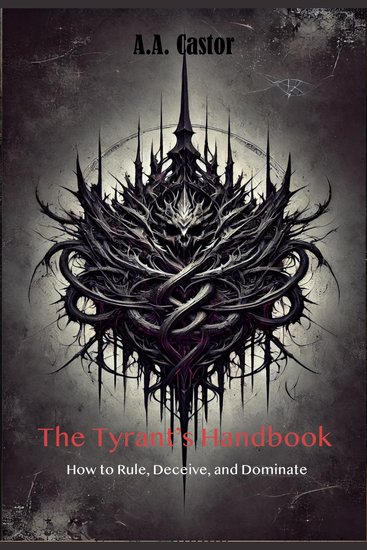
  • The Tyrant’s Handbook - How to Rule Deceive and Dominate - cover

    The Tyrant’s Handbook - How to...

    A.A. Castor

    • 0
    • 0
    • 0
    Power does not belong to the righteous—it belongs to those ruthless enough to take it. 
    From the ancient empires to modern political regimes, history has been shaped not by the moral, but by the manipulative. The Tyrant's Handbook: How to Rule, Deceive, and Dominate is a cold, strategic manual that dissects the psychology of control, the art of deception, and the brutal truths of leadership. 
    This book explores the unspoken laws of power—how rulers condition obedience, manipulate perception, use fear and loyalty as weapons, and ensure their dominance remains unchallenged. It exposes the tactics used by tyrants, corporate leaders, and political masterminds to bend reality to their will, from rewriting history to manufacturing crises to justify greater control. 
    Inside, you will learn: 
    ✔ The Psychology of Control – How to make people obey without force. 
    ✔ The Laws of Manipulation – Why perception is stronger than truth. 
    ✔ The Art of Deception – How lies and distractions keep rulers in power. 
    ✔ Fear vs. Loyalty – How to balance terror and rewards for absolute control. 
    ✔ Economic Domination – Using money, debt, and financial systems to enslave. 
    ✔ Eliminating Opposition – The tactics for removing threats before they rise. 
    ✔ The Theater of Rule – How politics, propaganda, and spectacle shape power. 
    ✔ The Eternal Game – How to keep control once you have it. 
    Power is the only law that matters. Those who do not understand it will forever be controlled by those who do. This book is for those who refuse to be ruled.
    Ver livro