Join us on a literary world trip!
Add this book to bookshelf
Grey
Write a new comment Default profile 50px
Grey
Subscribe to read the full book or read the first pages for free!
All characters reduced
Confidence Building - cover

Confidence Building

Lila Santoro

Translator A AI

Publisher: Publifye

  • 0
  • 0
  • 0

Summary

Confidence Building explores the development of self-assurance, arguing it's a learned skill, not an innate trait. The book emphasizes that understanding psychological mechanisms is key, moving beyond fleeting affirmations to foster genuine self-esteem. It highlights the impact of early life experiences and cognitive distortions on self-perception, offering insights into how these factors influence confidence levels.

 
Did you know that reframing negative thoughts is a powerful tool for boosting self-confidence? Or that assertiveness skills can be developed through targeted practice? The book presents a step-by-step guide, starting with the psychological underpinnings of self-confidence and progressing to practical strategies. Techniques for setting realistic goals, managing fear of failure, and cultivating self-acceptance through mindfulness are explored.

 
Each chapter includes actionable exercises. The book differentiates itself by grounding its approach in psychological science and cognitive behavioral therapy, bridging the gap between academic theory and real-world application.
Available since: 03/15/2025.
Print length: 107 pages.

Other books that might interest you

  • Gentle Guidance: Empowering Kids Through Connection and Care - "Discover the art of gentle parenting through our captivating audiobook enriching your child's life with care and connection!" - cover

    Gentle Guidance: Empowering Kids...

    Orson Wexley

    • 0
    • 0
    • 0
    Gentle Guidance: Empowering Kids Through Connection and Care 
    Are you eager to advance your understanding of child development and strengthen the bonds with your kids? 
    Searching for a thorough guide that equips you with all the necessary tools to nurture confidence through understanding and foster strong parent-child relationships?  
    Your quest ends here! 
    This audiobook is your ultimate companion for enhancing your knowledge, applying practical skills, and engaging in meaningful exercises. With this resource, you're set for success. 
    Updated for 2024-2025. 
    Key features of this insightful guide: 
    - In-depth insights about child development principles 
    - Comprehensive explanations of nurturing confidence in children 
    - Effective strategies for fostering strong connections between parents and kids 
    Our audiobook stands out with its extensive coverage, which is crucial for your growth as a caregiver. Concepts are not just touched upon; they are explored in detail.  
    This audiobook is an independent resource, not affiliated with any official early childhood education entity. 
    Crafted with a clear structure and accessible language, our guide ensures smooth transitions between topics. Say goodbye to complex jargon and embrace clear, concise, and accurate content. 
    So why wait? Click the BUY NOW button, secure your audiobook, and embark on your journey toward empowering your kids through connection and care! 
    Take this step towards nurturing your child's potential today!
    Show book
  • Ottoman Empire’s Most Important Battles The: The History and Legacy of the Ottomans’ Biggest Victories and Defeats - cover

    Ottoman Empire’s Most Important...

    Editors Charles River

    • 0
    • 0
    • 0
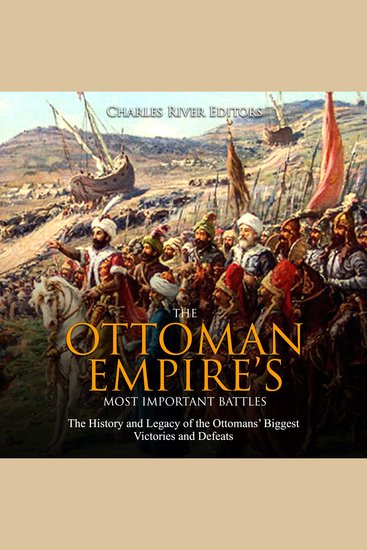
    In terms of geopolitics, perhaps the most seminal event of the Middle Ages was the successful Ottoman siege of Constantinople in 1453. The city had been an imperial capital as far back as the 4th century, when Constantine the Great shifted the power center of the Roman Empire there, effectively establishing two almost equally powerful halves of antiquity’s greatest empire. Constantinople would continue to serve as the capital of the Byzantine Empire even after the Western half of the Roman Empire collapsed in the late 5th century. Naturally, the Ottoman Empire would also use Constantinople as the capital of its empire after their conquest effectively ended the Byzantine Empire, and thanks to its strategic location, it has been a trading center for years and remains one today under the Turkish name of Istanbul.  
    The end of the Byzantine Empire had a profound effect not only on the Middle East but Europe as well. Constantinople had played a crucial part in the Crusades, and the fall of the Byzantines meant that the Ottomans now shared a border with Europe. Indeed, the Ottomans would clash with Russians, Austrians, Venetians, Polish, and more before collapsing as a result of World War I, when they were part of the Central powers.  
    In the wake of taking Constantinople, the Ottoman Empire would spend the next few centuries expanding its size, power, and influence, bumping up against Eastern Europe and becoming one of the world’s most important geopolitical players. It was a rise that would not truly start to wane until the 19th century. Preserving its mixed heritage, coming from both its geographic position rising above the ashes of the Byzantine Empire and the tradition inherited from the Muslim Conquests, the Ottoman Empire lasted more than six centuries.
    Show book
  • How to Write a Series - A Guide to Series Types and Structure plus Troubleshooting Tips and Marketing Tactics - cover

    How to Write a Series - A Guide...

    Sara Rosett

    • 0
    • 0
    • 0
    Struggling to structure your book series? Learn how to make a series work for you: increase reader engagement and take advantage of the built-in marketing potential a series gives you.Are you unsure which series structure is best for you? Or are you several books into a series, but you’re stuck? Do you want to expand your literary universe but aren’t sure how to do it? Perhaps you have a series languishing in your backlist, and you need ideas on how to market it. Get the knowledge you need to make smart decisions about your series with How to Write a Series. You’ll learn: The three basic types of seriesThe benefits and drawbacks of writing each type of seriesTips for extending your series beyond your original planIdeas for creating spinoffs and expanding your literary universeHow to know when it’s time to end a seriesHow to save time writing your series and how to keep track of detailsHow to deal with the problems that result from being locked into a story world How to refresh your interest in a series if you’ve grown boredCreative ways to market your series	I’ve been writing for fifteen years as both a hybrid and independent author. I’ve published over twenty-five fiction books in four different series. Everything I’ve learned about writing a series has been through trial and error. I hope my lessons-learned will give you a shortcut when it comes to writing your series, plus tips for troubleshooting problems, and ideas for promoting your series.Unlock the power of a series in your author career with How To Write a Series.
    Show book
  • Bones of Belonging - Finding Wholeness in a White World - cover

    Bones of Belonging - Finding...

    Annahid Dashtgard

    • 0
    • 0
    • 0
    In this exceptional book, inclusion leader Annahid Dashtgard shares her experiences looking for and teaching about belonging in our divided world. Through moving and deft interlocking stories, Dashtgard examines what it means to belong—to a country, in a marriage, and in our skin—and the price we pay when that belonging is absent.
    Show book
  • Nothing Means Anything (And That's Like Profound) - A Guide to Postmodernism - cover

    Nothing Means Anything (And...

    Sophia Blackwell

    • 0
    • 0
    • 0
    Finally, a philosophy book that doesn't take itself as seriously as the theorists it eviscerates! "Nothing Means Anything" mercilessly skewers postmodernism's most pretentious thinkers with savage wit and zero academic mercy. 
    Journey through the impenetrable jargon, circular logic, and breathtaking hypocrisy of French intellectuals who made careers out of stating the obvious in the most confusing way possible. From Derrida's word games to Foucault's paranoid power trips, from Baudrillard's reality-denial to Lyotard's grand narrative about the end of grand narratives, this book translates postmodern gobbledygook into hilarious plain English. 
    Whether you're a traumatized humanities student seeking revenge on the theorists who destroyed your GPA, a curious reader wondering what all the fuss is about, or just someone who enjoys watching pretentious nonsense get thoroughly roasted, this irreverent guide delivers. You'll learn how to sound profound while saying absolutely nothing, why your IKEA catalog is more meaningful than your actual life, and how to win any argument by claiming everything is a "discourse" (don't forget the air quotes). 
    Warning: Reading this book in public may cause uncontrollable snorting, concerned looks from strangers, and a weird sense of relief that someone finally said what we've all been thinking about these turtleneck-wearing, cigarette-smoking harbingers of intellectual doom. May cause spontaneous clarity and the disturbing realization that these insufferable French people might occasionally have been right about something.
    Show book
  • Music and Religion in the Writings of Ian McEwan - cover

    Music and Religion in the...

    Iain Quinn

    • 0
    • 0
    • 0
    This book examines Ian McEwan’s ability to discern in his writing sentiments that easily resonate with musicians, explores the value of music in exhibiting McEwan’s views on the world, and presents his perspective on religion’s role within society. 
    The majority of characters in Ian McEwan’s novels are educated members of the middle class, but without any great private financial means and certainly no great affluence. Despite different occupations, whether scientist (Solar), musician (On Chesil Beach, Amsterdam) or surgeon (Saturday), they are faced with moral, ethical, religious and personal dilemmas that bear resonance to a contemporary audience. 
    McEwan’s ability to discern sentiments that easily resonate with musicians place his contribution to the field of music and literature studies in a singular position among living writers discussing classical music in Britain. This book provokes questions for those who encounter these areas for the first time in McEwan’s writings, and it offers a place of sustained enquiry for those who have experienced these fields first-hand, whether as listeners, performers, congregants, audience members or scholars across literary, musical or ecclesiastical fields. Iain Quinn’s book will be of interest to scholars and students of contemporary British literature, as well as those interested in words and music studies more generally.
    Show book