¡Acompáñanos a viajar por el mundo de los libros!
Añadir este libro a la estantería
Grey
Escribe un nuevo comentario Default profile 50px
Grey
Suscríbete para leer el libro completo o lee las primeras páginas gratis.
All characters reduced
The Lost Family - How DNA Testing Is Upending Who We Are - cover

The Lost Family - How DNA Testing Is Upending Who We Are

Libby Copeland

Editorial: ABRAMS Press

  • 0
  • 1
  • 0

Sinopsis

“A fascinating exploration of the mysteries ignited by DNA genealogy testing—from the intensely personal and concrete to the existential and unsolvable.” —Tana French, New York Times–bestselling author  
 
You swab your cheek or spit in a vial, then send it away to a lab somewhere. Weeks later you get a report that might tell you where your ancestors came from or if you carry certain genetic risks. Or, the report could reveal a long-buried family secret that upends your entire sense of identity. Soon a lark becomes an obsession, a relentless drive to find answers to questions at the core of your being, like “Who am I?” and “Where did I come from?” Welcome to the age of home genetic testing. 
 
In The Lost Family, journalist Libby Copeland investigates what happens when we embark on a vast social experiment with little understanding of the ramifications. She explores the culture of genealogy buffs, the science of DNA, and the business of companies like Ancestry and 23andMe, all while tracing the story of one woman, her unusual results, and a relentless methodical drive for answers that becomes a thoroughly modern genetic detective story. Gripping and masterfully told, The Lost Family is a spectacular book on a big, timely subject. 
 
“An urgently necessary, powerful book that addresses one of the most complex social and bioethical issues of our time.” —Dani Shapiro, New York Times–bestselling author 
 
“Before you spit in that vial, read this book.” —The New York Times Book Review 
 
“Impeccably researched . . . up-to-the-minute science meets the philosophy of identity in a poignant, engaging debut.” —Kirkus Reviews (starred review)
Disponible desde: 03/03/2020.
Longitud de impresión: 302 páginas.

Otros libros que te pueden interesar

  • 100 Facts About Artificial Intelligence - English to Spanish - cover

    100 Facts About Artificial...

    Science-Based Language Learning Lab

    • 0
    • 0
    • 0
    Introduction to the 100 Somethings Language Learning Series 
     
    Welcome to a revolutionary approach to language learning! This series helps you master Spanish by intertwining it with compelling topics like Artificial Intelligence. Each book centers on a theme (art, science, history) and presents 100 carefully chosen facts in both English and Spanish. 
     
    How It Works: 
     
    - Each fact is first introduced in Spanish, encouraging you to interpret it. 
     
    - The following page provides the fact in English and then repeats it in Spanish, aiding comprehension and memorization. 
     
    - The second half flips this order—English first, then Spanish, and English again—helping you practice translation in both directions for better mastery. 
     
    Benefits: 
     
    - Concise Learning: Focuses on one-sentence facts to ensure every word learned is impactful and directly related to your interests, making them easier to remember. 
     
    - Reinforcement: Alternating languages for each fact naturally strengthens vocabulary and grammar. 
     
    - Engagement: Learning vocabulary through topics you're passionate about keeps the process dynamic and relevant. 
     
    - Dual Knowledge: You enrich your understanding of a specific subject while learning a new language. 
     
    This series is tailored for learners who thrive on clear, targeted information, making it both educational and enjoyable. Whether you’re a beginner or expanding your linguistic skills, this series promises an effective and engaging educational journey. Embrace these 100 facts and let your passions drive your progress in mastering a new language!
    Ver libro
  • A Billion Butterflies - A Life in Climate and Chaos Theory - cover

    A Billion Butterflies - A Life...

    Dr. Jagadish Shukla

    • 0
    • 0
    • 0
    The amazing true story of the man behind modern weather predictionConsider a world without weather prediction. How would we know when to evacuate communities ahead of fires or floods, or figure out what to wear tomorrow? Until 40 years ago, we couldn’t forecast weather conditions beyond ten days. Renowned climate scientist Dr. Jagadish Shukla is largely to thank for modern weather forecasting. Born in rural India with no electricity, plumbing, or formal schools, he attended classes that were held in a cow shed. Shukla grew up amid turmoil: overwhelming monsoons, devastating droughts, and unpredictable crop yields. His drive brought him to the Indian Institute of Tropical Meteorology, despite little experience. He then followed an unlikely path to MIT and Princeton, and the highest echelons of climate science. His work, which has enabled us to predict weather farther into the future than previously thought possible, allows us to feed more people, save lives, and hold on to hope in a warming world.Paired with his philanthropic endeavors and extreme dedication to the field, Dr. Shukla has been lauded internationally for his achievements, including a shared Nobel Peace Prize with Al Gore for his governmental research on climate change. A Billion Butterflies is a wondrous insider’s account of climate science and an unbelievable memoir of his life. Understanding dynamical seasonal prediction will change the way you experience a thunderstorm or interpret a forecast; understanding its origins and the remarkable story of the man who discovered it will change the way you see our world.A Macmillan Audio production from St. Martin’s Press.
    Ver libro
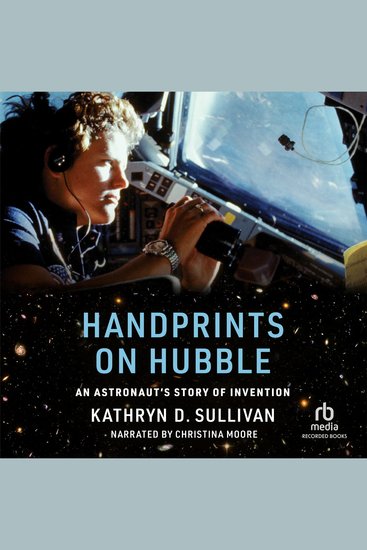
  • Handprints on Hubble - An Astronaut's Story of Invention - cover

    Handprints on Hubble - An...

    Anónimo

    • 0
    • 0
    • 0
    The first American woman to walk in space recounts her experience as part of the team that launched, rescued, repaired, and maintained the Hubble Space Telescope. 
      
    The Hubble Space Telescope has revolutionized our understanding of the universe. It has, among many other achievements, revealed thousands of galaxies in what seemed to be empty patches of sky; transformed our knowledge of black holes; found dwarf planets with moons orbiting other stars; and measured precisely how fast the universe is expanding. In Handprints on Hubble, retired astronaut Kathryn Sullivan describes her work on the NASA team that made all of this possible. Sullivan, the first American woman to walk in space, recounts how she and other astronauts, engineers, and scientists launched, rescued, repaired, and maintained Hubble, the most productive observatory ever built. 
      
    Along the way, Sullivan chronicles her early life as a “Sputnik Baby,” her path to NASA through oceanography, and her initiation into the space program as one of “thirty-five new guys.” (She was also one of the first six women to join NASA's storied astronaut corps.) She describes in vivid detail what liftoff feels like inside a spacecraft (it's like “being in an earthquake and a fighter jet at the same time”), shows us the view from a spacewalk, and recounts the temporary grounding of the shuttle program after the Challenger disaster. 
      
    Sullivan explains that “maintainability” was designed into Hubble, and she describes the work of inventing the tools and processes that made on-orbit maintenance possible. Because in-flight repair and upgrade was part of the plan, NASA was able to fix a serious defect in Hubble's mirrors—leaving literal and metaphorical “handprints on Hubble.” 
      
    "Dr. Sullivan starts out headed for the bottom of the sea. Soon, she flies us 200 miles above the sky, using her head, heart, and hands to solve problem after problem—and help us take in views that are out of this world. She does it all with her veneer of astronaut cool, of course. What an adventure—no wonder she loves it."—Bill Nye, CEO, The Planetary Society
    Ver libro
  • Handmade Houses and Feeders for Birds Bees and Butterflies - cover

    Handmade Houses and Feeders for...

    Michele McKee-Orsini

    • 0
    • 0
    • 0
    These handmade birdhouses and feeders, bee hotels, and butterfly and ladybird homes will bring welcome visitors to your garden.
    
    Handmade Houses and Feeders for Birds, Bees, and Butterflies features 35 beautiful havens to build to attract more wildlife into your garden. Each house is beautifully designed, with colourful details, but is also perfectly adapted for its intended inhabitants. There are birdhouses you can hang up or place on stands, and a bee house you can 'plant' in your flowerbed. There are also feeders for birds, and homes for butterflies and ladybirds. With her trademark attention to detail, Michele McKee-Orsini has designed a gorgeous collection of miniature palaces for the wildlife that we should all be encouraging into our gardens. Michele takes you through the basic woodworking and decorating skills you will need, and the step-by-step project instructions, clear artwork, and stunning photography will all inspire you to build your own havens for our flying friends. Handmade Houses and Feeders for Birds, Bees, and Butterflies is a compilation of previously published favourites.
    Ver libro
  • Dark Energy - Puzzles from the Cosmic Deep (3 in 1) - cover

    Dark Energy - Puzzles from the...

    Dirk Fallon

    • 0
    • 0
    • 0
    Dark Energy – Puzzles from the Cosmic Deep explores the most profound and unsolved mysteries of the universe. This 3-in-1 volume pulls you into the heart of modern astrophysics and cosmology, where scientists are wrestling with forces that defy all expectations. At the center of it all is dark energy — the invisible phenomenon that’s not only real but accelerating the expansion of the universe itself. 
    In The Dark Energy Puzzle, you’ll trace the history of its discovery, from unexpected observations of distant supernovae to the revolutionary idea that empty space may not be empty at all. You'll learn how this unknown force challenges Einstein’s theories and leaves physicists grasping for answers that lie beyond current scientific frameworks. 
    Dark Forces dives deeper into the nature of the unseen universe, examining how dark energy interacts with gravity, time, and the structure of space itself. Could there be hidden dimensions? Is dark energy connected to the quantum vacuum? This section explores the weird and wondrous possibilities at the intersection of general relativity and quantum mechanics. 
    Finally, Cosmic Paradoxes brings the biggest questions to the forefront. Why is the universe accelerating? Will it expand forever—or rip itself apart in a catastrophic end? How can something we can't see or directly measure dominate the fate of everything? These paradoxes don’t just challenge our understanding of space—they force us to rethink the foundations of reality. 
    Perfect for curious minds fascinated by astronomy, cosmology, and the frontiers of theoretical physics, this book offers a rich and readable journey through one of the greatest puzzles in modern science. As you peer into the deep cosmos, you’ll uncover not just answers, but bigger and stranger questions.
    Ver libro
  • World Prehistory - The Basics - cover

    World Prehistory - The Basics

    Brian M. Fagan, Nadia Durrani

    • 0
    • 0
    • 0
    Written in a non-technical style by two archaeologists and experienced writers about the past, the story begins with human origins in Africa some six million years ago and the spread of our remote ancestors across the Old World. Then we return to Africa and describe the emergence of Homo sapiens (modern humans) over 300,000 years ago, then, much later, their permanent settlement of Europe, Eurasia, Asia, and the Americas. From hunters and foragers, we turn to the origins of farming and animal domestication in different parts of the world after about 11,000 years ago and show how these new economies changed human existence dramatically. The narratives chronicle the rise and fall of civilizations, and the devastating effects of long droughts on many of them. The closing chapter poses a question: Why is world prehistory important in the modern world? What does it tell us about ourselves? 


    Providing a simple, but entertaining and stimulating, account of the prehistoric past from human origins to today from a global perspective, World Prehistory: The Basics is the ideal guide to the story of our early human past and its relevance to the modern world.
    Ver libro