Begleiten Sie uns auf eine literarische Weltreise!
Buch zum Bücherregal hinzufügen
Grey
Einen neuen Kommentar schreiben Default profile 50px
Grey
Jetzt das ganze Buch im Abo oder die ersten Seiten gratis lesen!
All characters reduced
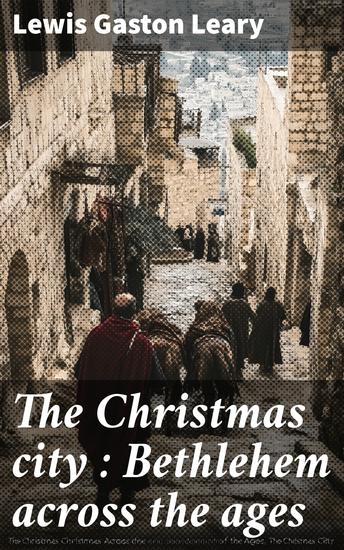
The Christmas city : Bethlehem across the ages - cover

The Christmas city : Bethlehem across the ages

Lewis Gaston Leary

Verlag: Good Press

  • 0
  • 0
  • 0

Beschreibung

In "The Christmas City: Bethlehem Across the Ages," Lewis Gaston Leary presents a compelling exploration of the historical and religious significance of Bethlehem, weaving together rich narratives that span millennia. Through a meticulous examination of texts, archaeological findings, and cultural practices, Leary captures the essence of Bethlehem not only as a geographical location but as a profound symbol of faith and hope. His literary style beautifully balances scholarly rigor with accessible prose, making the book both informative and engaging for readers across various backgrounds. The work sits firmly within the context of Christian literature and historical studies, fostering a deeper understanding of the city that remains central to the narrative of the Nativity and the Christian faith. Lewis Gaston Leary's academic pursuits and personal convictions notably influenced his writing of this book. A scholar with deep roots in religious studies and history, Leary's passion for the intersection of culture and spirituality informed his comprehensive approach to Bethlehem's past. His experiences in theological education and research lend authority to his insights, particularly as he delves into the socio-political changes that have shaped the region across the ages. This book invites readers to embark on an enlightening journey through time, linking them with the often-overlooked narratives of a city that continues to resonate across cultures. Ideal for both casual readers and serious scholars, "The Christmas City" is a profound addition to the literature on Bethlehem, perfect for those seeking to understand the rich tapestry of history surrounding this emblematic locale.
Verfügbar seit: 02.03.2025.
Drucklänge: 150 Seiten.

Weitere Bücher, die Sie mögen werden

  • Decoding Hindu Chronology - cover

    Decoding Hindu Chronology

    HENRY ROMANO

    • 0
    • 0
    • 0
    Since ancient times, the Hindus have had a lunisolar cycle based on the combination of solar and lunar years, determined by the course of the sun and the moon, but with the lunar year beginning near the solar year. Exactly how their earliest Calendar was arranged remains a mystery. Our focus is on the current form of their Calendar, developed around 400 under the influence of Greek astronomy and introduced into India at no long time. 
    There are two kinds of Hindu years, solar and lunar.  
    To understand the lunar Calendar, we will first explain the solar year, which governs the lunisolar system. Bengal, including Madras's Orissa, Tamil, and Malayalam districts, used solar years for civil purposes. General religious rites and festivals are regulated by the lunar year and the details of private and domestic life, such as choosing auspicious occasions for marriages and journeys, choosing lucky moments for shaving, etc. Almanacs that follow the lunar year contain details about the solar year, such as the sun's course through the zodiac signs. Despite following the solar year, almanacs include lunar year details.
    Zum Buch
  • Political Masculinity - How Incels Fundamentalists and Authoritarians Mobilise for Patriarchy - cover

    Political Masculinity - How...

    Susanne Kaiser

    • 0
    • 0
    • 0
    Men with assault rifles, balaclavas, and Hawaiian shirts pulled over bulletproof vests. Horned warriors with painted faces and fur headdresses draped over their naked torsos. The storming of the Capitol brought together men who had previously come across one another only online in the Manosphere. These were men with a common interest, followers of a male-supremacist ideology, who rioted in order to fight for their privilege.  Before then, the world had looked on as devastating attacks were carried out by incels: those who seek to gain unfettered access to women's bodies by redrawing the hierarchy of the sexes in order to ensure the subjugation of women. 


    For all of these men, masculinity is a political project, and the events at the Capitol were one episode in a growing movement. From the US and Canada to New Zealand, from Poland to Brazil, right-wing extremists, religious fundamentalists, and male supremacists are coming together in order to translate their reactionary dreams of male domination into politics, underscoring the masculine roots of the authoritarian backlash.
    Zum Buch
  • A Rare Recording of Poet Robert Frost Reading "The Gift Outright" at President Kennedy's Inauguration - cover

    A Rare Recording of Poet Robert...

    Robert Frost

    • 0
    • 0
    • 0
    In 1961, poet Robert Frost was invited to read at the inauguration of President John F. Kennedy. It would be the first by a poet for an inaugural ceremony. President-elect Kennedy asked Frost to recite the poem "The Gift Outright" unless the poet planned to write a poem especially for the occasion. Frost did, in fact, write a new poem for the day entitled "Dedication." However, when the time came to read, the wind and sun's glare made this impossible, though Frost made a valiant attempt. Instead, he reverted to "The Gift Outright," which he read by heart: 
     
    "The land was ours before we were the land’s. She was our land more than a hundred years, Before we were her people. She was ours In Massachusetts, in Virginia, But we were England’s, still colonials, Possessing what we still were unpossessed by, Possessed by what we now no more possessed. Something we were withholding made us weak, Until we found out that it was ourselves, We were withholding from our land of living, And forthwith found salvation in surrender. Such as we were we gave ourselves outright, (The deed of gift was many deeds of war), To the land vaguely realizing westward, But still unstoried, artless, unenhanced, Such as she was, such as she will become."
    Zum Buch
  • Inner Revolution Poetry - From Māyāvada to Prabhupāda - cover

    Inner Revolution Poetry - From...

    Yashomatinandana Dasa

    • 0
    • 0
    • 0
    The beauty of poetry is also practical. It is said in the Vedic scripture that to be a poet is one of the divine qualities possessed by devotees of the Lord. Like an ornament it enhances the character of a person, if he is using this poetry not for own sense gratification, but for glorification of the Supreme Person. That is the only work of a poet, namely to glorify the all-attractive person, literally Kṛṣṇa. 
    Words that do not glorify the All-attractive Person, Kṛṣṇa, are considered by saintly persons to be like places of pilgrimage for crows. Swan-like devotees who are actually residents of the kingdom of God do not derive any pleasure there. Thus, I follow in the footsteps of my spiritual teachers who were all expert poets and writers. 
    2016, as a believer and traveler I came to win back faith. Finding shelter with the wisdom texts of the Vedas, a doorway to self-realisation was opened. Self-realisation is nothing cheap, but the sole purpose of human existence. This human form of life is essentially meant for inquiring about the Absolute Truth. 
    When this mystical door opened, I had insight into spiritual truth, substantial, enlightened and blissful. In a state of meditation this spiritual drop touched my heart and I tried to get hold of it. Expressing my experiences in words of poetry helped to channel these spiritual visions and insights. 
    Once I sat on the Pacific Ocean and meditated. A vast consciousness surrounded me and I felt as if I was one with that vast consciousness. Later, I came back to an individual consciousness. I would read about this oneness experience, warned that this is māyā, illusion. In retrospect, this path of illusion (Mayavada) was enlightened by the spiritual master (Prabhupāda) who felt compassion with this delusioned seeker.
    Zum Buch
  • Drilled for Her Pleasure - MM Wife Voyeur - cover

    Drilled for Her Pleasure - MM...

    Randy Manners

    • 0
    • 0
    • 0
    He never could have imagined it would turn her on. 
      
    One liquor-laden night, and he’d told his wife everything. And now she wanted to watch. She seated herself in a corner of the bar as he sat down next to a sexy man in a Navy uniform. He didn’t know where to start, but he didn’t need to. Master Chief took control. The chief is hot and ready to teach a first-timer a few lessons – and he is more than happy to let dear wifey in on the action! 
      
    A steamy, short story full of man on man action and lady who loves to watch her man field get plowed!
    Zum Buch
  • Montenegro in the Late Middle Ages: The History of the Different States and Dynasties that Controlled the Area - cover

    Montenegro in the Late Middle...

    Editors Charles River

    • 0
    • 0
    • 0
    Much has been written about Western intervention during the breakup of Yugoslavia, and whether it made matters worse, prevented worse atrocities, or was simply ineffective. In early 1992, however, what was clear was that Europe was hopelessly divided over the best course of action to take towards Yugoslavia, and after several years of fighting, the Bosnian War was one of the most violent conflagrations in Europe since the end of World War II. 
    That war had been the byproduct of centuries of tensions in the Balkans, and an attempt in the wake of World War I to redraw the political boundaries of Europe and the Middle East. That included forming the Kingdom of Yugoslavia, initially known as the Kingdom of Serbs, Croats and Slovenes, a particularly fragile enterprise, and there was almost constant tension between the majority Serbs and the other Yugoslav nationalities, especially the Croats. As a result, the Kingdom was a land of political assassinations, underground terrorist organizations, and ethnic animosities. In 1929, King Alexander I suspended democracy and ruled as a dictator until he himself was assassinated in 1934. 
    Depending on the source, many authors have focused on different catalysts for Yugoslavia’s demise, but Vesna Drapac may have succinctly summed the situation up when he wrote that by the end, the state “lacked a reason to exist.” There is certainly something in this sentiment, but the disintegration came at an enormous cost. Given what happened in Yugoslavia, it should be little surprise the area that eventually became the modern nation of Montenegro has had a turbulent history for millennia, with shifting borders, different degrees of autonomy, and various conflicts occurring within it.
    Zum Buch