Join us on a literary world trip!
Add this book to bookshelf
Grey
Write a new comment Default profile 50px
Grey
Subscribe to read the full book or read the first pages for free!
All characters reduced
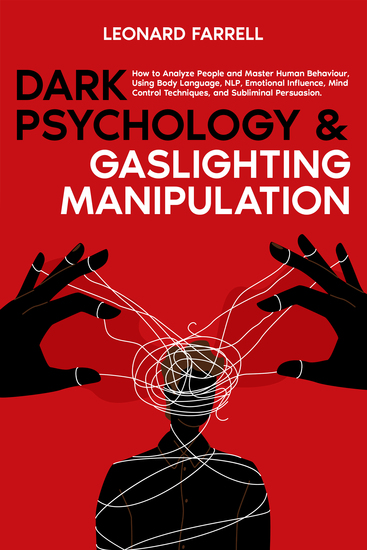
Dark Psychology & Gaslighting Manipulation - How to Analyze People and Master Human Behaviour Using Body Language NLP Emotional Influence Mind Control Techniques and Subliminal Persuasion - cover

Dark Psychology & Gaslighting Manipulation - How to Analyze People and Master Human Behaviour Using Body Language NLP Emotional Influence Mind Control Techniques and Subliminal Persuasion

Leonard Farrell

Publisher: Publishdrive

  • 0
  • 0
  • 0

Summary

Are you tired of being manipulated by others?
 
Do you struggle to understand why people behave the way they do?
 
Are you looking to strengthen your powers of communication and influence?
 
If you said YES to any of these questions, then “Dark Psychology & Gaslighting Manipulation” is for you!
 
In this book, you will learn how to analyze people, read body language, and use powerful techniques such as NLP, emotional influence, and subliminal persuasion to gain the upper hand in any situation.
 
Whether you want to defend yourself against narcissistic abuse or take your persuasion skills to the next level, this book will help you unlock the secrets of human behavior and master the art of manipulation!
 
You’ll learn to:
 
- Defend yourself against manipulation: Use the power of body language, the art of persuasion, and the psychology of narcissism to analyze people with ease and defend yourself against all forms of manipulation.
 
- Discover the secrets of NLP and mind control techniques: Use NLP and mind control techniques to your advantage, giving you the power to influence others and achieve your personal and professional goals.
 
- Protect yourself against subliminal persuasion and dark triad personalities: Gain insight into the tactics of narcissists and psychopaths, so you can defend yourself against all their ill intentions.
 
- Analyze people: Gain the ability to read people's body language, emotions, and intentions with ease, allowing you to stay one step ahead of any manipulator.
 
- Develop emotional influence: Learn how to use persuasion, mind control, and NLP to develop emotional influence over others, giving you the power to control any situation.
 
And so much more!
 
“Dark Psychology & Gaslighting Manipulation” is an easy-to-understand guide written with beginners in mind.
 
Thanks to step-by-step instructions and practical tools that you can use day-to-day, you’re sure to keep manipulators at bay while ensuring you get one step closer toward a happier, freer, and more successful life!
 
Get this book and start taking control of your life today!
Available since: 08/26/2024.
Print length: 170 pages.

Other books that might interest you

  • How we save the world - The Fight to Rewrite Our Future Begins Now - cover

    How we save the world - The...

    Jack Jay

    • 0
    • 0
    • 0
    How We Save The World by Jack Jay is a manifesto for those eager to reshape humanity’s future. Blending philosophy with actionable wisdom, Jay explores pressing global issues like inequality, environmental damage, and AI ethics. 
    Chapter 1: Introduces a new meta-narrative, emphasizing the need for a better global story. 
    Chapter 2: Explores the rapid evolution of technology. 
    Chapter 3: Discusses how information shapes reality through the butterfly effect. 
    Chapter 4: Outlines pragmatic philosophies for creating effective global movements. 
    Chapter 5: Introduces the concept of the “Prodemic” — viral methods anyone can use to upgrade humanity. 
    Chapter 6/7: Focus on hacking dopamine systems to avoid burnout and redefine laziness. 
    Chapter 8: Advocates for simplicity in self-improvement and avoiding over-optimization. 
    Chapter 9: Addresses the AI alignment problem, offering a solution for humanity to collectively manage the risks of AI. 
    Chapter 10: Redefines consumerism and philanthropy through designer goods purchased via tax-deductible donations. 
    Chapter 11: Introduces “storyhacking” to help individuals start global movements. 
    Chapter 12: Emphasizes long-term thinking in a future dominated by AI. 
    Chapter 13: Presents the concept of "spear ritual wisdom" as a catalyst for positive global change. 
    Chapter 14-16: Dive deeper into leading and sustaining such a movement. 
    Chapter 17: Discusses real-world operations for achieving tipping points in society. 
    Chapter 18: Focuses on the strategy behind global leadership and spear rituals. 
    Chapter 19: Recaps the book’s worldview, offering new solutions and missions for a brighter future. 
    The book combines deep reflections with practical approaches for individuals and movements to spark change, encouraging people to take action in reshaping the world.
    Show book
  • The Overlife - A Tale of Schizophrenia - cover

    The Overlife - A Tale of...

    Diana Dirkby

    • 0
    • 0
    • 0
    The author of this book, Diana Dirkby, is an Australian-born research mathematician who lives with paranoid schizophrenia, a severe brain disorder, as did her mother. The title, “The Overlife,” suggests that a diagnosis of schizophrenia can be the beginning of a new, worthwhile life and not simply the death of the hopes and dreams that preceded the diagnosis. This book gives a fictional account of a mother and daughter living with paranoid schizophrenia. We follow the widely disparate effects of this brain disorder on Sarah, the narrator, and her mother, Jodie. We also meet Dalaigh, Jodie’s husband and Sarah’s father, with his violent resentment at being trapped in a marriage he doesn’t want. By age eight, Sarah is Jodie’s caregiver and must negotiate her mother’s rapidly worsening mental health and her father’s white-hot fury. The weight of these adult conflicts on the shoulders of one so young seems impossible to bear.
    Show book
  • Honey - Healing Effects Techniques and Tips - cover

    Honey - Healing Effects...

    Trish Turner

    • 0
    • 0
    • 0
    The History and Origins of Honey 
    Honey has a rich history that dates back thousands of years, making it one of the oldest natural sweeteners known to humankind. Ancient civilizations, including the Egyptians, Greeks, and Romans, revered honey not only for its taste but also for its healing properties. Archaeological evidence shows that honey was used in religious rituals, medicine, and as an offering to the gods. From its use in ancient Egypt to preserve mummies to its presence in ancient Ayurvedic texts, honey has played a vital role across various cultures and traditions. 
      
    The Role of Honey in Ancient and Modern Medicine 
    Honey's reputation as a healing substance is deeply rooted in both ancient and modern medicinal practices. In ancient times, it was often used as a natural remedy for wounds, burns, and digestive issues. Its antibacterial and antiseptic properties made it a staple in folk medicine. Modern science has continued to validate these uses, with studies showing honey's effectiveness in promoting wound healing, soothing sore throats, and boosting immune function. Today, honey remains a popular natural treatment in holistic health approaches and is often integrated into contemporary medicinal formulations.
    Show book
  • The Final Pandemic - An Antidote To Medical Tyranny - cover

    The Final Pandemic - An Antidote...

    Dr Samantha Bailey, Dr Mark Bailey

    • 0
    • 0
    • 0
    Humanity is under assault from pandemics but not for the reasons that the mainstream sources portray. This book examines the claims regarding alleged “contagious” disease outbreaks such as COVID-19 to shed more light on what they are, or perhaps more importantly, what they are not. The belief that germs from the natural environment (or a laboratory) are attacking us has led most of the population to go along with lockdowns, civil rights restrictions, unprecedented peacetime censorship and more vaccines. However, when the foundational science is exposed and it is understood how the cases are created, no “pandemic” looks the same ever again. 
    In line with our other content we dissect multiple aspects of what has been put forward as scientific evidence for germ theory, alleged “viruses,” diagnostic tests, and “treatments” whether they be drugs or vaccines. It is all too often a world of mythology with carefully constructed narratives designed to benefit the medico-pharmaceutical industry and other vested interests. Unfortunately, it pulls the public into a belief system that is not only counterproductive to health but frequently life shortening and sometimes deadly. We have endeavoured to illustrate this with famous case examples to demonstrate how the media promotes deception with fear-inducing sensationalised headlines that are often bereft of scientific evidence. Just as important is how the illusions are maintained and we share our own experiences of what happens when doctors speak out against the prevailing narrative. The Final Pandemic is a title that announces that the concept of contagious and death-dealing ‘germs’ is finished. Hopefully this helps people realise that there is no need to participate in these man-made “crises” ever again. 
    "...the evidence the authors have presented here is quite simply, irrefutable, however alarming that conclusion might be." - Prof. Tim Noakes
    Show book
  • The Headmaster - Frank L Boyden of Deerfield - cover

    The Headmaster - Frank L Boyden...

    John McPhee

    • 0
    • 0
    • 0
    "It was a delight to re-read and record The Headmaster. My Deerfield days came back to me in a great rush. ... So much of Mr. Boyden's teaching focused on what boys needed to grow up to be adults in society, with a particular emphasis on giving back to the community.” —Edoardo BalleriniStarting in 1902 at a country school that had an enrollment of fourteen, Frank Boyden built an academy that has long since taken its place on a level with Andover and Exeter. Boyden, who died in 1972, was the school's headmaster for sixty-six years. John McPhee portrays a remarkable man "at the near end of a skein of magnanimous despots who...created enduring schools through their own individual energies, maintained them under their own absolute rule, and left them forever imprinted with their own personalities." More than simply a portrait of the Headmaster of Deerfield Academy, it is a revealing look at the nature of private school education in America. A Macmillan Audio production from Farrar, Straus and Giroux.
    Show book
  • Summary & Analysis - The Stranger In The Woods - Based On The Book By Michael Finkel - cover

    Summary & Analysis - The...

    Book Summary Station

    • 0
    • 0
    • 0
    SUMMARY & ANALYSIS 
      
    THE STRANGER IN THE WOODS 
    BASED ON THE BOOK BY MICHAEL FINKEL 
      
    SUMMARY WRITTEN BY: BOOK SUMMARY STATION 
      
    CONTENT 
    The Hermit's Routine and First Encounter 
    Capture and Interrogation 
    Knight's Story Emerges 
    The Legend of the North Pond Hermit 
    The Author's Connection and Initial Correspondence 
    First Visit and Glimpses of Knight's Character 
    Knight's Campsite and Details of his Survival 
    Knight's Background and Philosophies on Solitude 
    Winter Survival, Psychological Analysis and Aftermath 
    General Analysis 
      
    ABOUT THE ORIGINAL BOOK 
    "The Stranger in the Woods" by Michael Finkel tells the story of Christopher Knight, a man who lived alone in the Maine woods for 27 years, becoming known as the North Pond Hermit. The book explores his reasons for leaving society, his methods for surviving the harsh winters, and the psychological implications of such extreme isolation. It details his interactions with the outside world through a series of burglaries at nearby cabins, and how he sustained himself with the items he stole. The narrative also examines the public's fascination with Knight after his capture, and the challenges he faced when attempting to re-enter society. The story goes into Knight's background, and how his beliefs and philosophies shaped his solitary life, touching on themes of solitude, autonomy, and the individual versus society.
    Show book