Junte-se a nós em uma viagem ao mundo dos livros!
Adicionar este livro à prateleira
Grey
Deixe um novo comentário Default profile 50px
Grey
Assine para ler o livro completo ou leia as primeiras páginas de graça!
All characters reduced
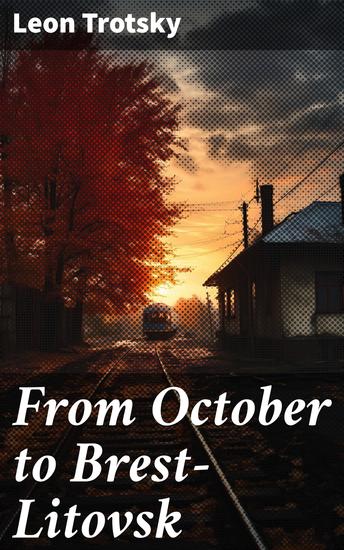
From October to Brest-Litovsk - Revolutionary Reflections on War and Peace: Insights from Brest-Litovsk - cover
LER

From October to Brest-Litovsk - Revolutionary Reflections on War and Peace: Insights from Brest-Litovsk

Leon Trotsky

Editora: Good Press

  • 0
  • 0
  • 0

Sinopse

In "From October to Brest-Litovsk," Leon Trotsky presents a comprehensive account of the tumultuous period following the October Revolution of 1917 up to the signing of the Treaty of Brest-Litovsk in 1918. Written with incisive clarity, this seminal work interweaves personal narrative with political analysis, offering a rich tapestry of events that shaped early Soviet Russia. Trotsky's literary style is characterized by its vigorous rhetoric and deep ideological commitment, effectively immersing the reader in the revolutionary fervor of the time, while also critiquing the internal and external threats to the nascent Bolshevik regime. The work serves as both a historical document and a persuasive argument for the revolutionary principles he espoused, situated firmly within the context of Marxist theory and the global struggle for proletarian empowerment. Leon Trotsky, a key figure in the Bolshevik Revolution and a prominent Marxist theorist, wrote this book during his exile from political power following a power struggle within the Communist Party. His firsthand experience as the People's Commissar for Foreign Affairs and his pivotal role in negotiating peace with the Central Powers deeply informed his perspective on the intricacies of revolution and diplomacy. Trotsky's advocacy for permanent revolution and his analysis of historical materialism manifest in this narrative, reflecting both his political ideologies and his disillusionment with factionalism within the Soviet leadership. "From October to Brest-Litovsk" is a must-read for anyone interested in understanding the complexities of the Russian Revolution, negotiating peace amid conflict, and the foundational elements of Bolshevik principles. Trotsky'Äôs insights are as relevant today as ever, making this work not only a historical account but also a critical commentary on the struggle for revolutionary change. This book will enrich the reader's understanding of revolutionary dynamics and the political landscape of the early 20th century.
Disponível desde: 16/11/2023.
Comprimento de impressão: 89 páginas.
Outros livros que poderiam interessá-lo

  • Nor Fish Nor Fowl: From Deckhand to Flight Lieutenant - The Story of a Merchant Navy seaman in the Royal Air Force Marine Branch - cover

    Nor Fish Nor Fowl: From Deckhand...

    Colin Yorke

    • 0
    • 0
    • 0
    In 1934, after five years travelling the world as a Merchant Seaman, my father, aged 21, enlisted in the British Royal Air Force to escape the Depression. Entering the Marine Branch, he swapped big ships for small fast boats - Seaplane Tenders, Armoured Target Boats and High Speed Launches. 
    In 1940, when the Air Sea Rescue service was formed, he joined the crew of High Speed Launch 102 (now fully restored and based at Portsmouth) as a Coxswain, stationed at Blyth. Three busy years on the "Spitfires of the Sea" followed, before his leg was "smashed" in heavy seas. 
    On recovery, he spent time in the Faroe Islands and in the English Channel, after "D-Day", and before being commissioned. The war's end found him in West Africa. After VJ Day he was demobbed, then recalled and posted to Egypt. 
    After a brief unhappy spell in "Civvy Street", he re-enlisted in the RAF as an acting corporal. First on the scene when HSL 2555 blew up, he was commended and subsequently carried the RAF ensign at the 1950 Battle of Britain celebrations in Paris, France. On return to the UK he was once again commissioned. 
    In Malta, during the Suez Crisis, he supervised a flying boat airlift of families and service personnel through Malta as the Canal Zone was evacuated. Later, serving in Cold War Germany, he skippered German boats with mixed German/British crews and was present when the Unit was handed back to the Germans. 
    In 1961, aged just 48, injuries forced his retirement from the RAF. 
    Now, fittingly narrated by my actor daughter, this book reveals a great deal of the little known story of the RAF Marine Branch, its boats and the life of a British serviceman's family in war and peace.
    Ver livro
  • Rescue Yourself - How to complete a PhD without a supervisor - cover

    Rescue Yourself - How to...

    Tara Brabazon

    • 0
    • 0
    • 0
    You enrol in a PhD, believing in the project and committed to its completion. But something goes wrong. A supervisor leaves the institution, becomes sick, or discards you from their research team or lab.  What happens next?  Who can rescue you?  This book - Rescue Yourself:  How to complete a PhD without a supervisor - helps students organize their habits, strategies, behaviour and emotions to finish a PhD.  Let's start our work from the fear, confusion and worry, and scaffold a thesis to success.
    Ver livro
  • Kidnapped - cover

    Kidnapped

    Robert Louis Stevenson

    • 0
    • 0
    • 0
    A story of friendship, honor, and adventure that will captivate young minds, readers will love the enthralling tale of young protagonist David Balfour in his journey of self-discovery, loss, and endurance. A tale that explores the historical landscape of Scotland, this is a coming-of-age story like no other. With beautiful full-page illustrations in color, as well as original illustrations in black and white, children will adore this vibrant edition. Featuring detailed foiling on the front and back and accompanied by a ribbon bookmark to keep your place, these stunning books will make a wonderful addition to any bookshelf.
    Ver livro
  • Persian Corridor in World War II The: The History of the Allies’ Most Important Supply Route - cover

    Persian Corridor in World War II...

    Editors Charles River

    • 0
    • 0
    • 0
    Operation Barbarossa was the most fateful decision of World War II, and when it gave the Soviets common cause with the British (and subsequently the Americans), the purpose of the Lend-Lease Act changed in nature as well. The bulk of Germany’s formidable armed forces were committed to the offensive in the east, which relieved the pressure on the British and meant that a German attack on Britain or elsewhere in Western Europe was not going to happen, so keeping the Soviets in the war became the most essential goal of the supply program. 
    Getting supplies to the Soviets to help them resist the German armies became a strategic imperative, and Iran’s geography of bordering the Persian Gulf to the south and Soviet territory to the north brought Iran to the front and center in the strategic supply effort. The German invasion devastated much of European Russia, but also devastated Ukraine and Belarus, other member “republics” in the Soviet Union, and the portions of the Soviet Union that bordered on Iran were Armenia, Azerbaijan and east of the Caspian, Turkmenistan. 
    The Persian Corridor involved British and Dominion forces, as well as Soviet armed forces and personnel, but the operation and management of the Persian Corridor became largely an American show. Most of the immense amount of aid sent was for transshipment across Iran to the Soviets, but it also involved supplying British and Commonwealth forces in Iran, Iraq and elsewhere in the Middle East. Some was used to feed and supply Iran’s people, and some was used to modernize and maintain Iran’s infrastructure. There was also the need to supply the American troops working in the Persian Corridor. While 80% or so of the aid came from the U.S., there was also a significant amount of aid sent from Canada, Australia, South Africa and especially India. 
    Ver livro
  • Great Kingdoms of Africa - cover

    Great Kingdoms of Africa

    David Adjaye

    • 0
    • 0
    • 0
    A groundbreaking, sweeping overview of the great kingdoms in African history and their legacies, written by world-leading experts. 


    This is the first book for nonspecialists to explore the great precolonial kingdoms of Africa that have been marginalized throughout history. Great Kingdoms of Africa aims to decenter European colonialism and slavery as the major themes of African history and instead explore the kingdoms, dynasties, and city-states that have shaped cultures across the African continent. 


    This groundbreaking book offers an innovative and thought-provoking overview that takes us from ancient Egypt and Nubia to the Zulu Kingdom almost two thousand years later. Each chapter is written by a leading historian, interweaving political and social history and drawing on a rich array of sources, including oral histories and recent archaeological findings. Great Kingdoms of Africa is a timely and vital book for anyone who wants to expand their knowledge of Africa's rich history.
    Ver livro
  • Killer Memory - Jeannie Rousseau: A True WWII Female Spy Story - cover

    Killer Memory - Jeannie...

    Jo Duval

    • 0
    • 0
    • 0
    Picture this: A young, bright girl in Paris goes undercover to deliver the crucial intelligence that will single-handedly stop the production of Nazi superweapons and spare the lives of thousands. 
    Jeannie Rousseau appeared to be just a highly educated girl, fluent in five languages, graduating at the top of her class at the elite university, the Paris Institute of Political Sciences. She had no idea she would become one of the most amazing women in WWII. When the German troops invaded France, Rousseau fought back — using nothing other than her gifted mind. 
    If you are moved by true stories of women-empowered espionage full of soul-stirring historical context, then Killer Memory is a story you need to read. Jeannie Rousseau bravely took on the Gestapo, posing as an ally and sympathizer to extract the highly sensitive, secret plans of the Nazi party. Using her exceptional photographic memory and flawless German, Rousseau kept an extraordinary record of classified German operations. 
    Working as an official liaison and translator for the Nazi occupiers, Rousseau gained their trust and evolved into an amateur spy. After a close call with the Gestapo, Rousseau had a chance encounter with an old friend that would change her life forever. 
    Working closely with the Nazi party, Rousseau was bestowed with invaluable information, including details of the V-2 rockets, the Nazis’ new superweapons. Rousseau’s spy work paid off. Through her infiltration, the development of the superweapons was significantly delayed and thousands of lives were spared. 
    Dive deep into a compelling history lesson as you discover the birth of espionage, the moments leading up to the Second World War, and how these elements combined to create one of the best spy stories in history. 
    Killer Memory is part of the greater series, Remarkable Women in War, sharing with you the most moving stories of women's empowerment during times of militarism.
    Ver livro