¡Acompáñanos a viajar por el mundo de los libros!
Añadir este libro a la estantería
Grey
Escribe un nuevo comentario Default profile 50px
Grey
Suscríbete para leer el libro completo o lee las primeras páginas gratis.
All characters reduced
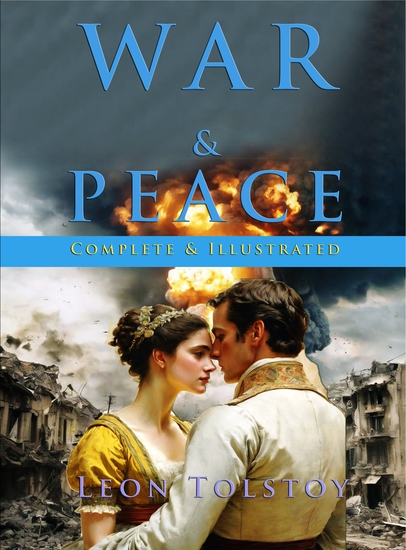
War & Peace - (Complete & Illustrated) - cover

War & Peace - (Complete & Illustrated)

Leon Tolstoy

Traductor Aylmer Maude, Louise Maude

Editorial: E-Kitap Projesi & Cheapest Books

  • 0
  • 0
  • 0

Sinopsis

Tolstoy incorporated extensive historical research. He was also influenced by many other novels. A veteran of the Crimean War, Tolstoy was quite critical of standard history, especially the standards of military history, in War and Peace. Tolstoy read all the standard histories available in Russian and French about the Napoleonic Wars and combined more traditional historical writing with the novel form. He explains at the start of the novel's third volume his own views on how history ought to be written. His aim was to blur the line between fiction and history, in order to get closer to the truth, as he states in Volume II.

The novel is set 60 years earlier than the time at which Tolstoy wrote it, "in the days of our grandfathers", as he puts it. He had spoken with people who had lived through war during the French invasion of Russia in 1812, so the book is also, in part, accurate ethnography fictionalized. He read letters, journals, autobiographical and biographical materials pertaining to Napoleon and the dozens of other historical characters in the novel. There are approximately 160 real persons named or referred to in War and Peace.

Plot summary:

War and Peace has a large cast of characters, the majority of whom are introduced in the first book.

Some are actual historical figures, such as Napoleon and Alexander I. While the scope of the novel is vast, it is centered around five aristocratic families. The plot and the interactions of the characters take place in the era surrounding the 1812 French invasion of Russia during the Napoleonic wars.

Book/Volume One

The novel begins in July 1805 in Saint Petersburg, at a soiree given by Anna Pavlovna Scherer—the maid of honour and confidante to the queen mother Maria Feodorovna. Many of the main characters and aristocratic families in the novel are introduced as they enter Anna Pavlovna's salon. Pierre (Pyotr Kirilovich) Bezukhov is the illegitimate son of a wealthy count, an elderly man who is dying after a series of strokes. Pierre is about to become embroiled in a struggle for his inheritance. Educated abroad at his father's expense following his mother's death, Pierre is essentially kindhearted, but socially awkward, and owing in part to his open, finds it difficult to integrate into Petersburg society. It is known to everyone at soiree that Pierre is his father's favorite of all the old count's illegitimate children.

Also attending the soireé is Pierre's friend, the intelligent and sardonic Prince Andrei Nikolayevich Bolkonsky, husband of Lise, the charming society favourite. Finding Petersburg society unctuous and disillusioned with married life after discovering his wife is empty and superficial, Prince Andrei makes the fateful choice to be an aide-de-camp to Prince Mikhail Ilarionovich Kutuzov in the coming war against Napoleon.

The plot moves to Moscow, Russia's ancient city and former capital, contrasting its provincial, more Russian ways to the highly mannered society of Petersburg. The Rostov family are introduced. Count Ilya Andreyevich Rostov has four adolescent children. Thirteen-year-old Natasha (Natalia Ilyinichna) believes herself in love with Boris Drubetskoy, a disciplined young man who is about to join the army as an officer. Twenty-year-old Nikolai Ilyich pledges his love to Sonya (Sofia Alexandrovna), The eldest child of the Rostov family, Vera Ilyinichna, is cold and somewhat haughty but has a good prospective marriage in a Russian-German officer, Adolf Karlovich Berg. Petya (Pyotr Ilyich) is nine and the youngest of the Rostov family; like his brother, he is impetuous and eager to join the army when of age. The heads of the family, are an affectionate couple but forever worried about their disordered finances.
Disponible desde: 10/02/2024.
Longitud de impresión: 1500 páginas.
Otros libros que te pueden interesar

  • Little Dorrit - cover

    Little Dorrit

    Charles Dickens

    • 0
    • 0
    • 0
    Little Dorrit is a novel by Charles Dickens, originally published in serial form between 1855 and 1857. The story features Amy Dorrit, youngest child of her family, born and raised in the Marshalsea prison for debtors in London. Arthur Clennam encounters her after returning home from a 20-year absence, ready to begin his life anew.
    The novel satirises some shortcomings of both government and society, including the institution of debtors' prisons, where debtors were imprisoned, unable to work and yet incarcerated until they had repaid their debts. The prison in this case is the Marshalsea, where Dickens's own father had been imprisoned. Dickens is also critical of the impotent bureaucracy of the British government, in this novel in the form of the fictional Circumlocution Office. Dickens satirises the stratification of society that results from the British class system, too.
    Ver libro
  • Daughters of the Vicar - cover

    Daughters of the Vicar

    D H Lawrence

    • 0
    • 0
    • 0
    ‘Daughters of the Vicar’ was written by D H Lawrence in 1911. It was the eleventh of his sixty-seven short stories, all of which will be published individually in audio book format by the Blackthorn Press. Lawrence is at his best in this story, taken from the scenes of his childhood and based on characters he knew intimately. The main themes of the story are the class system which dominated society at the time and the pressures put on the young lovers who have to overcome it and the position of women in society who have nothing to offer but their bodies. For the sake of security and position one daughter makes a loveless marriage whilst the other daughter gives all that up for love.
    Ver libro
  • The Adventures of Huckleberry Finn - cover

    The Adventures of Huckleberry Finn

    Mark Twain

    • 0
    • 0
    • 0
    In the sequel to Tom Sawyer, his sidekick Huckleberry Finn takes centre stage.
    
    Innocent and well-intentioned, Huck is brought face to face with the reality of slavery in the southern states as he helps his friend Jim escape to freedom.
    Ver libro
  • The Custom of the Country - cover

    The Custom of the Country

    Edith Wharton

    • 0
    • 0
    • 0
    The Spraggs, a wealthy family of Midwesterners, are visiting New York City to marry off their beautiful daughter Undine. While Undine's beauty catches the attention of several high-society men, she finds it difficult to fit in with the old-money social circles that rule New York. When she finally marries Ralph Marvell, she embraces a life full of frivolities, which eventually leads to her tumultuous demise. Best known for inspiring the hit series Downton Abbey, this classic novel is a scathing critique of ambition featuring one of the most ruthless heroines in literature.
    Ver libro
  • Les Misérables: Volume 4: The Idyll in the Rue Plumet and the Epic in the Rue St Denis - Book 7: Slang (Unabridged) - cover

    Les Misérables: Volume 4: The...

    Victor Hugo

    • 0
    • 0
    • 0
    Victor-Marie Hugo (26 February 1802 - 22 May 1885) was a French poet, novelist, essayist, playwright, and dramatist of the Romantic movement. During a literary career that spanned more than sixty years, he wrote abundantly in an exceptional variety of genres: lyrics, satires, epics, philosophical poems, epigrams, novels, history, critical essays, political speeches, funeral orations, diaries, and letters public and private, as well as dramas in verse and prose.
    BOOK 7: SLANG: Pigritia is a terrible word. It engenders a whole world, la pègre, for which read theft, and a hell, la pègrenne, for which read hunger.
    Ver libro
  • The Whale Tooth - cover

    The Whale Tooth

    Jack London

    • 0
    • 0
    • 0
    In his tales of the South Seas, Jack London so often employs dark humor and grim irony in order to illuminate the clash of cultures. In The Whale Tooth, a white man becomes the victim of his own impulse to proselytize the benighted "heathen" on Melanesia.
    Ver libro