¡Acompáñanos a viajar por el mundo de los libros!
Añadir este libro a la estantería
Grey
Escribe un nuevo comentario Default profile 50px
Grey
Suscríbete para leer el libro completo o lee las primeras páginas gratis.
All characters reduced
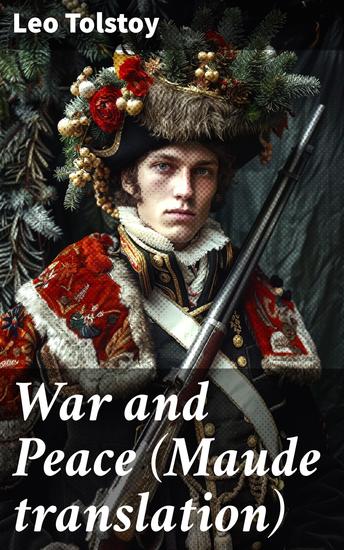
War and Peace (Maude translation) - Enriched edition Love War and Society: A Russian Epic Masterpiece of Human Relationships and Historical Reflections - cover

War and Peace (Maude translation) - Enriched edition Love War and Society: A Russian Epic Masterpiece of Human Relationships and Historical Reflections

Leo Tolstoy

Editorial: Good Press

  • 0
  • 0
  • 0

Sinopsis

In the monumental epic 'War and Peace,' Leo Tolstoy weaves a rich tapestry of 19th-century Russian society during the Napoleonic Wars. This intricately structured narrative juxtaposes historical events with a deep exploration of personal and philosophical themes, including the nature of power, fate, and human morality. The Maude translation is esteemed for its fidelity to Tolstoy's original prose and its ability to convey the author's nuanced characterizations and profound insights, making it accessible to contemporary readers while respecting the text's complexity. The novel employs a variety of literary techniques, including detailed character studies and sweeping historical narratives, rendering it a quintessential work within the realist tradition yet transcending conventional genre boundaries. Leo Tolstoy, a leading figure in Russian literature, was deeply influenced by his own experiences in the Russian aristocracy and his subsequent spiritual questioning. His profound moral inquiries and ambitions for personal growth resonate throughout 'War and Peace,' reflecting his ambition not only to narrate a grand historical chronicle but also to engage with existential questions of purpose and ethics. Tolstoy's unique position allows him to convey the intricacies and adversities of his time with both empathy and critique. 'War and Peace' is not merely a historical novel; it is a transformative examination of the human condition. I highly recommend this profound work to anyone seeking to understand the complexities of life, love, and the often chaotic interplay of history. Tolstoy's brilliant storytelling will appeal to both scholars and casual readers alike, offering an enduring reflection on the cycles of war and peace that remain relevant today.

In this enriched edition, we have carefully created added value for your reading experience:
- A succinct Introduction situates the work's timeless appeal and themes.
- The Synopsis outlines the central plot, highlighting key developments without spoiling critical twists.
- A detailed Historical Context immerses you in the era's events and influences that shaped the writing.
- An Author Biography reveals milestones in the author's life, illuminating the personal insights behind the text.
- A thorough Analysis dissects symbols, motifs, and character arcs to unearth underlying meanings.
- Reflection questions prompt you to engage personally with the work's messages, connecting them to modern life.
- Hand‐picked Memorable Quotes shine a spotlight on moments of literary brilliance.
- Interactive footnotes clarify unusual references, historical allusions, and archaic phrases for an effortless, more informed read.
Disponible desde: 19/12/2023.
Longitud de impresión: 1456 páginas.
Otros libros que te pueden interesar

  • Canterville Ghost The (Unabridged) - cover

    Canterville Ghost The (Unabridged)

    Oscar Wilde

    • 0
    • 0
    • 0
    "The Canterville Ghost" The first of Wilde's stories to be published, appearing in the magazine The Court and Society Review in February 1887. When a family from the United States buys Canterville Chase, they are told it is haunted by a horrible spirit, but this does not deter them in the slightest. Indeed, when they find a recurring blood stain on the floor, and hear creaking chains in the night, even seeing the ghost himself, all they do is clean up the blood and insist that the ghost oil his manacles if he is going to keep living in the house. This perturbs the ghost to no end, and he does everything he can to try to frighten the family.
    Ver libro
  • Equality at Sea (Unabridged) - cover

    Equality at Sea (Unabridged)

    Frederick Marryat

    • 0
    • 0
    • 0
    Captain Frederick Marryat (10 July 1792 - 9 August 1848) was a Royal Navy officer, a novelist, and an acquaintance of Charles Dickens. He is noted today as an early pioneer of nautical fiction, particularly for his semi-autobiographical novel Mr Midshipman Easy (1836). He is remembered also for his children's novel The Children of the New Forest (1847), and for a widely used system of maritime flag signalling known as Marryat's Code.
    EQUALITY AT SEA: The next morning Jack Easy would have forgotten all about his engagement with the captain, had it not been for the waiter, who thought that after the reception which our hero had given the first lieutenant, it would be just as well that he should not be disrespectful to the captain.
    Ver libro
  • Flatland - cover

    Flatland

    Edwin A. Abbott

    • 0
    • 0
    • 0
    "Flatland: A Romance of Many Dimensions" is a satirical novella by Edwin A. Abbott, first published in 1884. The story takes place in a two-dimensional world and follows the experiences of A. Square, a mathematician and resident of Flatland. As A. Square discovers the existence of a third dimension, the book delves into themes of dimensionality, hierarchy, and social constraints. Though it might seem like a straightforward mathematical or geometric allegory, "Flatland" also offers insightful commentary on the social and cultural mores of Victorian England.
    Ver libro
  • Treasure Island (Part 6: Captain Silver) - cover

    Treasure Island (Part 6: Captain...

    Robert Louis Stevenson

    • 0
    • 0
    • 0
    Part 6: Captain Silver from Treasure Island:
    "For sheer storytelling delight and pure adventure, Treasure Island has never been surpassed. From the moment young Jim Hawkins first encounters the sinister Blind Pew at the Admiral Benbow Inn until the climactic battle for treasure on a tropic isle, the novel creates scenes and characters that have fired the imaginations of generations of readers. Written by a superb prose stylist, a master of both action and atmosphere, the story centers upon the conflict between good and evil - but in this case a particularly engaging form of evil. It is the villainy of that most ambiguous rogue Long John Silver that sets the tempo of this tale of treachery, greed, and daring. Designed to forever kindle a dream of high romance and distant horizons, Treasure Island is, in the words of G. K. Chesterton, 'the realization of an ideal, that which is promised in its provocative and beckoning map; a vision not only of white skeletons but also green palm trees and sapphire seas.' G. S. Fraser terms it 'an utterly original book' and goes on to write: 'There will always be a place for stories like Treasure Island that can keep boys and old men happy.'
    Ver libro
  • Don Quixote - cover

    Don Quixote

    Miguel de Cervantes

    • 0
    • 0
    • 0
    Miguel de Cervantes Saavedra was born September 29, 1547, was a Spanish writer widely regarded as the greatest writer in the Spanish language and one of the world's pre-eminent novelists. He is best known for his novel Don Quixote, a work often cited as both the first modern novel and one of the pinnacles of world literature. Much of his life was spent in poverty and obscurity, many of its details are disputed or unknown, and the bulk of his surviving work was produced in the three years preceding his death. Despite this, his influence and literary contribution are reflected by the fact that Spanish is often referred to as "the language of Cervantes".[12] An incident in the story of Don Quixote (1870), by English painter Robert Hillingford, depicts a scene from Cervantes' magnum opus. In 1569, Cervantes was forced to leave Spain and moved to Rome, where he worked in the household of a cardinal. In 1570, he enlisted in a Spanish Navy infantry regiment and was badly wounded at the Battle of Lepanto in October 1571. He served as a soldier until 1575 when he was captured by Barbary pirates; after five years in captivity, he was ransomed and returned to Madrid. His first significant novel, titled La Galatea, was published in 1585, but he continued to work as a purchasing agent, then later a government tax collector. Part One of Don Quixote was published in 1605, Part Two in 1615. Other works include the 12 Exemplary Novels a long poem, Journey to Parnassus); and Eight Plays and Eight Entr'actes. The Travails of Persiles and Sigismunda, was published posthumously in 1616.
    Ver libro
  • Treasure Island (Part 4: The Stockade) - cover

    Treasure Island (Part 4: The...

    Robert Louis Stevenson

    • 0
    • 0
    • 0
    Part 4: The Stockade from Treasure Island:
    "For sheer storytelling delight and pure adventure, Treasure Island has never been surpassed. From the moment young Jim Hawkins first encounters the sinister Blind Pew at the Admiral Benbow Inn until the climactic battle for treasure on a tropic isle, the novel creates scenes and characters that have fired the imaginations of generations of readers. Written by a superb prose stylist, a master of both action and atmosphere, the story centers upon the conflict between good and evil - but in this case a particularly engaging form of evil. It is the villainy of that most ambiguous rogue Long John Silver that sets the tempo of this tale of treachery, greed, and daring. Designed to forever kindle a dream of high romance and distant horizons, Treasure Island is, in the words of G. K. Chesterton, 'the realization of an ideal, that which is promised in its provocative and beckoning map; a vision not only of white skeletons but also green palm trees and sapphire seas.' G. S. Fraser terms it 'an utterly original book' and goes on to write: 'There will always be a place for stories like Treasure Island that can keep boys and old men happy.'
    Ver libro