¡Acompáñanos a viajar por el mundo de los libros!
Añadir este libro a la estantería
Grey
Escribe un nuevo comentario Default profile 50px
Grey
Suscríbete para leer el libro completo o lee las primeras páginas gratis.
All characters reduced
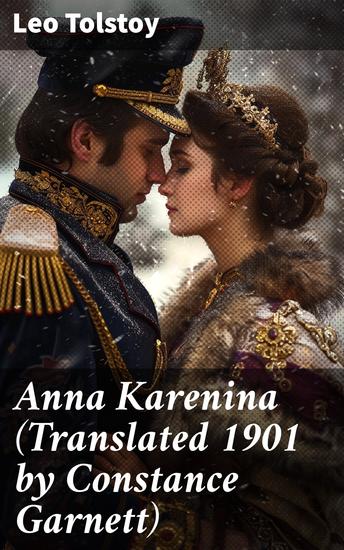
Anna Karenina (Translated 1901 by Constance Garnett) - Enriched edition Love Society and Morality in 19th Century Russia: A Timeless Classic of Tragic Romance and Family Relationships - cover

Anna Karenina (Translated 1901 by Constance Garnett) - Enriched edition Love Society and Morality in 19th Century Russia: A Timeless Classic of Tragic Romance and Family Relationships

Leo Tolstoy

Editorial: Good Press

  • 0
  • 0
  • 0

Sinopsis

Leo Tolstoy's "Anna Karenina," in Constance Garnett's masterful 1901 translation, transcends the boundaries of its 19th-century Russian setting to explore timeless themes of love, fidelity, and societal expectation. The novel's intricate narrative weaves together the lives of several characters, most notably the tragic heroine Anna and her passionate affair with Count Vronsky, against a backdrop of Russian aristocracy. Tolstoy's realism and attention to psychological depth illuminate the complexities of human relationships, while his symbolic use of contrasting rural and urban settings amplifies the moral dilemmas faced by his characters. Tolstoy, a prominent figure in world literature, was deeply influenced by his experiences in the Russian gentry and his philosophical explorations of ethics and morality. His own struggles with faith, love, and societal norms undoubtedly informed the creation of Anna's poignant journey, revealing the profound anguish at the intersection of desire and duty. These personal reflections, combined with his acute observations of Russian life, position Tolstoy as a critical voice of his era, deeply invested in the moral fabric of society. "Anna Karenina" is an essential read for anyone seeking a profound exploration of human emotion and societal constraints. Tolstoy's rich character development and deep philosophical inquiries welcome readers into a world where love and despair collide, making this novel not only a literary masterpiece but also a significant commentary on the human condition.

In this enriched edition, we have carefully created added value for your reading experience:
- A succinct Introduction situates the work's timeless appeal and themes.
- The Synopsis outlines the central plot, highlighting key developments without spoiling critical twists.
- A detailed Historical Context immerses you in the era's events and influences that shaped the writing.
- An Author Biography reveals milestones in the author's life, illuminating the personal insights behind the text.
- A thorough Analysis dissects symbols, motifs, and character arcs to unearth underlying meanings.
- Reflection questions prompt you to engage personally with the work's messages, connecting them to modern life.
- Hand‐picked Memorable Quotes shine a spotlight on moments of literary brilliance.
- Interactive footnotes clarify unusual references, historical allusions, and archaic phrases for an effortless, more informed read.
Disponible desde: 20/12/2023.
Longitud de impresión: 950 páginas.

Otros libros que te pueden interesar

  • Evening Guest An - From their pens to your ears genius in every story - cover

    Evening Guest An - From their...

    Alexander Kuprin

    • 0
    • 0
    • 0
    Alexander Kuprin was born in Narovchat, Penza in Russia on 7th September 1870. 
    At 3 his Father died and he and mother moved to Moscow. By 10 he was enrolled at the Second Moscow Military High School and there his interest in literature began. The Alexander Military Academy followed and two years later he was a sub-lieutenant and posted to an Infantry Regiment for a further four years. 
    Despite his duties he was a now a keen writer and published his first short story at this time. His military duties also garnered him experiences for his breakthrough work ‘The Duel’.  Leaving the military he left for Kiev to work for local newspapers.  He continued to publish both stories and novels and by 1901 he was in St Petersburg becoming part of a group that included Chekhov, Ivan Bunin, Maxim Gorky and Leonid Andreyev.  
    In the years that followed further controversial works and acclaim followed.  His comments on the regime meant he was also put under secret police surveillance.   
    As World War I erupted, Kuprin opened a military hospital but was then given command of an infantry company in Finland. He was soon discharged on grounds of ill health.  
    The October Revolution saw him praise Lenin, but he warned that the Bolsheviks threatened Russian culture and might cause further widespread suffering to the peasants.  As Civil War raged he took his family to Helsinki and then on to Paris. 
    Exile saw his talents decline further and his succumbing to alcoholism. He became lonely and withdrawn. The family's poverty increased his malaise.   
    In May 1937, the Kuprin’s returned to Moscow.  He now saw his work published but wrote almost nothing new.  In 1938 his health rapidly deteriorated.  Already suffering from a kidney problems and sclerosis, he had now developed cancer of the oesophagus.  
    Alexander Kuprin died on 25th August 1938.
    Ver libro
  • The Brickfield - cover

    The Brickfield

    L.P. Hartley

    • 0
    • 0
    • 0
    Richard Mardick is an elderly man with a secret that he has kept since his youth. He recounts his memories to his young protégé and secretary so that his story can be preserved. Faced with illness, the teenage Richard was sent to live with different relatives while being trained as a farmer. Lonely and stifled by family life, he then met a girl and his life changed… with shattering significance for his future. Haunting and subtle, L.P. Hartley’s The Brickfield is a beautifully crafted companion to The Go-Between, exploring childhood and adolescence through the eyes of an adult.
    Ver libro
  • The Picture Of Dorian Gray - cover

    The Picture Of Dorian Gray

    Oscar Wilde

    • 0
    • 0
    • 0
    Written in his distinctively dazzling manner, Oscar Wilde's story of a fashionable young man who sells his soul for eternal youth and beauty is the author's most popular work. The tale of Dorian Gray's moral disintegration caused a scandal when it first appeared in 1890, but though Wilde was attacked for the novel's corrupting influence, he responded that there is, in fact, "a terrible moral in Dorian Gray." Just a few years later, the book and the aesthetic/moral dilemma it presented became issues in the trials occasioned by Wilde's homosexual liaisons, which resulted in his imprisonment. Of Dorian Gray's relationship to autobiography, Wilde noted in a letter, "Basil Hallward is what I think I am: Lord Henry what the world thinks me: Dorian what I would like to be—in other ages, perhaps."
    Ver libro
  • Agnes Grey - cover

    Agnes Grey

    Anne Brontë

    • 0
    • 0
    • 0
    When young Agnes Grey’s family falls on hard financial times, she decides to take a job as a governess with the wealthy Bloomfield family, and then later the even-wealthier Murray family. But they are cruel and unkind, and with them Agnes is lonely isolated, and very aware of how vulnerable she is.


    What Agnes wants is happiness and fulfillment, but are they out of reach for her?


    Agnes Grey is Anne Brontë’s first novel and based on the author’s own experiences of the challenges faced by young women born without many opportunities.
     
     
    Ver libro
  • A Respectable Woman - From their pens to your ears genius in every story - cover

    A Respectable Woman - From their...

    Kate Chopin

    • 0
    • 0
    • 0
    Katherine O'Flaherty was born on the 8th February 1850 in St Louis, Missouri to parents of French and Irish descent. 
    At age 5, she was sent to the Sacred Heart Academy and, apart from a 2 year period at home when her father died, remained there until graduating in 1868.  Whilst there she began writing and became an avid reader of almost anything that crossed her path.   
    Kate married Oscar Chopin in 1870 and the couple moved to New Orleans, and later to the rural setting of Cloutierville, Louisiana to raise their 6 children.  
    In 1882 her husband died leaving her in a deep trench of debt.  Despite her best efforts to turn the businesses around they were sold, and she moved the family back to St Louis and the financial help of her mother.  Sadly, her mother died within the year.  Kate, now struggling with depression, pushed herself to write and gained a local reputation as a writer of short stories that captured the local color and vibrancy of her surroundings. 
    By the early 1890’s her short stories were published nationally.  With this widespread audience also came negative reviews, controversy, and cries of immorality as themes such as interracial relationships, the rights of women and other burning issues of the day were written about. 
    Despite the criticism, which unnerved her, she continued to write though in the main her works, around 100 short stories and two novels, were not attributed with any literary worth. 
    Kate Chopin died from a brain haemorrhage in St Louis Missouri on the 22nd of August 1904.  She was 54. 
    For much of the 20th Century her work was forgotten and out of print.  It was only in early 1970’s, with the rise of feminism and the call for a more just society that she was given the status her works had long described and shone a literary light at.  She is now safely revered as one of America’s great authors.
    Ver libro
  • Love's Labour's Lost - cover

    Love's Labour's Lost

    William Shakespeare

    • 0
    • 0
    • 0
    King Ferdinand and his three friends, Biron, Longaville, and Dumain, plan to study philosophy for the next three years. During their academic pursuits, they must vow to sleep only three hours a night and not let any woman within a mile of court. These strict rules will prevent any distractions from their work - but their promises are soon put to the test when a princess and her three companions arrive for a state visit.
    Ver libro