Unisciti a noi in un viaggio nel mondo dei libri!
Aggiungi questo libro allo scaffale
Grey
Scrivi un nuovo commento Default profile 50px
Grey
Iscriviti per leggere l'intero libro o leggi le prime pagine gratuitamente!
All characters reduced
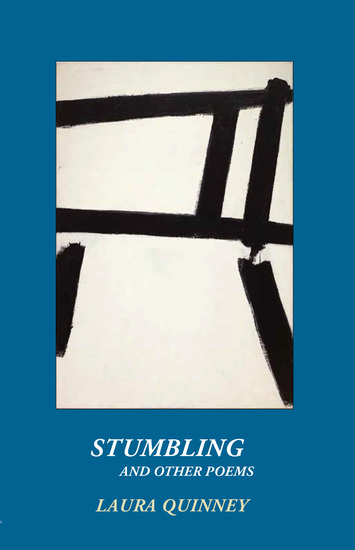
Stumbling and other poems - cover

Stumbling and other poems

Laura Quinney

Casa editrice: Borderland Books

  • 0
  • 0
  • 0

Sinossi

Most poets recollect or describe the present. In her third book of poems, Laura Quinney (whose “superbly spare meditations” Harold Bloom compared to the poetry of Paul Celan and Emily Dickinson) does something more uncanny: recalling what it once was like to anticipate the future, she remembers what she thought the past would look like from the present moment, and in so doing deepens the meaning of memory. This is her third book of poetry.
Disponibile da: 06/01/2024.

Altri libri che potrebbero interessarti

  • Bangerz - cover

    Bangerz

    Michaela Kathleen

    • 0
    • 0
    • 0
    A short poetry collection inspired by the Miley Cyrus album Bangerz.
    Mostra libro
  • Visit - Short science fiction story - cover

    Visit - Short science fiction story

    Dr. Amr Mounir

    • 0
    • 0
    • 0
    In the distant future, students from Atlantic City and their teacher embark on a journey to explore the Capitol Building, the last remnant of a vanished American civilization. Amid the ruins, questions arise that reshape the past.
    Mostra libro
  • Complete Novels and Novellas of Leo Tolstoy - cover

    Complete Novels and Novellas of...

    Leo Tolstoy

    • 0
    • 0
    • 0
    What if literature could reveal the truth of human life?
    
    The Complete Novels and Novellas of Leo Tolstoy brings together the major long-form works of one of the greatest writers in world literature. With unmatched psychological insight and moral seriousness, Tolstoy explored love and suffering, faith and doubt, violence and compassion—capturing the full complexity of the human condition.
    
    This comprehensive collection includes Tolstoy's monumental novels alongside his powerful novellas, where intimate personal struggles unfold against sweeping social and historical backdrops. From the chaos of war to the quiet crises of the soul, Tolstoy's stories confront the deepest questions of how to live, love, and act justly.
    
    Profound, humane, and timeless, Tolstoy's writing continues to challenge and transform readers across generations.
    
    Inside this eBook, you'll explore:
    
    All major novels and novellas by Leo Tolstoy in one collection
    
    Iconic works such as War and Peace, Anna Karenina, and The Death of Ivan Ilyich
    
    Deep psychological realism and moral philosophy
    
    A cornerstone of Russian and world literature
    
    Studied worldwide and revered for over a century, Tolstoy's works remain essential reading for anyone seeking truth, depth, and enduring literary power.
    
    Read deeply. Reflect honestly. Buy now and experience the complete novels and novellas of Leo Tolstoy.
    Mostra libro
  • The Story of a Man Who Collapsed Into His Notebook - cover

    The Story of a Man Who Collapsed...

    Ivana Sajko

    • 0
    • 2
    • 0
    . . . I’ve forgotten how to travel, how to surrender to the favor and misfortune of the rails, how one says goodbye, how long one actually stands facing backward watching Point A swiftlydisappearing, and after that how long does he continue standing standing standing . . . I open my notebook, but I have no answer, I write: “traveling from Point A to Point B, from a littleseaside town to Berlin, I gaze out the window at the unfinished houses on the outskirts, warehouses in the industrial zone, stunted trees along the river with plastic bags hanging fromtheir branches like bats . . .”
     
    Sajko teases out the mental state and personal history of the protagonist, posing departure as a major theme that serves as a touchstone not only for our region [of Southeastern Europe] but also for the times we are living in. —Antonela Marušić, Novosti
     
    This is a stylistically superb novel, very readable. . . . And although this is a deeply personal text, it functions much more broadly, giving expression to the experiences, doubts, fears and all things encountered not only by this one, but a whole series of generations. —Matija Prica, booksa.hr
     
    The Story of a Man Who Collapsed Into His Notebook is about departures, childhood, the end of a relationship and the vanishing possibility in today’s world of fleeing to a better place. Written in the first person, each chapter a single sentence, the novel is an internal soliloquy of self-examination, an excavation of a life punctuated by upheaval and loss, hope and disillusionment, ambition and failure. The reader joins the narrator on his journey, both on the train and in his mind—from disjointed memories triggered by his departure from home, through attempts to put his relationships and experiences in some kind of order to find meaning in them and perhaps assign blame, to confronting his most painful memories—finally arriving with him at his destination with a sense of clarity and the possibility of a new beginning.
    Mostra libro
  • Ovarium - Poems - cover

    Ovarium - Poems

    Joanna Ingham

    • 0
    • 0
    • 0
    Tender, loving and visceral, Ovarium is a pamphlet of poems about a giant ovarian cyst. The poet charts her journey with the cyst, from diagnosis to surgery to recovery, via a landscape of scanner rooms and hospital wards.
    
    The poems explore the impact of illness, and the body as a site of disgust and shame but also healing and endurance. Ingham's poems are forensic as she looks at the disorientating and sometimes patriarchal language of anatomy and medicine, and the way illness can change the relationship we have with our own bodies.
    I tried to think of you as fruit, growing
    against the sun-warm wall of my gut.
    Melon-headed, you nudged the leafy organs,
    dug out a place for yourself in the plot.
    I never guessed. I was only bloody earth
    to you, a coldframe full of light.
    
    - from 'Cyst'
    Mostra libro
  • The Slave Trade A Poem - Hugely influential activist and social reform poem - cover

    The Slave Trade A Poem - Hugely...

    Hannah More

    • 0
    • 0
    • 0
    Hannah More was born on February 2nd, 1745 at Fishponds in the parish of Stapleton, near Bristol. She was the fourth of five daughters. 
    The City of Bristol, at that time, was a centre for slave-trading and Hannah would, over time, become one of its staunchest critics.  
    She was keen to learn, possessed a sharp intellect and was assiduous in studying.  Hannah first wrote in 1762 with The Search after Happiness (by the mid-1780s some 10,000 copies had been sold). 
    In 1767 Hannah became engaged to William Turner.  After six years, with no wedding in sight, the engagement was broken off.  Turner then bestowed upon her an annual annuity of £200.  This was enough to meet her needs and set her free to pursue a literary career.   
    Her first play, The Inflexible Captive, was staged at Bath in 1775. The famous David Garrick himself produced her next play, Percy, in 1777 as well as writing both the Prologue and Epilogue for it.  It was a great success when performed at Covent Garden in December of that year.  
    Hannah turned to religious writing with Sacred Dramas in 1782; it rapidly ran through nineteen editions. These and the poems Bas-Bleu and Florio (1786) mark her gradual transition to a more serious and considered view of life. 
    Hannah contributed much to the newly-founded Abolition Society including, in February 1788, her publication of Slavery, a Poem recognised as one of the most important of the abolition period.   
    Her work now became more evangelical.  In the 1790s she wrote several Cheap Repository Tracts which covered moral, religious and political topics and were both for sale or distributed to literate poor people.  The most famous is, perhaps, The Shepherd of Salisbury Plain, describing a family of incredible frugality and contentment. Two million copies of these were circulated, in one year. 
    In 1789, she purchased a small house at Cowslip Green in Somerset. She was instrumental in setting up twelve schools in the area by 1800. 
    She continued to oppose slavery throughout her life, but at the time of the Abolition Bill of 1807, her health did not permit her to take as active a role in the movement as she had done in the late 1780s, although she maintained a correspondence with Wilberforce and others.  
    In July 1833, the Bill to abolish slavery throughout the British Empire passed in the House of Commons, followed by the House of Lords on August 1st. 
    Hannah More died on September 7th, 1833.
    Mostra libro