¡Acompáñanos a viajar por el mundo de los libros!
Añadir este libro a la estantería
Grey
Escribe un nuevo comentario Default profile 50px
Grey
Suscríbete para leer el libro completo o lee las primeras páginas gratis.
All characters reduced
We Permeate into the Tao Te Ching - cover

We Permeate into the Tao Te Ching

Lao Tzu

Traductor 박 Nomadsirius

Editorial: 와이에이치파트너스

  • 0
  • 0
  • 0

Sinopsis

Prologue.Lao Tzu from the Jin Dynasty, ruled by the descendants of Shun, who first created the rite, was born in Gokin-ri of the Cho dynasty. In 534 B.C., the Jin Dynasty fell to the Cho Dynasty. Laozi was said to be a contemporary of Confucius during the 6th or 5th century BCE. In 501 B.C., a 51-year-old Confucius in the Noh Dynasty, set out on a journey to find Lao-tzu, an old man with full hair, to learn the etiquette of the Jin Dynasty. According to the records of ‘the Zhuangzi’, they met in middle-upper stream of Huisu, not far from the Sang of the old Jin dynasty. Confucius first encountered Lao-tzu\'s natural and self-free philosophy. He turned away after confirming that it is distinctly different from his politics of humanity, which he tried to heal the world with courtesy and benevolence. Lao Tzu turned his back on the world in despair in the age of the brute. He felt the ephemerality of the human world. At Hamgokgwan, he left 5,000 characters of \'The Tao Te Ching\' to Yoon-hee to leave. It is the cradle of all philosophy and thought.
Disponible desde: 12/08/2022.
Longitud de impresión: 317 páginas.
Otros libros que te pueden interesar

  • Plagues and Their Aftermath - How Societies Recover from Pandemics - cover

    Plagues and Their Aftermath -...

    Brian Michael Jenkins

    • 0
    • 0
    • 0
    From a plague in Athens during the Peloponnesian War in 430 BCE, to another in 540 that wiped out half the population of the Roman empire, down through the Black Death in the Middle Ages and on through the 1918 flu epidemic (which killed between 50 and 100 million people) and this century's deadly SARS outbreak, plagues have been a much more relentless fact of life than many realize. 


    The legacy of epidemics, Brian Michael Jenkins observes, is not only one of lives lost but of devastated economies and social disorder, all of which have severe political repercussions. 


    Thus, each chapter of Plagues and Their Aftermath draws on those historical precursors to focus on one particular aspect of their aftermath: What happens to political systems? What happens in the area of crime and terrorism? Do wars happen? What are the effects on cultures? What was the impact of widespread fear and public hysteria, of increased suspicion and scapegoating, of the spread of rumors and conspiracy theories? 


    Jenkins's sobering analysis is riveting and thought-provoking listening for general listeners and specialists alike, and throws welcome light into what many fear is a dark future.
    Ver libro
  • The Connected Community - Discovering the Health Wealth and Power of Neighborhoods - cover

    The Connected Community -...

    Cormac Russell, John McKnight,...

    • 0
    • 0
    • 0
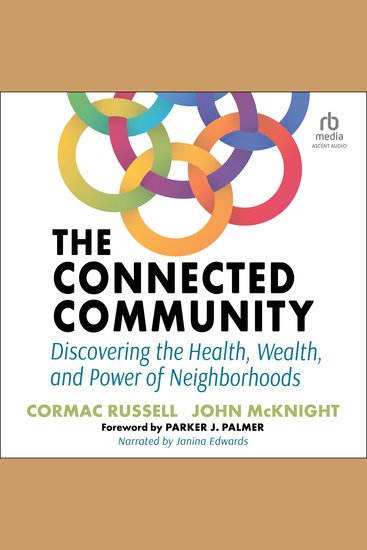
    Find out how to uncover the hidden talents, assets, and abilities in your neighborhood and bring them together to create a vibrant and joyful community. It takes a village! 
     
    We may be living longer, but people are more socially isolated than ever before. As a result, we are hindered both mentally and physically, and many of us are looking for something concrete we can do to address problems like poverty, racism, and climate change. What if solutions could be found on your very doorstep or just two door knocks away? 
     
    Cormac Russell is a veteran practitioner of asset-based community development (ABCD), which focuses on uncovering and leveraging the hidden resources, skills, and experience in our neighborhoods. He and John McKnight, the cooriginator of ABCD, show how anyone can discover this untapped potential and connect with his or her neighbors to create healthier, safer, greener, more prosperous, and welcoming communities. They offer a wealth of illustrative examples from around the world that will inspire you to explore your own community and discover its hidden treasures. 
     
    You will learn to take action on what you already deeply know-that neighborliness is not just a nice-to-have personal characteristic but essential to living a fruitful life and a powerful amplifier of community change and renewal.
    Ver libro
  • Kalidasa’s Meghadhuta - With a brief annotation in English - cover

    Kalidasa’s Meghadhuta - With a...

    M. Venkataraman

    • 0
    • 0
    • 0
    The Meghadhuta also known as Meghasandesam is one of the beautiful works of Kalidasa. It is a poem in Sanskrit Language consisting of 117 verses. It is actually one of a few minor compositions of Kalidasa. Being one of the greatest poets of Sanskrit Literature, he has produced epics like the Raghuvamsa Mahakavya and Kumarasambhavam and dramas like Abigyana Sakuntalam. 
    The ideas contained in this poem is simple but romantic. Alaka is a mountain in the Himalayas. The god of wealth, Kubera is the king of this place. He has a group of divine attendants working for him. These attendants are known as Yakshas. One of these Yakshas was very much smitten and obsessed with his wife. Hence, he ignored his duties. Kubera, therefore, cursed him and banished him into the woods on planet Earth. The Yaksha came to a mountainous place called Ramagiri named after Lord Rama near the present state of Chattisgarh in India and was residing in an ashram there. 
    The Yaksha spent several months on the mountain. Thoroughly dejected, the love-lorn Yaksha keeps thinking about his wife. His wife also keeps thinking about him all day and all night. It is the time of monsoon. The Yaksha sees a rain cloud passing by. He requests the cloud to carry a message to his wife. The Yaksha then starts to describe the route that the cloud should take to meet his lover. This forms the crux of the verses of this poem. 
    The works of Kalidasa are synonymous with the beauty of nature, lyrical poetry, dramatic stories, great heroes and sensuous heroines. The Meghadhuta focusses mainly on sensual love and the beauty of nature. Kalidasa’s genius lies in making these two subjects flow into each other in this work. For example, Kalidasa picturises the rivers as sensuous women, and he advises his friend namely the cloud to take interest in the rivers along the way on his journey from the plains to Alaka.
    Ver libro
  • Soap Magic Part 3 - cover

    Soap Magic Part 3

    Kathrin Pissinger

    • 0
    • 0
    • 0
    Magic. Mayhem. Soap. 
    Who better to ask about soap magic than a psychic, right? Well, I'm not convinced either, but if the soap works on the magically inclined as well as on other people, then that's not an opportunity for me to waste. And this is how I ended up in a pile of pillows, with the psychic under me, over me, and pretty much all around me. And one day, an archaeologist might discover under all those pillows a position we haven't tried yet, but until then, this was more than I had actually hoped for. 
    So, well, the third part of Soap Magic gets us through all the things lesbians can do to and with each other, including, but not limited to, pillow sex. Also conains soap.
    Ver libro
  • The Race to the Future - 8000 Miles to Paris – The Adventure that Accelerated the Twentieth Century - cover

    The Race to the Future - 8000...

    Kassia St. Clair

    • 0
    • 0
    • 0
    The racers battle over steep inclines, through narrow mountain passages, and across the arid Gobi Desert. Competitors endure torrential rain and choking dust. There are barely any roads, and petrol is almost impossible to find. 


    More than its many adventures, the Peking-to-Paris Motor Challenge took place on the precipice of a new world. As the twentieth century dawned, imperial regimes in China and Russia were crumbling, paving the way for the rise of communist ones. The electric telegraph was rapidly transforming modern communication, and with it, the news media, commerce, and politics. Suspended between the old and the new, the Peking-to-Paris, as bestselling historian Kassia St. Clair writes, became a critical tipping point. 


    A gripping, immersive narrative of the race, The Race to the Future sets the drivers' derring-do (and occasional cheating) against the backdrop of a larger geopolitical and technological race to the future. Interweaving events from the fall of the Qing dynasty to the departure of the horse economy and the rise of gendered marketing, St. Clair shows how the Peking-to-Paris provided an impetus for profound social, cultural, and industrial change, while masterfully capturing the mounting tensions between nations and empires—all building up to the cataclysmic event that changed everything: the First World War.
    Ver libro
  • The Law - cover

    The Law

    Frédéric Bastiat

    • 0
    • 0
    • 0
    "The Law" by Frédéric Bastiat is a seminal work in political philosophy and economics, offering a robust defense of individual liberty and property rights against the encroachments of government. Written in 1850, Bastiat's concise yet profound treatise critiques the use of law as an instrument of coercion and redistribution, arguing instead that its proper role is the protection of individual freedoms. Through eloquent and accessible prose, Bastiat expounds on the dangers of socialism and economic interventionism, advocating for a system where the law serves only to uphold justice, ensure public order, and protect rights. His work remains a cornerstone of libertarian thought, celebrated for its lucid analysis of the principles underpinning a free society and its prescient warnings against the overreach of governmental power.
    Ver libro