Join us on a literary world trip!
Add this book to bookshelf
Grey
Write a new comment Default profile 50px
Grey
Subscribe to read the full book or read the first pages for free!
All characters reduced
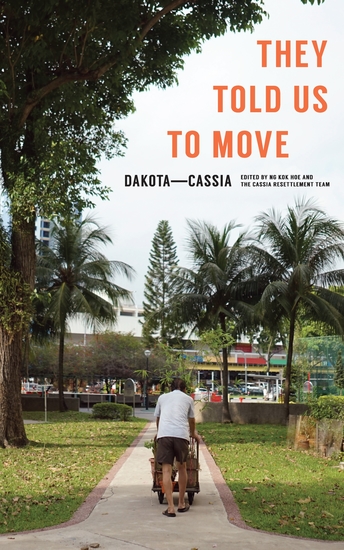
They Told Us To Move: Dakota—Cassia - cover

They Told Us To Move: Dakota—Cassia

Kok Hoe Ng

Publisher: Ethos Books

  • 0
  • 0
  • 0

Summary

What happens when an entire community is moved?  
 
Dakota Crescent was one of Singapore's oldest public housing estates and a rental flat neighbourhood for low-income households. In 2016, its residents—many of whom are elderly—were relocated to Cassia Crescent to make way for redevelopment. To help them resettle, a group of volunteers came together and formed the Cassia Resettlement Team. 
 
They Told Us to Move tells the story of the relocation through interviews with the residents from the Dakota community and reflections by the volunteers. Accompanying these are essays by various academics on urban planning; gender and family; ageing, poverty, and social services; civil society and citizenship; and architectural heritage and place-making. Through this three-part conversation, the book explores human stories of devotion, expectation, and remembrance. It asks what we can achieve through voluntary action and how we can balance self-reliance and public services. 
 
This book is for people who want to understand the kind of society we are, and question what kind of society we want to be.
Available since: 08/21/2024.
Print length: 268 pages.

Other books that might interest you

  • Stumbling Blocks - A Second Generation Holocaust Memoir - cover

    Stumbling Blocks - A Second...

    Jennifer Krebs

    • 0
    • 0
    • 0
    Stumbling Blocks is a powerful intergenerational memoir by Jennifer Krebs that explores her family’s journey from Nazi Germany to rural America. Blending personal history, Jewish identity, and emotional reflection, the book traces her father’s memories of growing up under the Third Reich and her own coming-of-age in small-town New York as the daughter of a survivor. The title refers to the Stolpersteine—brass plaques in Europe commemorating victims of National Socialism—that spark a meditation on trauma, memory, and belonging. With warmth, honesty, and a touch of wit, Krebs reflects on family legacy, the echoes of history, and the quiet resilience of survival.
    Show book
  • Thriving in Babylon - Why Hope Humility and Wisdom Matter in a Godless Culture - cover

    Thriving in Babylon - Why Hope...

    Larry Osborne

    • 0
    • 0
    • 0
    Meet a man forced to live in a fast changing and godless society. He faced fears about the future, concern for his safety, and the discouragement of world that seemed to be falling apart at warp speed. Sound familiar? His name was Daniel, and with the power of hope, humility, and wisdom, he not only thrived, he changed an empire while he was at it. Though he lived thousands of years ago, he has a much to teach us today. 
    Even in Babylon, God Is in Control 
    In Thriving in Babylon, Larry Osborne explores the “adult” story of Daniel to help us not only survive – but actually thrive in an increasingly godless culture. Here Pastor Osborne looks at:Why panic and despair are never from GodWhat true optimism looks like How humility disarms even our greatest of enemies Why respect causes even those who will have nothing to do with God to listen How wisdom can snatch victory out of the jaws of defeat 
    For those who know Jesus and understand the full implications of the cross, the resurrection, and the promises of Jesus, everything changes – not only in us, but also in our world.
    Show book
  • Autobiography of Mother Jones - cover

    Autobiography of Mother Jones

    Mary Harris Jones

    • 0
    • 0
    • 0
    Mary Harris "Mother" Jones (1830-1930) was a fierce and tireless advocate of the labor movement. A trade union organizer, a feminist, and a working class hero, Mother Jones spent years fighting for the labor rights of miners, industrial workers, and children.
    Show book
  • Room Swept Home - cover

    Room Swept Home

    Remica Bingham-Risher

    • 0
    • 0
    • 0
    In a strange twist of kismet, Remica Bingham-Risher's paternal great-great-great grandmother, Minnie Lee Fowlkes, is interviewed for the Works Progress Administration Slave Narratives in Petersburg, Virginia in 1937, and her maternal grandmother, Mary Knight, is sent to Petersburg in 1941, diagnosed with "water on the brain"—postpartum depression being an ongoing mystery—nine days after birthing her first child. Braiding meticulous archival research with Womanist scholarship and her hallmark lyrical precision, Bingham-Risher's latest collection of poems treads the murky waters of race, lineage, faith, mental health, women's rights, and the violent reckoning that inhabits the discrepancy between lived versus textbook history, asking: What do we inherit when trauma is at the core of our fractured living? Utilizing primary and secondary sources, Bingham-Risher weaves together a richly textured vision of her foremothers' everyday and exceptional living: two very different women at opposite ends of their lives, converging upon the same space and time. The lives these women inhabit and generations they fostered add infinite layers to the fabric of the American tapestry. Room Swept Home serves as a gloriously rendered portrait of all that is held in the line between the private and public, the investigative and generative, the self and those who came before us.
    Show book
  • Running Through the Dark - The rise and fall of an ultrarunner - cover

    Running Through the Dark - The...

    Jen Scotney

    • 0
    • 0
    • 0
    Ultrarunner Jen Scotney has achieved podium finishes in some of the UK's toughest races and now has her sights firmly set on the Pennine Way. In Running Through the Dark, Jen talks about her ambitions, not just to run the 268-mile Pennine Way but to take the record as the fastest woman to do so. But that didn't happen. Nothing went according to plan. The Jen the world knew was a successful lawyer and running coach – all photoshoots and finish-line smiles – but the truth was much darker. The real Jen Scotney, the one she hid from everybody, suffered with chronic fatigue, debilitating injuries, tragedy, grief and at times had a will so beaten down by setbacks that there just didn't seem any point in going on.
    But she did go on. Running Through the Dark is Jen's account of her ultra-journey. Playing out on the moors of the Pennines, the fells of the Lake District and the mountains of Wales and Scotland, this is much more than a running book, it is a story about resilience, about never giving up, and about battling through the night and always believing that there will be a new dawn.
    Show book
  • Five American Women Rebels: The Lives and Legacies of Some of the Women Who Decisively Changed American Society - cover

    Five American Women Rebels: The...

    Editors Charles River

    • 0
    • 0
    • 0
    For much of American history, women were second-class citizens in the sense they could not vote or run for office and had few property rights. However, women were often able to overcome social restrictions and forcefully affect the world around them, sometimes nationally. This took a real force of character, determination, and sometimes bravery. 
    	Women were discouraged from becoming involved in politics, and the majority of American men thought women belonged in the home. As the 1800s progressed, American women became more and more significant in changing their country for the better. This meant that women gravitated toward causes society thought were appropriate for women, which were those merging family issues and Christianity, both of which allowed women to organize and form local and national organizations. Women active in these causes were not subject to censure. 
    	The most important cause allowing women to overcome Victorian expectations of being ladylike was temperance, which eventually resulted in the Prohibition era. Prohibition had several elements, but it was focused on pushing for making the manufacture, sale, and possession of alcohol illegal and convincing individuals to swear off alcohol.
    Show book