Junte-se a nós em uma viagem ao mundo dos livros!
Adicionar este livro à prateleira
Grey
Deixe um novo comentário Default profile 50px
Grey
Assine para ler o livro completo ou leia as primeiras páginas de graça!
All characters reduced
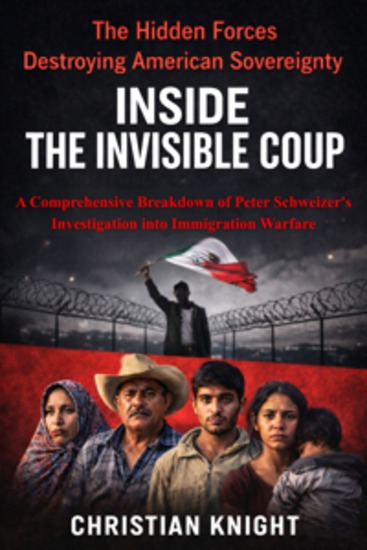
Inside The Invisible Coup: The Hidden Forces Destroying American Sovereignty - A Comprehensive Breakdown of Peter Schweizer's Investigation into Immigration Warfare - cover
LER

Inside The Invisible Coup: The Hidden Forces Destroying American Sovereignty - A Comprehensive Breakdown of Peter Schweizer's Investigation into Immigration Warfare

Knight Christian

Editora: BookRix

  • 0
  • 0
  • 0

Sinopse

In a world where political power operates behind closed doors, Inside The Invisible Coup takes a deep dive into one of the most crucial issues of our time: the quiet erosion of American sovereignty through immigration warfare. Drawing on the investigative insights of Peter Schweizer, this book reveals how powerful forces—elite institutions, global actors, and political insiders—have systematically reshaped the nation’s immigration policies to serve their interests, all while undermining democratic consent.Rather than focusing on the sensationalism of border chaos, this book exposes the hidden systems that have turned migration into a political weapon. Christian Knight uncovers the mechanisms by which migration has become an instrument of influence, shaping the nation’s economy, security, and electoral landscape in ways that are neither transparent nor accountable. Through meticulous research, Knight shows how the manipulation of data, media narratives, and policy decisions has altered the course of American democracy, often without the consent of the people.This is not a book that demonizes immigrants. Instead, it focuses on the broader systems at play—how policies have been crafted to bypass the will of the American people, shifting costs and consequences to local communities and leaving citizens without a real say in the matter. Inside The Invisible Coup exposes how the moral narrative of compassion has been weaponized, used to silence debate and stifle any calls for reform.With clarity and urgency, Christian Knight presents a comprehensive analysis of how American sovereignty has been undermined and what must be done to restore it. This book is for readers who are aware of the shift happening within their nation, who feel the growing disconnect between promises made and outcomes delivered, and who want to reclaim control over the policies that affect their lives.Inside The Invisible Coup challenges readers to confront uncomfortable truths about the political system and demand real change, not just for the future of immigration, but for the very future of American democracy.Readers will discover:🛑 The hidden forces turning immigration into a political tool, rather than a humanitarian challenge💼 How the control of immigration laws has shifted from the people to the elites💥 The real impact of mass migration on national security, economy, and elections🗣️ Why the public’s consent has been systematically sidelined in the immigration debate🔨 What meaningful reform could look like, and how it can restore true democratic powerInside The Invisible Coup is your chance to uncover the truth and demand a change that will reshape the future of American sovereignty. Don’t let your nation’s future be decided behind closed doors—take action now and be part of the movement to reclaim democracy.
Disponível desde: 29/01/2026.
Comprimento de impressão: 126 páginas.

Outros livros que poderiam interessá-lo

  • On Liberty - cover

    On Liberty

    John Stuart Mill

    • 0
    • 0
    • 0
    On Liberty by John Stuart Mill is a powerful and enduring philosophical essay that explores the nature and boundaries of individual freedom in society. Written in 1859 during a period of political and intellectual upheaval, Mill makes an impassioned case for the sanctity of personal liberty—arguing that individuals should be free to act, think, and express themselves as they choose, so long as they do not harm others. 
    Mill’s central thesis, often referred to as the "harm principle," remains one of the cornerstones of liberal political thought: that the only justification for societal or governmental interference in a person’s life is to prevent harm to others. With remarkable clarity, he examines the relationship between authority and autonomy, tackling issues like free speech, individuality, moral policing, and the role of dissent in democratic society. 
    Narrated with depth and thoughtfulness by Luke Oldham, this audiobook brings to life one of the most influential works in political philosophy—a timeless defense of freedom and a clarion call for the courage to think for oneself.
    Ver livro
  • The Invisible Hand - Economic Intelligence And Industrial Espionage - cover

    The Invisible Hand - Economic...

    Davis Truman

    • 0
    • 0
    • 0
    "The Invisible Hand" delves deep into the clandestine world of economic intelligence and industrial espionage, where the forces shaping global economies are often unseen and unknown. 
    In this riveting exploration, author Davis Truman unveils the intricate web of intrigue that underpins modern capitalism. From covert operations to sophisticated cyber espionage, this book reveals how nations and corporations deploy their resources relentlessly for competitive advantage. 
    Drawing from real-life examples and historical case studies, "The Invisible Hand" exposes governments' and businesses' shadowy tactics to gain insight into their rivals' strategies, steal trade secrets, and manipulate markets. 
    Ver livro
  • How to Be a Patriotic Christian - Love of Country as Love of Neighbor - cover

    How to Be a Patriotic Christian...

    Richard J. Mouw

    • 0
    • 0
    • 0
    What does it mean to love our country?
    Some Christians see loyalty to America as central to our faith and identity. Other Christians are skeptical that our nation warrants such devotion or attachment. But Richard Mouw encourages Christians to have a healthy sense of national peoplehood that promotes civic kinship and responsible citizenship. He navigates between Christian nationalism on one hand and cynicism about country on the other to avoid the perils of both idolatry and disengagement.
    Mouw grapples with sticky questions such as how to honor national holidays in church and the place of protests in forging a more perfect union. Placing love of country in the context of Christian love of neighbor, he sees patriotism as an expression of our heavenly citizenship and a call to help our country be a place where all people can thrive in peace.
    Mouw's winsome and wise reflections direct our patriotic affections toward the civic good of others within our churches and in our communities. This guide helps us travel together on a shared national journey toward liberty and justice for all.
    Ver livro
  • Imitation Democracy - The Development of Russia's Post-Soviet Political System - cover

    Imitation Democracy - The...

    Dmitrii Furman

    • 0
    • 0
    • 0
    After the collapse of the Soviet Union, Russia under Yeltsin and Putin implemented a political system of "imitation democracy," marked by "a huge disparity between formal constitutional principles and the reality of authoritarian rule." How did this system take shape, how else might it have developed, and what are the prospects for re-envisioning it more democratically in the future? 


    These questions animate Dmitrii Furman's Imitation Democracy, a welcome antidote to books that blandly decry Putin as an omnipotent dictator, without considering his platforms, constituencies, and sources of power. With extensive public opinion polling drawn from throughout the late- and post-Soviet period, Furman offers a definitive account of the formation of the modern Russian political system, casting it into powerful relief through comparisons with other post-Soviet states. 


    Peopled with grey technocrats, warring oligarchs, patriots, and provocateurs, Furman's narrative details the struggles among partisan factions, and the waves of public sentiment, that shaped modern Russia's political landscape, culminating in Putin's third presidential term, which resolves the contradiction between the "form" and "content" of imitation democracy, "the formal dependence of power on elections and the actual dependence of elections on power."
    Ver livro
  • NATO After Russia's Invasion of Ukraine - Threat Perceptions and Their Consequences - cover

    NATO After Russia's Invasion of...

    Jason W. Davidson

    • 0
    • 0
    • 0
    A revealing look at differing threat perceptions in six key NATO countries 
     
    When Russia began its full-scale invasion of Ukraine in February 2022, analysts and policymakers highlighted the unifying shock that NATO members experienced. However even before the return of US president Donald Trump, beneath this seeming cohesion lay deep-seated differences in how member states perceive and prioritize security threats. 
     
    NATO after Russia's Invasion of Ukraine analyzes the six most influential members of the alliance: the United States, the United Kingdom, France, Germany, Poland, and Italy. Through extensive interviews with current and former policymakers and a detailed examination of public statements and policies, Jason W. Davidson delivers a unique assessment of how divergent threat perceptions influence the NATO allies' major defense decisions, such as defense spending, and whether the alliance addresses each ally's most important threat and its view of NATO's most important challenges. With the rise in tumultuous geopolitical challenges posed by Russia, China, terrorism, mass refugee flows, and nationalism, this book provides the crucial context needed to navigate NATO's evolving role in international security.
    Ver livro
  • Psychological Warfare - Using Psychological Tactics to Undermine or Control - cover

    Psychological Warfare - Using...

    Cito Harder

    • 0
    • 0
    • 0
    Psychological warfare is the deliberate use of tactics designed to influence, manipulate, and control the thoughts, emotions, and behaviors of individuals or groups. It involves the strategic deployment of psychological tactics to achieve specific objectives, often with the goal of weakening the will, confidence, and decision-making abilities of an opponent. Unlike physical warfare, which relies on the use of force and violence, psychological warfare focuses on undermining an adversary’s mental state, creating doubt, confusion, fear, or anxiety. The concept of psychological warfare spans across military, political, social, and personal domains, and its methods are utilized to achieve both large-scale and individual objectives. 
    At its core, psychological warfare operates by exploiting the weaknesses of human perception, beliefs, and emotions. It seeks to manipulate how people think, feel, and act, often in ways that are subtle and hard to detect. Through the strategic use of information, misinformation, fear, and emotional appeals, psychological warfare can alter the course of events and influence outcomes in a way that physical force alone cannot achieve. This manipulation can be direct, as in the use of propaganda, or more covert, as in the use of gaslighting to distort reality and create confusion. 
    Psychological warfare can be seen in many contexts, from international conflict and military operations to corporate competition, political campaigns, and even personal relationships. For example, in warfare, psychological tactics are employed to break the enemy’s morale, instill fear, and create division within their ranks. In the political arena, psychological warfare is often used to manipulate public opinion, spread propaganda, and discredit opponents.
    Ver livro