¡Acompáñanos a viajar por el mundo de los libros!
Añadir este libro a la estantería
Grey
Escribe un nuevo comentario Default profile 50px
Grey
Suscríbete para leer el libro completo o lee las primeras páginas gratis.
All characters reduced
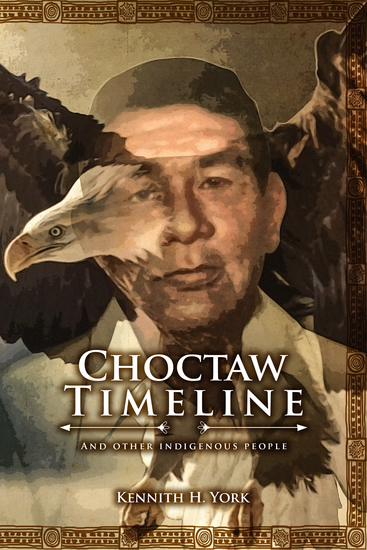
Choctaw Timeline - And Other Indigenous People - cover

Choctaw Timeline - And Other Indigenous People

Kennith H York

Editorial: Proisle Publishing Services

  • 0
  • 0
  • 0

Sinopsis

Kennith York presents a rich prehistory and history of the World, Native America and Choctaw Indians
 
"Choctaw Timeline and Other Indigenous Peoples" is a critically researched book that draws on the available dates and events of various developments of World Indigenous peoples including the peopling of North, Central and South America.
 
The Choctaw Indians are one of the oldest tribes in the Americas, dating from the era of when the whooly mammoth roamed the Southeast. They are the native inhabitants of the area now comprising the states of Alabama, Florida, Georgia, Louisiana, and Mississippi. The book culminates with the Mississippi Band of Choctaw Indians whose members continue to speak their language, maintain their unique culture, and live on their indigenous land in Mississippi.
 
Kennith York had originally thought about writing definitive history of the Choctaw Indians but after doing some research he decided on a timeline inclusive of the world population. Choctaw Timeline presents various peoples and their participation in world civilization. The book presents an in-depth development of human beings, the migrations of people and eventual arrival in the Americas. The history of Native Americans, the State of Mississippi and Choctaw Indians is presented in a progression of dates, people and events.
 
It is a good prehistory/history book that will be great reference for the entire family.
Disponible desde: 13/09/2022.
Longitud de impresión: 134 páginas.


Otros libros que te pueden interesar

  • Disappearance of the Surcouf The: The Mysterious Sinking of the Allies’ Largest Submarine during World War II - cover

    Disappearance of the Surcouf...

    Editors Charles River

    • 0
    • 0
    • 0
    When the Surcouf launched in 1929, it was a technological marvel. This wasn’t a conventional submarine at all, but a 3,300-ton, 300-foot-long submersible light cruiser. Armed not just with torpedoes but also a pair of eight-inch guns, the Surcouf had a range of over 10,000 miles and was equipped with a seaplane in a hanger and a prison capable of holding up to 40 prisoners. When it was launched, the submarine looked like something out of the novels of Jules Verne, and many people believed it would make all existing submarines (and many surface warships) obsolete. However, by the time France found itself at war with Nazi Germany in 1939, the Surcouf was outdated and basically irrelevant, though it was still in active service with the French Navy. 
    When France was defeated by Nazi Germany in June 1940, the majority of French troops and warships ceased fighting. However, some relocated to Britain, the only nation still fighting Germany, to join Free French forces under the command of the charismatic General Charles De Gaulle. The crew of the Surcouf joined the Free French Navy and served from late 1940 to February 1942, when she called in at the British port of Bermuda before sailing for the island of Tahiti, French Polynesia, in the South Pacific. On February 12, the Surcouf left Bermuda en route for Tahiti via the Panama Canal and was never seen again. 
    There have been many theories about what might have happened to the Surcouf and her 130-man crew, ranging from an accidental collision to sabotage and even accidental (or deliberate) attacks by her allies. As a result, the fate of the Surcouf has become one of the most enduring and baffling maritime mysteries, and it still generates a great deal of debate.
    Ver libro
  • The Dictionary of Body Language - A Field Guide to Human Behavior - cover

    The Dictionary of Body Language...

    Anónimo

    • 0
    • 0
    • 0
    From the world’s #1 body language expert* comes the essential audiobook for decoding human behavior 
    “The ultimate body language reference. I’ll be both referring to and recommending this book on a daily basis for many years to come.” —Amy Cuddy 
    Joe Navarro has spent a lifetime observing others. For 25 years, as a Special Agent for the FBI, he conducted and supervised interrogations of spies and other dangerous criminals, honing his mastery of nonverbal communication. After retiring from the bureau, he has become a sought-after public speaker and consultant, and an internationally bestselling author. Now, a decade after his groundbreaking book What Every BODY is Saying, Navarro returns with his most ambitious work yet. The Dictionary of Body Language is a pioneering “field guide” to nonverbal communication, describing and explaining the more than 400 behaviors that will allow you to gauge anyone’s true intentions. 
    Moving from the head down to the feet, Navarro reveals the hidden meanings behind the many conscious and subconscious things we do. Readers will learn how to tell a person’s actual feelings from subtle changes in their pupils; the lip behaviors that betray concerns or hidden information; the many different varieties of arm posturing, and what each one means; how the position of our thumbs when we stand akimbo reflects our mental state; and many other fascinating insights to help you both read others and change their perceptions of you. 
    Listeners will turn to The Dictionary Body Language again and again—a body language bible for anyone looking to understand what their boss really means, interpret whether a potential romantic partner is interested or not, and learn how to put themselves forward in the most favorable light. 
    *GlobalGurus.org
    Ver libro
  • Discovering the True Self - Kodo Sawaki's Art of Zen Meditation - cover

    Discovering the True Self - Kodo...

    Kôdô Sawaki, Arthur Braverman

    • 0
    • 0
    • 0
    "You can't see your true Self. [But] you can become it. Becoming your true Self is zazen." 


    As an orphan in the slums of Tsu City, Japan, Kodo Sawaki had to fight his way to adulthood, and became one of the most respected Zen masters of the twentieth century. He had a great understanding of Dogen Zenji's teaching and he knew how to express Dogen's philosophy. Sawaki's primary mission was to bring all people to an awareness of the Self, which he believed came through Zen meditation. 


    His humor and straightforward talk garnered Sawaki followers from all walks of life. Though he remained poor by choice, he was rich in spirit. Two of his students who became known in America as well as in Japan were Kosho Uchiyama, abbot of Antaiji Temple and author of Opening The Hand of Thought, and Gudo Nishijima, Zen teacher and translator of Dogen's Shobogenzo. 


    A student of Kosho Uchiyama, Arthur Braverman has compiled an anthology of Sawaki's writings and a garland of sayings gathered from throughout his lifetime. One of a few collections of Sawaki's teachings published in English, his life and work bracket the most intriguing and influential period of modern Zen practice in Japan and America.
    Ver libro
  • How to Destroy America in Three Easy Steps - cover

    How to Destroy America in Three...

    Anónimo

    • 0
    • 0
    • 0
    A NEW YORK TIMES BESTSELLER! 
    A growing number of Americans want to tear down what it’s taken us 250 years to build—and they’ll start by canceling our shared history, ideals, and culture. 
    Traditional areas of civic agreement are vanishing. We can’t agree on what makes America special. We can’t even agree that America is special. We’re coming to the point that we can’t even agree what the word America itself means. “Disintegrationists” say we’re stronger together, but their assault on America’s history, philosophy, and culture will only tear us apart. 
    Who are the disintegrationists? From Howard Zinn’s A People’s History of the United States to the New York Times’ 1619 project, many modern analyses view American history through the lens of competing oppressions, a racist and corrupt experiment from the very beginning. They see American philosophy as a lie – beautiful words pasted over a thoroughly rotted system. They see America’s culture of rights as a façade that merely reinforces traditional hierarchies of power, instead of being the only culture that guarantees freedom for individuals. 
    Disintegrationist attacks on the values that built our nation are insidious because they replace each foundational belief, from the rights to free speech and self-defense to the importance of marriage and faith communities, with nothing more than an increased reliance on the government.  
    This twisted disintegrationist vision replaces the traditional “unionist” understanding that all Americans are united in a shared striving toward the perfection of universal ideals. 
    How to Destroy America in Three Easy Steps shows that to be a cohesive nation we have to uphold foundational truths about ourselves, our history, and reality itself—to be unionists instead of disintegrationists. Shapiro offers a vital warning that if we don’t recover these shared truths, our future—our union—as a great country is threatened with destruction.
    Ver libro
  • Younger Dryas Period The: The History of the Earth’s Drastic Climate Change at the End of the Pleistocene Era - cover

    Younger Dryas Period The: The...

    Editors Charles River

    • 0
    • 0
    • 0
    From about 12,900 to 11,700 before present (BP), near Ice Age conditions returned to the Northern Hemisphere of the planet. It was a sudden shift from the warm temperatures that had prevailed for nearly 2,000 years. This period is referred to by archaeologists, geologists, and earth scientists as the Greenland Stadial, but it is more commonly known as the Younger Dryas. The Younger Dryas marked the end of the last glacial period, the end of the Pleistocene Era, and the beginning of the Holocene Era, which is the current era. It was a period of great change, when climate change happened quite quickly, directly affecting the flora, fauna, and humans of the Northern Hemisphere in the process. The impact on the human populations was perhaps most important because, in some places, it virtually destroyed emerging cultures, while in other places, it might have propelled humans to develop new survival traits and technologies later used to move humanity into the Neolithic era. Although scholars now know quite a bit about the Younger Dryas, many elements of it are still debated. Other aspects serve as a predictor of what humans can expect in the future. 
    	There is, however, still plenty of information about the Younger Dryas that remains unknown or open to debate. Not all scholars agree on the dates of the Younger Dryas or how long it lasted. Even more controversial are the alternate theories about what caused the Younger Dryas and the effect it had on the Northern Hemisphere’s bio-populations. This book examines the background of the Younger Dryas, its effects on bio-populations, and how it contributed to the emergence of the Neolithic Era. Alternative theories will be examined and compared to more standard ideas currently prevailing in academia.
    Ver libro
  • Francis Drake: A short biography - 5 Minutes: Short on time - long on info! - cover

    Francis Drake: A short biography...

    5 Minutes, 5 Minute Biographies,...

    • 0
    • 0
    • 0
    Francis Drake, discoverer and His Majesty's privateer: Life and work in a short biography! Everything you need to know, brief and concise. Infotainment, education and entertainment at its best!
    Ver libro