Junte-se a nós em uma viagem ao mundo dos livros!
Adicionar este livro à prateleira
Grey
Deixe um novo comentário Default profile 50px
Grey
Assine para ler o livro completo ou leia as primeiras páginas de graça!
All characters reduced
Spanish Civil War - History of the War in Spain between 1936-1939 Explained - cover
LER

Spanish Civil War - History of the War in Spain between 1936-1939 Explained

Kelly Mass

Editora: Efalon Acies

  • 0
  • 0
  • 0

Sinopse

The Spanish Civil War spanned from 1936 to 1939 and was a domestic conflict in Spain. The Nationalists, comprising Falangists, monarchists, conservatives, and traditionalists, rallied around General Francisco Franco and sought to overthrow the left-leaning Popular Front government of the Second Spanish Republic, forming an alliance with communists and syndicalist anarchists. The war garnered various interpretations globally, seen as a class struggle, a clash between dictatorship and democratic republicanism, and a power struggle between fascism and communism. Claude Bowers, the U.S. ambassador to Spain during World War II, even referred to it as a "dress rehearsal." The Nationalists emerged victorious in early 1939 and dominated Spain until Franco's death in November 1975.

The conflict began with a pronunciamiento against the Republican government, led by General Emilio Mola with General José Sanjurjo as a figurehead. President Manuel Azaña headed the coalition of Republicans, backed by communist and socialist parties in the Cortes. Supporting the Nationalist faction were CEDA, monarchists (including Alfonsists and conservative Carlists), and the fascist political party Falange Española de las JONS. Franco eventually emerged as the dominant leader of the Nationalists after the demise of Sanjurjo, Emilio Mola, and Manuel Goded Llopis.
Disponível desde: 16/01/2024.

Outros livros que poderiam interessá-lo

  • The Secrets of Dark Psychology - An Essential Guide to Narcissism Emotional Manipulation Mind Control Machiavellianism Psychopathy the Dark Triad and Psychological Warfare - cover

    The Secrets of Dark Psychology -...

    Dexter Hopkins

    • 0
    • 0
    • 0
    Are You in Control of Your Mind—Or Is Someone Else? 
    Have you ever walked away from a conversation wondering how you ended up saying yes to something you didn’t want? Ever felt emotionally drained without knowing why? Or questioned your own memory after an argument? 
    That’s not just manipulation. That’s dark psychology—and it’s more common, more subtle, and more powerful than you think. 
    Learn the Hidden Rules of Power People Don’t Talk About 
    Whether you want to protect yourself from emotional predators or gain an edge in high-stakes environments like work, dating, or negotiation, here’s where it starts. 
    No fluff. No theory. Just sharp, real-world strategies you can spot, understand, and counter. 
    Here's What You'll Take Away:How to detect emotional manipulation before it traps youThe true nature of narcissists, psychopaths, and Machiavellians—and how to deal with themWhy empathy is a weapon, and how manipulators exploit itThe signs you're being gaslit, even by someone closeSubtle mind control techniques used by lawyers, leaders, and loversWhat the “Dark Triad” really looks like in actionHow seduction becomes psychological warfareHow workplace politics hide power games—and how to play them smarterThe science behind manipulation: conditioning, reinforcement, NLP, and moreHow to build a defense system for your mind 
    People around you already use these tactics. Most of them don’t even know they’re doing it. But once you know how dark psychology works, you’ll never see the world the same way again.If you’re ready to take control of your thoughts, your choices, and your life—this is where it starts.
    Ver livro
  • Heart Soul Mind Strength - A Narrative History of InterVarsity Press 1947-2022 - cover

    Heart Soul Mind Strength - A...

    Andrew T. Le Peau, Linda Doll

    • 0
    • 0
    • 0
    "Some publishers tell you what to believe. Other publishers tell you what you already believe. But InterVarsity Press helps you believe."
    J. I. Packer
    The history of evangelicalism cannot be understood apart from the authors and books that shaped it. Over the past century, leading figures such as pastor-scholar John Stott, apologist James W. Sire, evangelist Rebecca Manley Pippert and spiritual formation writer Eugene Peterson helped generations of readers to think more biblically and engage the world around them. For many who take their Christianity seriously, books that equip them for a life of faith have frequently come from one influential publisher: InterVarsity Press.
    Andy Le Peau and Linda Doll provide a narrative history of InterVarsity Press, from its origins as the literature division of a campus ministry to its place as a prominent Christian publishing house. Here is a behind-the-scenes look at the stories, people, and events that made IVP what it is today. Recording good times and bad, celebrations and challenges, they place IVP in its historical context and demonstrate its contribution to the academy, church and world.
    In honor of IVP's seventy-fifth anniversary, senior editor Al Hsu has updated this edition with new content, bringing the story up to 2022 and including stories about contemporary authors such as Esau McCaulley and Tish Harrison Warren. As IVP continues to adapt to changes in publishing and the global context, the mission of publishing thoughtful Christian books has not changed. IVP stands as a model of integrative Christianity for the whole person—heart, soul, mind and strength.
    Ver livro
  • Napoleon's Imperial Guard Uniforms and Equipment Volume 1 - The Infantry - cover

    Napoleon's Imperial Guard...

    Paul L. Dawson

    • 0
    • 1
    • 0
    The author of Battle for Paris 1815 examines the uniforms and equipment of the infantry of Napoleon’s Imperial Guard.   From its origins as the Consular Guard of the French Republic, and as Napoleon’s personal bodyguard, the Imperial Guard developed into a force of all arms numbering almost 100,000 men. Used by Napoleon as his principal tactical reserve, the Guard was engaged only sparingly, being deployed at the crucial moment of battle to turn the tide of victory in favor of the Emperor of the French.   Naturally, the Imperial Guard has been the subject of numerous books over many decades, yet there has never been a publication that has investigated the uniforms and equipment of the infantry of the Imperial Guard with such detail and precision. The author has collected copies of almost all the surviving documents relating to the Guard, which includes a vast amount of material regarding the issuing of dress items, in some instances down to company level.   This information is supported by an unrivaled collection of illustrations, many of which have never been published before, as well as images of original items of equipment held in museums and private collections across the globe. In addition, the renowned military artist, Keith Rocco, has produced a series of unique paintings commissioned exclusively for this book.   This glorious book is, and will remain, unsurpassed as the standard work on the clothing and equipment of the Imperial Guard, and will not only be invaluable to historians, but also reenactors, wargamers and modelers. It is one of the most important publications ever produced on this most famous of military formations.
    Ver livro
  • Plato's Meno - cover

    Plato's Meno

    Plato

    • 0
    • 0
    • 0
    A dialogue between Socrates and Meno probes the subject of ethics. Can goodness be taught? If it can, then we should be able to find teachers capable of instructing others about what is good and bad, right and wrong, or just and unjust. Socrates and Meno are unable to identify teachers of ethics, and we are left wondering how such knowledge could be acquired.
     
    To answer that puzzle, Socrates questions one of Meno’s servants in an attempt to show that we know fundamental ideas by recollecting them.
    Ver livro
  • The Woketopus - The Dark Money Cabal Manipulating the Federal Government - cover

    The Woketopus - The Dark Money...

    Tyler O'Neil

    • 0
    • 0
    • 0
    Why did the Biden White House celebrate Transgender Day of Visibility on Easter Sunday? Why is the bureaucracy prioritizing electric vehicles and less reliable forms of energy when Americans struggle to pay the bills amid historic inflation and higher gas prices? 


    America's bureaucrats appear to live on a different planet from the working class in this country, and that's no accident. The Woketopus explains how America's elites are pulling the strings in Washington to prioritize their pet projects over the needs of the American people. O'Neil's prose reveals how the left's NGO apparatus pursues its woke agenda, maneuvering like an octopus by circumventing Congress and entrenching its interests in the federal government. 


    Discover how the donors who helped prop up the anti-Israel protests on college campuses are impacting policy in Washington; pull back the curtain on how federal agencies became engines of cultural change; and find out how the Left's dark money influences federal law enforcement to demonize conservatives in an attempt to silence anyone who wants to criticize this agenda.
    Ver livro
  • Kublai Khan: The Life and Legacy of the Legendary Mongolian Emperor of China - cover

    Kublai Khan: The Life and Legacy...

    Editors Charles River

    • 0
    • 0
    • 0
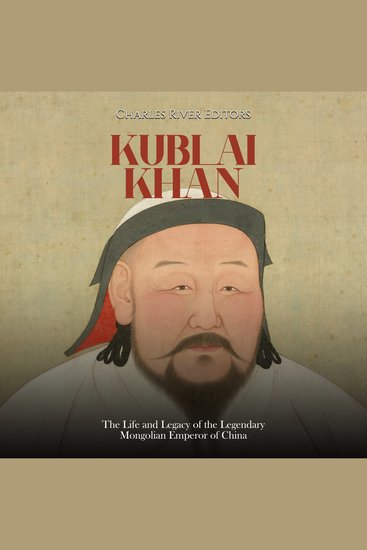
    Aside from Genghis, the most famous of the Mongolian rulers was Genghis’s grandson, Kublai Khan, who was raised as Mongolian in the traditional way, but also exposed to Chinese culture. Kublai’s father Tolui made sure all of his sons could ride and hunt, but he was apparently also concerned that they understood the characteristics and possibilities of the more settled regions under Mongolian rule. Thus, while Kublai and his brothers were still boys, his grandfather Genghis arranged a great Mongolian hunt. This traditional event involved many thousands of riders starting in a great circle and gradually moving into the center, driving the game in front of them. It was a hunt, but it was also a traditional kind of practice military exercise. Kublai killed a couple of small animals, and Genghis is reported to have been pleased with his grandsons.  
    	As Great Khan, Kublai Khan ruled the Mongolian Empire from his capital in modern-day Beijing, with a court that included Mongolians, Arabs, and Persians from throughout his empire. While Genghis may have been a warrior, Kublai was a man of culture, intellect and curiosity, and his court was a luxurious one rich in art, music, and goods. Under his reign, trade along the Silk Road was both easier and more efficient than ever before. Toll gates were removed, and traders could move freely from place to place. It was said that even women could travel safely with goods without fear of harm.  
    	Kublai was clearly an influential ruler, but what helped his legacy endure was that he hosted the famous Italian traveler Marco Polo, who stayed in China for years and described what he saw in detail. When Marco Polo’s travelogue was published back in Europe, it immediately became one of the most famous works on the continent, and while modern historians still debate which parts were factual and fictional, there can be no question that Kublai Khan was a monumental leader in Asia. 
    Ver livro