¡Acompáñanos a viajar por el mundo de los libros!
Añadir este libro a la estantería
Grey
Escribe un nuevo comentario Default profile 50px
Grey
Suscríbete para leer el libro completo o lee las primeras páginas gratis.
All characters reduced
The Babel Message - A Love Letter to Language - cover

The Babel Message - A Love Letter to Language

Keith Kahn-Harris

Editorial: Icon Books

  • 0
  • 1
  • 0

Sinopsis

'Quite simply, and quite ridiculously, one of the funniest and most illuminating books I have ever read. I thought I was obsessive, but Keith Kahn-Harris is playing a very different sport. He really has discovered the whole world in an egg.' Simon Garfield
A thrilling journey deep into the heart of language, from a rather unexpected starting point.

Keith Kahn-Harris is a man obsessed with something seemingly trivial - the warning message found inside Kinder Surprise eggs:

WARNING, read and keep: Toy not suitable for children under 3 years. Small parts might be swallowed or inhaled.

On a tiny sheet of paper, this message is translated into dozens of languages - the world boiled down to a multilingual essence. Inspired by this, the author asks: what makes 'a language'? With the help of the international community of language geeks, he shows us what the message looks like in Ancient Sumerian, Zulu, Cornish, Klingon - and many more. Along the way he considers why Hungarian writing looks angry, how to make up your own language, and the meaning of the heavy metal umlaut.

Overturning the Babel myth, he argues that the messy diversity of language shouldn't be a source of conflict, but of collective wonder. This is a book about hope, a love letter to language.
'This is a wonderful book. A treasure trove of mind-expanding insights into language and humanity encased in a deliciously quirky, quixotic quest. I loved it. Warning: this will keep you reading.' - Ann Morgan, author of Reading the World: Confessions of a Literary Explorer
Disponible desde: 04/11/2021.
Longitud de impresión: 336 páginas.


Otros libros que te pueden interesar

  • A Rare Recording of Edwin Hubble - cover

    A Rare Recording of Edwin Hubble

    Edwin Hubble

    • 0
    • 0
    • 0
    Edwin Powell Hubble (November 20, 1889 - September 28, 1953), born in Marshfield, MO, was an American astronomer who played a crucial role in establishing the fields of extragalactic astronomy and observational cosmology. Hubble proved that many objects previously thought to be clouds of dust and gas and classified as "nebulae" were actually galaxies beyond the Milky Way. Hubble's name is most widely recognized for the Hubble Space Telescope, which was named in his honor. The following is a 1945 recording of Hubble's lecture at the New York Philharmonic.
    Ver libro
  • Hope and Fear - Modern Myths Conspiracy Theories and Pseudo History - cover

    Hope and Fear - Modern Myths...

    Ronald H. Fritze

    • 0
    • 0
    • 0
    A myth-busting journey through the twilight world of fringe ideas and alternative facts. 


    Is a secret and corrupt Illuminati conspiring to control world affairs and bring about a New World Order? Was Donald Trump a victim of massive voter fraud? Is Elizabeth II a shapeshifting reptilian alien? Who is doing all this plotting? 


    In Hope and Fear, Ronald H. Fritze explores the fringe ideas and conspiracy theories people have turned to in order to make sense of the world around them, from myths about the Knights Templar and the Ten Lost Tribes of Israel, to Nazis and the occult, the Protocols of Zion and UFOs. As Fritze reveals, when conspiracy theories, myths, and pseudo-history dominate a society's thinking, facts, reality, and truth fall by the wayside.
    Ver libro
  • The Mythology of Atlantis - Searching for the Lost Civilization - cover

    The Mythology of Atlantis -...

    Odessa Nightshade

    • 0
    • 0
    • 0
    The legend of Atlantis has fascinated historians, philosophers, and adventurers for centuries. First described by the ancient Greek philosopher Plato, Atlantis was said to be a powerful and advanced civilization that mysteriously vanished beneath the sea. Despite being written over 2,000 years ago, Plato’s account continues to inspire countless theories, books, and even modern expeditions in search of this lost world. But was Atlantis ever real, or was it simply a metaphor for human folly? Understanding the origins of this myth is crucial to separating historical possibility from pure fantasy.  
      
    Plato’s dialogues, Timaeus* and *Critias, provide the earliest known description of Atlantis. According to him, the island was a technologically superior and wealthy society that existed around 9,000 years before his time. It was said to be located beyond the "Pillars of Hercules," now known as the Strait of Gibraltar. However, due to the moral corruption of its people, the gods allegedly punished Atlantis by submerging it beneath the waves. This dramatic tale has led to endless speculation about whether Plato based it on real events or simply crafted it as an allegory about the dangers of hubris and imperial overreach.  
      
    Interestingly, Atlantis is not the only story of a lost civilization. Cultures around the world have myths of great lands that disappeared under the ocean. In Hindu mythology, the ancient city of Dwarka was said to have been swallowed by the sea. The biblical tale of the Great Flood and even the legends of Lemuria and Mu suggest a shared human fascination with lost worlds. Some researchers argue that these stories could be echoes of real historical disasters, such as the sudden sinking of landmasses due to earthquakes, tsunamis, or rising sea levels. Could Atlantis be another version of these global flood myths? 
    Ver libro
  • The Zong - A Massacre the Law & the End of Slavery - cover

    The Zong - A Massacre the Law &...

    James Walvin

    • 0
    • 0
    • 0
    The first full review of the mass murder by crew members on the slave ship Zong and the lasting repercussions of this horrifying event 


    On November 29, 1781, Captain Collingwood of the British ship Zong commanded his crew to throw overboard one-third of his cargo: a shipment of Africans bound for slavery in America. The captain believed his ship was off course, and he feared there was not enough drinking water to last until landfall. This book is the first to examine in detail the deplorable killings on the Zong, the lawsuit that ensued, how the murder of 132 slaves affected debates about slavery, and the way we remember the infamous Zong today. 


    Historian James Walvin explores all aspects of the Zong's voyage and the subsequent trial—a case brought to court not for the murder of the slaves but as a suit against the insurers who denied the owners' claim that their "cargo" had been necessarily jettisoned. The scandalous case prompted wide debate and fueled Britain's awakening abolition movement. Without the episode of the Zong, Walvin contends, the process of ending the slave trade would have taken an entirely different moral and political trajectory. He concludes with a fascinating discussion of how the case of the Zong, though unique in the history of slave ships, has come to be understood as typical of life on all such ships.
    Ver libro
  • Battle of Cannae and the Battle of Zama The: The History and Legacy of the Second Punic War’s Most Important Battles - cover

    Battle of Cannae and the Battle...

    Editors Charles River

    • 0
    • 0
    • 0
    Certain foreign policy decisions led to continuing enmity between Carthage and the burgeoning power of Rome, and what followed was a series of wars which turned from a battle for Mediterranean hegemony into an all-out struggle for survival. Although the Romans gained the upper hand in the wake of the First Punic War, Hannibal brought the Romans to their knees for over a decade during the Second Punic War. While military historians are still amazed that he was able to maintain his army in Italy near Rome for nearly 15 years, scholars are still puzzled over some of his decisions, including why he never attempted to march on Rome in the first place. 
    Cannae is still considered one of the greatest tactical victories in the history of warfare, and the fact the battle was a complete victory resulting in the wholesale annihilation of the enemy army made it the textbook example for military commanders to try to duplicate. Of course, others usually were unsuccessful. Cannae was the kind of complete victory that every commander from Caesar to Frederick the Great to Napoleon to Robert E. Lee sought, and that few generals save Caesar and Napoleon bagged whole armies is a testament to the near impossibility of achieving a victory like Cannae. 
    On October 19, 202 BCE, on the plain of Zama in modern Tunisia, battle was joined, and for the first time in one of the battles of the Second Punic War, Hannibal had the infantry advantage and Rome had the cavalry advantage. The result would decide the fate of the Second Punic War and the course of history. 
    Not surprisingly, after the serious threat Hannibal posed during the Second Punic War, the Romans didn’t wait much longer to take the fight to the Carthaginians in the Third Punic War, which ended with Roman legions smashing Carthage to rubble. As legend has it, the Romans literally salted the ground upon which Carthage stood to ensure its destruction once and for all.
    Ver libro
  • United States in World War II The: The History and Legacy of American Involvement in the War - cover

    United States in World War II...

    Charles River Editors

    • 0
    • 0
    • 0
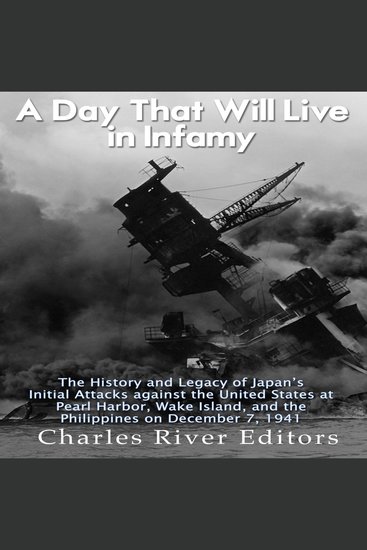
    All Americans are familiar with the “day that will live in infamy.” At 9:30 a.m. on Sunday, December 7, 1941, Pearl Harbor, the advanced base of the United States Navy’s Pacific Fleet, was ablaze. It had been smashed by aircraft launched by the carriers of the Imperial Japanese Navy. All eight battleships had been sunk or badly damaged, 350 aircraft had been knocked out, and over 2,000 Americans lay dead. Indelible images of the USS Arizona exploding and the USS Oklahoma capsizing and floating upside down have been ingrained in the American conscience ever since. In less than an hour and a half the Japanese had almost wiped out America’s entire naval presence in the Pacific.  
    	The United States began 1942 determined to avenge Pearl Harbor, but the Allies, now including the Soviet Union by necessity, did not agree on the war strategy. In 1941, both the Germans and British moved armies into North Africa, where Italy had already tried and failed to reach the Suez Canal. The British sought American help in North Africa, where British General Bernard Montgomery was fighting the legendary “Desert Fox,” General Erwin Rommel. At the same time, Stalin was desperate for Allied action on the European continent that could free up the pressure on the besieged Soviets.  
    	President Roosevelt had a consequential decision to make, and he eventually decided to land American forces on North Africa to assist the British against Rommel, much to Stalin’s chagrin. While the Americans and British could merely harass the Germans with air power and naval forces in the Atlantic, Stalin’s Red Army had to take Hitler’s best shots in Russia throughout 1942. But the Red Army’s tenuous hold continued to cripple the Nazi war machine while buying the other Allies precious time. 
    	As it turned out, Roosevelt’s decision to first fight in North Africa would make an Allied invasion of the European continent possible in 1943.
    Ver libro