Join us on a literary world trip!
Add this book to bookshelf
Grey
Write a new comment Default profile 50px
Grey
Subscribe to read the full book or read the first pages for free!
All characters reduced
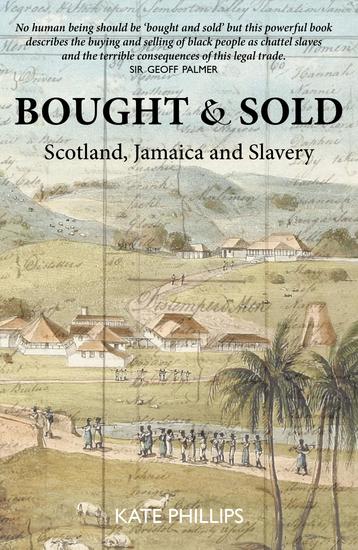
Bought & Sold - Scotland Jamaica and Slavery - cover

Bought & Sold - Scotland Jamaica and Slavery

Kate Phillips

Publisher: Luath Press

  • 0
  • 0
  • 0

Summary

This book traces the story of how and why thousands of Scots made money from buying and selling humans… a story we need to own. We need to admit that many Scots were enthusiastic participants in slavery.
Union with England gave Scotland access to both trade and settlement in Jamaica, Britain's richest colony and its major slave trading hub. Tens of thousands from Scotland lived and worked there. The abolition campaign and slave revolts threatened Scottish plantation owners, merchants, traders, bankers and insurance brokers who made their fortunes from slave-farmed sugar in Jamaica and fought hard to preserve the system of slavery. Archives and parliamentary papers in both countries reveal these transatlantic Scots in their own words and allow us to access the lives of their captives. 
Scotland and Jamaica were closely entwined for over one hundred years. Bought & Sold traces this shared story from its early beginnings in the 1700s to the abolition of slavery in the British Empire and reflects on the meaning of those years for both nations today.
Available since: 05/30/2022.
Print length: 344 pages.

Other books that might interest you

  • Margaret Thatcher - Life After Downing Street - cover

    Margaret Thatcher - Life After...

    Peter Just

    • 0
    • 0
    • 0
    "A joy to read." Andrew Roberts
    The story of Margaret Thatcher's post-premiership years is a tale of high drama and low farce, with, at its heart, one extraordinary woman.
    Margaret Thatcher enjoyed perhaps one of the most consequential political afterlives in British history. No longer in office but never really out of power, she was not only one of the most impactful Prime Ministers the UK has ever had; she was also one of the most impactful former Prime Ministers the UK has ever had. British politics today undoubtedly reflects Thatcher's time in No. 10, but it is also shaped by her later life and how people reacted and still react to it.
    To mark the centenary of her birth, Margaret Thatcher: Life After Downing Street provides a radical reassessment of how Thatcher's premier emeritus years have been viewed to date. Covering the four main areas of her work after Downing Street – philosophy, party, policy and performance – and analysing her continued and continuing influence on the Conservative leaders and Prime Ministers of all parties who followed her, it demonstrates why, however small the politics may or may not have got since 1990, Margaret Thatcher is still big.
    Show book
  • World War 3: How Close Are We Really? - cover

    World War 3: How Close Are We...

    Marcus Reed

    • 0
    • 0
    • 0
    The world of 2025 feels more fragile than ever. From the war in Ukraine and rising tensions in the Taiwan Strait, to proxy battles in the Middle East and the militarization of the Arctic, global flashpoints are multiplying. Technology, cyberattacks, nuclear weapons, and fragile alliances create a dangerous mix where one mistake could ignite World War 3. 
    This audiobook explores the reality behind the headlines and asks the urgent question: how close are we, really, to a global conflict? 
    You will discover: 
     
    The regions most likely to spark escalation — Ukraine, Taiwan, the Middle East, and beyond.How cyber warfare, AI, and hypersonic missiles are changing the rules of conflict.Why nuclear deterrence, once a safeguard, may now be the greatest risk of all.How alliances like NATO can both protect and endanger global stability.The psychology of leaders under pressure, and why miscalculation could be catastrophic. 
    Neutral, clear, and unsettling, World War 3: How Close Are We Really? is not about panic — it’s about awareness. It shows the fragile silence holding our world together, and reminds us that the future is not written. 
    The storm hasn’t started yet. But the silence is breaking.
    Show book
  • Strange and Obscure Stories of the Revolutionary War - cover

    Strange and Obscure Stories of...

    Tim Rowland

    • 0
    • 0
    • 0
    We all know about Washington's crossing of the Delaware and Betsy Ross's stitching together the Stars and Stripes, but how about a little-known, valid reason for the war itself and why General George was able to survive a plague that wiped out many of his fellow countrymen? 


    History buff Tim Rowland provides an entertaining look at happenings during and surrounding the Revolutionary War that you won't find in history books. He digs into the war's major events and reveals the unknown, bizarre, and often wildly amusing things the participants were doing while breaking away from Great Britain. 


    For example, conventional wisdom says that "no taxation without representation" was an important reason for the revolution, but not in the way we've been told. Strange but true, the spark that touched off the revolution was in fact a tax cut. 


    During the French and Indian War and then again in the first year of the revolution, the British were accused of biological warfare. So feared was the disease that soldiers began to illegally inoculate themselves. Washington himself was immune, thanks to a Caribbean trip taken as a young man when his brother Lawrence sought a cure for tuberculosis.
    Show book
  • The Sickness Unto Death - cover

    The Sickness Unto Death

    Søren Kierkegaard

    • 0
    • 0
    • 0
    Soren Kierkegaard was a Danish philosopher, theologian, and religious author interested in human psychology. He is regarded as a leading pioneer of existentialism and one of the greatest philosophers of the 19th Century.
    Show book
  • Psychological Coercion - Using Psychological Persuasion to Force Compliance - cover

    Psychological Coercion - Using...

    Cito Harder

    • 0
    • 0
    • 0
    Psychological coercion is a powerful and often insidious form of manipulation designed to force an individual to act against their will or better judgment. It involves the use of mental and emotional tactics to instill fear, guilt, or pressure, making the person feel compelled to comply with demands or expectations. While it does not rely on physical force, the impact of psychological coercion can be just as damaging, if not more so, as it leaves lasting emotional scars that can affect an individual’s sense of self-worth, autonomy, and mental health. 
    At its core, psychological coercion undermines a person’s ability to make decisions freely. It exploits their vulnerabilities—whether emotional, psychological, or social—in order to gain control or influence their behavior. This form of coercion can take many different shapes, including threats, isolation, intimidation, manipulation, or subtle forms of pressure. While the methods may vary, the common thread is the intentional use of mental and emotional tactics to manipulate or control another person’s actions. 
    Psychological coercion is distinct from other forms of persuasion because it involves the use of power and control to manipulate an individual into compliance. In many cases, the person being coerced may not even recognize the pressure being applied to them. This is due to the subtlety with which coercion often operates—it can take place in everyday interactions, with the perpetrator using psychological manipulation in a way that may seem harmless or even caring at first. Over time, however, the individual being manipulated becomes increasingly susceptible to the influence of the coercer, often leading to a loss of personal agency and a sense of powerlessness.
    Show book
  • Summary of Thomas C Foster's How to Read Novels Like a Professor - cover

    Summary of Thomas C Foster's How...

    Falcon Press

    • 0
    • 0
    • 0
    Buy now to get the main key ideas from Thomas C. Foster's How to Read Novels Like a Professor 
      
    When novels became a thing around the seventeenth century, it was all thrilling. It wasn't possible for readers to say, “This is unoriginal, this has been done before, this is a good or bad novel.” Every novel was an innovation. As time progressed, a framework for the conventional novel emerged: a linear narrative, stories about people growing up or falling apart, compelling characters, and definite conclusions that provide emotional satisfaction. 
    In How to Read Novels Like a Professor (2008), Thomas C. Foster dives deep into each of these elements, using his own set of laws for the novel to help readers increase their understanding. He backs up his explanations with a wealth of vivid literary examples that will make you want to read every novel he mentions.
    Show book