¡Acompáñanos a viajar por el mundo de los libros!
Añadir este libro a la estantería
Grey
Escribe un nuevo comentario Default profile 50px
Grey
Suscríbete para leer el libro completo o lee las primeras páginas gratis.
All characters reduced
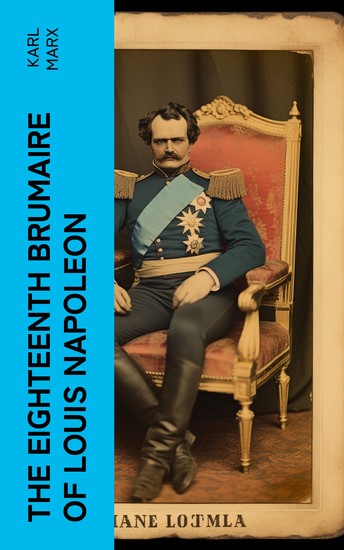
The Eighteenth Brumaire of Louis Napoleon - cover

The Eighteenth Brumaire of Louis Napoleon

Karl Marx

Traductor Daniel De Leon

Editorial: e-artnow

  • 0
  • 0
  • 0

Sinopsis

This book about Napoleon Bonaparte's coup d'etat of 1851 in France allows Marx to explain why he thinks the earlier French Revolution of 1848, gave Napoleon the wings to achieve his triumph. This event, which occurred on 8th-9th November 1851, is often regarded as the end of the Revolution and the one that allowed Napoleon to establish his power over France. Karl Marx gives his particular views on this event and on Napoleon.
Disponible desde: 08/12/2023.
Longitud de impresión: 109 páginas.

Otros libros que te pueden interesar

  • Utopia - cover

    Utopia

    Thomas Moore

    • 0
    • 0
    • 0
    Discover the Vision of a Perfect Society
     
    Step into the thought-provoking world of Thomas More's Utopia, a groundbreaking work of political philosophy and social critique that continues to inspire and challenge readers centuries after its publication. This audiobook invites you to explore More's vision of an ideal society, where harmony, justice, and equality reign supreme—a bold contrast to the flaws and inequities of his own time.
     
    What to Expect:
    
      A detailed journey through the fictional island of Utopia, where communal living replaces greed, and reason governs human behavior.
      Insightful commentary on the political and social structures that define More's utopian vision, including systems of governance, education, and religion.
      A timeless exploration of human nature, ambition, and the pursuit of perfection.
    
     
    Presented in an engaging and accessible format, this audiobook bridges the gap between historical context and contemporary relevance. Whether you are a student, a philosopher, or simply a curious listener, Utopia offers a powerful lens through which to reflect on the ideals and challenges of building a better world.
     
    Embark on a journey to a society that dares to ask, What if we could be better? Download now and start exploring the possibilities of Utopia.
    Ver libro
  • The First Lessons In Principles of Cooking - cover

    The First Lessons In Principles...

    Lady Barker

    • 0
    • 0
    • 0
    Discover the timeless wisdom of Victorian domestic science in First Lessons in the Principles of Cooking by Lady Barker—a thoughtful and empowering guide for anyone interested in the foundations of cookery. Written in the late 19th century, this classic manual goes far beyond recipes, exploring the “why” behind food preparation with a practical, scientific lens. 
    Lady Barker advocates for economy, nutrition, and efficiency in the kitchen, teaching readers how to minimize waste and improve health through knowledge of food composition and cooking methods. From milk and bread to beef, vegetables, and boiling techniques, each chapter blends chemistry with domestic pragmatism. 
    Perfect for culinary historians, home cooks, and those curious about the roots of nutritional education, this audiobook offers both inspiration and insight into the intelligent art of cookery—revealing how understanding the science of food can uplift households of any size or income.
    Ver libro
  • Picturing America - The Golden Age of Pictorial Maps - cover

    Picturing America - The Golden...

    Stephen J. Hornsby

    • 0
    • 0
    • 0
    Instructive, amusing, colorful—pictorial maps have been used and admired since the first medieval cartographer put pen to paper depicting mountains and trees across countries, people and objects around margins, and sea monsters in oceans. More recent generations of pictorial map artists have continued that traditional mixture of whimsy and fact, combining cartographic elements with text and images and featuring bold and arresting designs, bright and cheerful colors, and lively detail. In the United States, the art form flourished from the 1920s through the 1970s, when thousands of innovative maps were mass-produced for use as advertisements and decorative objects—the golden age of American pictorial maps.  Picturing America is the first book to showcase this vivid and popular genre of maps. Geographer Stephen J. Hornsby gathers together 158 delightful pictorial jewels, most drawn from the extensive collections of the Library of Congress. In his informative introduction, Hornsby outlines the development of the cartographic form, identifies several representative artists, describes the process of creating a pictorial map, and considers the significance of the form in the history of Western cartography. Organized into six thematic sections, Picturing America covers a vast swath of the pictorial map tradition during its golden age, ranging from “Maps to Amuse” to “Maps for War.” Hornsby has unearthed the most fascinating and visually striking maps the United States has to offer: Disney cartoon maps, college campus maps, kooky state tourism ads, World War II promotional posters, and many more. This remarkable, charming volume’s glorious full­-color pictorial maps will be irresistible to any map lover or armchair traveler.
    Ver libro
  • Suleiman the Magnificent - The Most Famous Ottoman Empire’s Sultan - cover

    Suleiman the Magnificent - The...

    Kelly Mass

    • 0
    • 0
    • 0
    Suleiman was the most famous sultan of the Ottoman empire in the sixteenth century. His reign meant an increase of interest in art, expanded regions under Muslim law, and hundreds of thousands of men employed in the army, ready to fight wars against surrounding nations. Political and law reforms took place, and in the matter of a short time span, much of the culture and society in the region had been changed. 
    The Ottoman Empire didn’t last, though, and after Suleiman’s death, the empire remained stagnant and went on a steady decline sometime later. In the beginning of the 20th century, there wasn’t much left of the once great empire. 
    In this book, you will find everything you need to know about Suleiman’s life, his mission, his victories, death, and the events that occurred after his death in the Ottoman Empire.
    Ver libro
  • SAT Success: Unlock Instant Mastery with Proven Strategies - "Unlock SAT success! Access captivating audio lessons filled with proven strategies for effortless mastery" - cover

    SAT Success: Unlock Instant...

    Ronan Buxted

    • 0
    • 0
    • 0
    SAT Success: Unlock Instant Mastery with Proven Strategies   
    Are you eager to advance your education and solidify your knowledge by acing the SAT?  
    Looking for an all-in-one guide that has everything you need to excel in your SAT preparation? 
    Your search ends here! 
    This guide is your ultimate resource for enhancing your understanding, honing your skills, and engaging in practical exercises. With this, you’re poised for success. 
    Updated for the latest SAT exam structure. 
    Key features of this comprehensive guide: 
    - In-depth insights into effective SAT preparation techniques   
    - Thorough explanations of essential SAT concepts   
    - Proven strategies for exam preparation and tackling challenging questions   
    Our guide stands out for its extensive coverage, crucial for your exam success. Concepts are explored in detail rather than merely touched upon. 
    Please note that this guide is not affiliated with any official SAT organization and is a purely independent resource aimed at your benefit. 
    Crafted with a straightforward structure and accessible language, our SAT Exam Guide ensures seamless transitions between key themes. Bid farewell to complicated terminology and embrace clear, accurate, and informative content.  
    So, why hesitate? Hit the BUY NOW button, secure your guide, and embark on your journey toward SAT success! 
    Transform your SAT preparation today and unlock your potential!
    Ver libro
  • The Great Famine of the 14th Century - Europe's Population Crisis - cover

    The Great Famine of the 14th...

    Sarah Willards

    • 0
    • 0
    • 0
    The Great Famine of the 14th century did not erupt suddenly; it was the result of a long-simmering crisis deeply rooted in environmental, agricultural, and demographic factors. Europe, by the early 1300s, was already teetering on the edge of unsustainability. For decades, the continent had experienced a population boom, pushing communities to cultivate every inch of arable land. Marginal lands—forests, wetlands, and rocky hills—were cleared to make room for crops, but the soil was thin and poorly suited for long-term farming. This overuse exhausted the land, reducing yields and straining food supplies even in stable years. 
    At the same time, Europe entered a period of climatic deterioration now known as the Little Ice Age. Beginning in the early 14th century, temperatures across the continent began to drop slightly but consistently. This seemingly minor shift had devastating effects on agriculture. Cooler, wetter summers shortened the growing season and increased rainfall, which flooded fields and rotted seeds before they could sprout. Harsh winters extended well into the spring, delaying planting and shrinking the harvest window. These erratic weather patterns culminated in a series of catastrophic crop failures between 1315 and 1317. 
    Adding to these environmental pressures was a demographic crisis. By the turn of the century, Europe’s population had grown to levels unseen in centuries. Villages were packed, and food demand had reached unprecedented highs. Yet agricultural output could not keep pace. The productivity of medieval farming methods had plateaued, and innovations were slow to arrive. The result was a fragile system stretched beyond its limits. Even a single poor harvest could lead to hunger; multiple bad years spelled disaster.
    Ver libro